
Devi
Adi Shakti, the Mother of all — Mahalakshmi, Mahakali and Mahasaraswati, the three faces of one Mother — worshipped in every direction of Bharat.
15 TemplesAdi Shakti — the first power, she without whom nothing stirs. She is Jagadamba, mother of the worlds; Bhavani and Ambe and Durga; Mata Rani of the hills, whose bulawa, her own call, a pilgrim waits for before setting out. Her book is the Devi Mahatmya, the seven hundred verses that stand as chapters eighty-one to ninety-three of the Markandeya Purana and are recited as the Durga Saptashati through the nine nights of Navaratri. Its thirteen chapters fall into three charitas, and at the head of each the reciter invokes a presiding form — Mahakali over the first, Mahalakshmi over the middle, Mahasaraswati over the last; dissolution, sustenance and creation; tamas, rajas and sattva. They are three faces of one Mother and not three Mothers, and that is the whole teaching of the text: the many goddesses of Bharat are her many names. The Shakti Peethas — the seats where the body of Sati came to earth — are the crown of her worship, and they keep their own reckonings, their own yatra and their own page here. This tradition gathers the other great homes of the Devi, and no temple counted among the Peethas of the canonical lists is named again on this one: what remains is not the smaller company but the wider — the Mother's land, which the Peethas crown and can never enclose.
What the Saptashati invokes, her shrines make visible. In a limestone cave of the Trikuta hills above Katra there is no image at all: on a rock base some five and a half feet high stand three self-manifest pindis — whitish Mahasaraswati on the left for sattva and creation, the yellowish-red Mahalakshmi in the middle for rajas and sustenance, black Mahakali on the right for tamas and dissolution — and the Mother of that cave is Shri Mata Vaishno Devi, to whom lakhs upon lakhs climb the thirteen kilometres from Katra each year, saying the yatra begins only with her call. Far to the south-east, at Ratanpur in Chhattisgarh — Ratnapura, the city of jewels, seat of the Kalachuris of Dakshina Kosala — Mahamaya is Kosaleshwari, sovereign of that land: Mahalakshmi seated below in her sanctum and Mahasaraswati above and to her right, so that wealth and wisdom are given in a single darshan, with Mahakali honoured beside them in the older temple. One cave and one sanctum, and the same three.
Her homes stand in every direction of Bharat. Kashi is Shiva's city, but its nourishment is hers: Annapurna keeps her kitchen a few steps from Vishwanath in the old lanes, and the city's ancient assurance is that within its bounds nobody goes hungry — a promise its annakshetra makes good every day. In Bengal she is Bhavatarini, she who carries her children across the ocean of existence, worshipped in Rani Rashmoni's nine-spired temple at Dakshineswar on the Hooghly, where Sri Ramakrishna Paramahamsa kept her service some thirty years. In the deep south she is sovereign and not consort: at Madurai the pilgrim enters Meenakshi's shrine before Sundareswarar's, and a Tamil saying names the three great goddesses in one breath — Kanchi Kamakshi, Madurai Meenakshi, Kashi Visalakshi. In the Kangra hills Chamunda sits above the Baner and makes no Peetha claim at all, holding instead a living place in the Devi-bhoomi of that valley and a station on the Nau Devi circuit families from across the north walk together; and in Garhwal, on a bare summit above the Mussoorie road, Surkanda Devi is honoured simply as the Siddhapeeth of those hills, where the head of the Mother is said to have come to rest. These are the homes this tradition is being built out towards, one researched entry at a time.
The Pilgrimage Circuit
There is no fixed circuit here, and that is her glory: the Mother is sought where she dwells, and every hill, river-bank and old city of Bharat keeps its own. The canonical seats — the Peethas of the eighteen, the fifty-one and the wider lists — are gathered on the Shakti Peethas tradition page and walked as the Shakti Peetha Yatra on MereMandir, so a temple counted among them is listed there and not here. What this page holds is the land around that canon, sought as the city or the mountain it guards is sought, and woven into whatever journey brings a devotee near. Navaratri, kept twice a year in Chaitra and in Sharad, fills every one of these houses; Bengal keeps Durga Puja and its three Kali Pujas besides, and the northern hills their Shravan melas.
Devi Temples
See all on the map →A hand-researched beginning, not a full count — more great temples of this tradition are added as our research completes.

Dakshineswar Kali
Dakshineswar, Kolkata, West Bengal
Rani Rashmoni's nine-spired temple on the Hooghly, where Ma Bhavatarini is worshipped and where Sri Ramakrishna Paramahamsa kept the Mother's service for thirty years.

Tarapith
Tarapith, Birbhum, West Bengal
Ma Tara of Birbhum — the Siddhapeeth on the Dwarka where the Mother is worshipped in stone as she gives her breast to Shiva, and where the sadhak Bamakhepa kept his vigil.

Chottanikkara Bhagavathy
Chottanikkara, Ernakulam, Kerala
Rajarajeswari above and Bhadrakali below — the Mother worshipped as Saraswathy at dawn, Lakshmi at noon and Durga at dusk, in the shrine to which Kerala has always brought the afflicted.

Meenakshi, Madurai
Madurai, Tamil Nadu
Meenakshi the fish-eyed goddess — a Pandya princess crowned queen of Madurai, who met Shiva in battle and married him; among the greatest Devi temples of Bharat.

Annapurna Devi Mandir, Kashi
Varanasi, Uttar Pradesh
The goddess who feeds Kashi — Annapurna with her ladle and her bowl of rice, a few steps from Vishwanath in the old lanes, where Shiva himself once came holding a beggar's bowl.

Shri Mata Vaishno Devi
Trikuta hills, Katra (Reasi), Jammu & Kashmir
The Mother of the Trikuta hills — three self-manifest pindis in a cave above Katra, reached by a thirteen-kilometre climb that millions make each year at her call.

Chamunda Devi, Kangra
Kangra, Himachal Pradesh
Chamunda Nandikeshwar Dham — the Devi and Mahadev keeping one house above the Baner Khad, where the Mother came down from her snow-peak to be within her people's reach.

Surkanda Devi
Kaddukhal, Tehri Garhwal, Uttarakhand
The Devi of the Sirkut summit above Kaddukhal — where Garhwal holds that Sati's head came to rest, with the Himalayan snows laid out to the north.

Mahamaya Devi, Ratanpur
Ratanpur, Bilaspur, Chhattisgarh
Mahamaya of Ratanpur — Kosaleshwari, the goddess of old Kosala — worshipped as the twin presence of Lakshmi and Saraswati in the Kalachuri capital, and the first great Devi shrine of Chhattisgarh.

Karni Mata, Deshnoke
Deshnoke, Bikaner, Rajasthan
Shri Karniji of Deshnoke — the Charan mystic revered as the Devi incarnate, guardian of the thrones of Bikaner and Jodhpur, in whose marble court live the kabas: her own kin, reborn in her care.
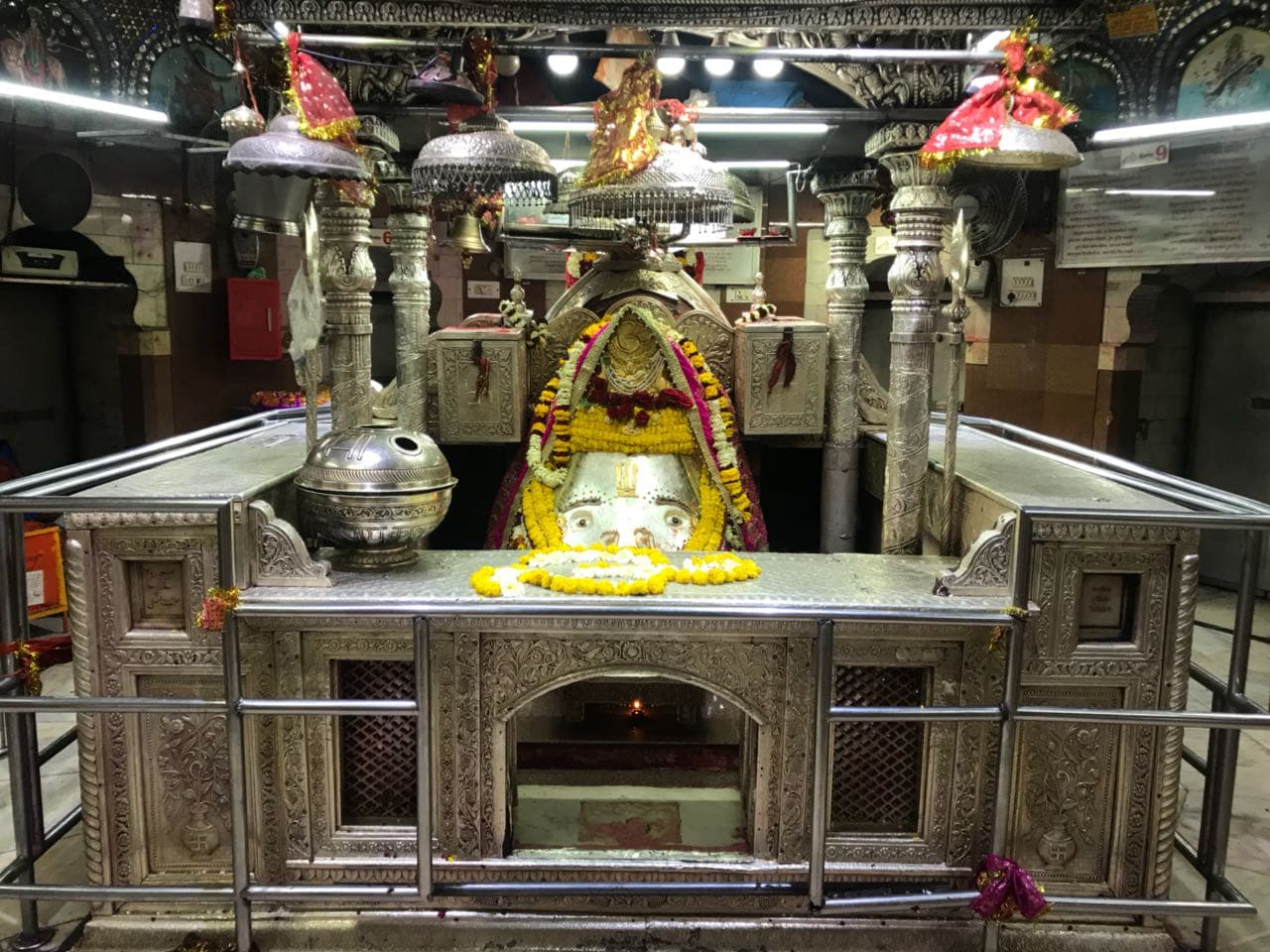
Kalkaji Mandir
Kalkaji, New Delhi, Delhi
Kalika of the Aravalli ridge — the self-manifested pindi on Suryakuta hill, where Delhi has carried its manokamna, its heart's wish, through every age of the city.

Jhandewalan Devi
Jhandewalan, New Delhi, Delhi
The Devi of the flags on Delhi's Aravalli spur — her vigraha found buried through a devotee's dream, worshipped still in the cave below while the Mother sits enthroned in the darbar above.

Yogmaya, Mehrauli
Mehrauli, New Delhi, Delhi
Yogamaya of Mehrauli — the sister of Shri Krishna, who slipped from Kamsa's hand and rose into the sky to announce his doom — worshipped beside the Qutb through every Delhi raised and ruined around her.

Mundeshwari Devi
Ramgarh, Kaimur, Bihar
The octagonal shrine on the Kaimur hills where worship has never stopped — Devi Mundeshwari in her niche, the four-faced Shiva linga at the centre, and the goat that is offered and walks away alive.

Maa Sharda Devi, Maihar
Maihar, Madhya Pradesh
Sharda of the Vindhya hills — Saraswati as the Mother of learning, on the Trikuta summit above Maihar, where the long stair, the ropeway and Alha's first darshan meet.
Frequently Asked Questions
Which temples belong to the Devi tradition?+
The great homes of the Mother across Bharat that stand outside the Peetha canon — Shri Mata Vaishno Devi in the Trikuta hills, Annapurna of Kashi, Dakshineswar on the Hooghly, Meenakshi of Madurai, Chamunda Devi of Kangra, Surkanda Devi of Garhwal and Mahamaya of Ratanpur, with more added as the research completes. The Shakti Peethas keep their own tradition page on MereMandir, so a shrine whose standing rests on one of the canonical reckonings is never listed here as well.
Who are Mahalakshmi, Mahakali and Mahasaraswati?+
The three presiding forms of the Devi Mahatmya — the seven hundred verses recited as the Durga Saptashati. Its thirteen chapters fall into three charitas, and the reciter invokes Mahakali at the head of the first, Mahalakshmi at the head of the middle and Mahasaraswati at the head of the last: tamas, rajas and sattva; dissolution, sustenance and creation. They are three faces of one Mother, and at Vaishno Devi they are worshipped as three natural pindis in a single cave, with no image at all.
How is the Devi tradition different from the Shakti Peethas?+
A Shakti Peetha is a seat where a part of the body of Sati is held to have come to earth, named in one of the canonical reckonings — the eighteen of the Ashtadasha stotram, the fifty-one of the Pithanirnaya, the chausath, the wider lists. MereMandir keeps that page exact: only shrines carrying such standing are listed as Shakti Peethas. This tradition holds the Devi temples that make no Peetha claim, or that are honoured in their own regions as Siddhapeeths — no lesser shrines, simply a different kind of standing, and the honest place for them.
When is the best time to seek the Devi's darshan?+
Navaratri above all — nine nights kept twice a year, in Chaitra (March–April) and in Sharad (September–October), when every one of these shrines keeps its fullest worship, and the most crowded season too. Bengal's Durga Puja falls in the Sharad Navaratri and Dakshineswar keeps three Kali Pujas through the year; Kashi's golden Annapurna gives darshan only in the few days from Dhanteras to Annakut; Madurai's great festival is the Chithirai Thiruvizha in April–May. October to March is the kindest weather across the plains, and the hill shrines are best outside the deep monsoon.