

The Devi of the flags on Delhi's Aravalli spur — her vigraha found buried through a devotee's dream, worshipped still in the cave below while the Mother sits enthroned in the darbar above.
- Deity
- Devi Jhandewali (Aadi Shakti)
- Location
- Jhandewalan, New Delhi, Delhi
- Category
- Devi
- Established
- Founded by tradition in the 19th century by the devotee Badri Das; the present marble complex is modern, and the Badri Bhagat Jhandewala Temple Society has administered the shrine since 1944
- Setting
- On Deshbandhu Gupta Marg at Jhandewalan, between Karol Bagh and Paharganj, on the rocky Aravalli spur that runs through Delhi
- Best Time to Visit
- October to March; the two Navratris — Chaitra (March–April) and Ashwin (September–October) — bring the greatest gatherings
- Jhandewali — 'she of the flags'; both the Devi and the locality take their name from the jhande offered here
- The tradition: Badri Das, a cloth merchant of Chandni Chowk, was shown the buried vigraha in a dream
- The vigraha came up from a chamber in the Aravalli rock; her broken hands were replaced with hands of silver
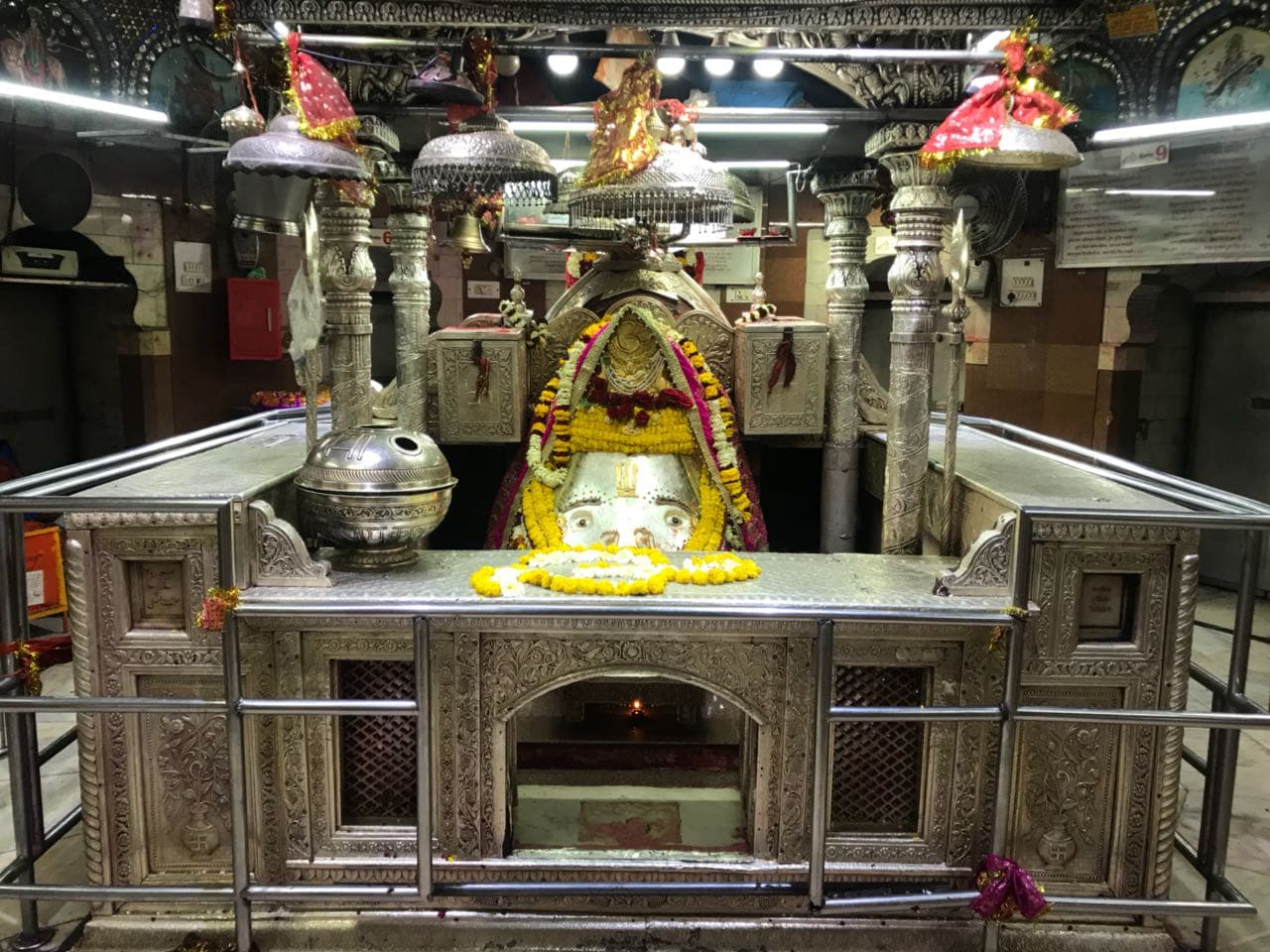
- Two darbars — the gufa below with the found vigraha, the bhavan darbar above with the murti Badri Das installed
- Also called Gufa Wali Mata, the Mother of the cave, where a lamp is kept burning
- Administered since 1944 by the Badri Bhagat Jhandewala Temple Society, which carries the founder's name
- The doors open at 4:00 AM; mangala aarti at 6:00 AM and the shayan aarti at 10:00 PM
- Both Navratris are kept — Chaitra and Ashwin — with the shringar aarti brought forward to 4:00 AM
- Durga Ashtami is kept with a night-long jagran; Shravan brings the Rudrabhishek at the Shivalaya above
- Jhandewalan station on the Blue Line stands about eight hundred metres from the gateway
Significance
There are two darbars here, one above the other, and the older is below. Steps go down from the courtyard to the gufa, the cave opened in the digging, and it is there that the found vigraha is worshipped, her silver hands upon her and a lamp kept burning before her. Delhi knows her by that too: Gufa Wali Mata, the Mother of the cave. Above, in the bhavan darbar, stands the murti Badri Das installed over the place of the finding, and it is there that the crowd takes darshan. The temple's own live broadcast carries both — mukhya darshan and gufa darshan.
The day is long and fixed. The doors open at four in the morning; mangala aarti is at six, the shringar aarti at nine, bhog aarti at noon, the evening shringar aarti at half past seven and the shayan aarti at ten, with a short closing before evening while the shrine is cleaned.
Navratri is the season, and Jhandewalan keeps both — Chaitra in the spring and Ashwin in the autumn. The hours stretch. The shringar aarti is brought forward to four in the morning, so that the first darshan is taken while the road outside is dark; singers keep the Devi's praise from morning until evening; the shayan aarti waits until the small hours. On Durga Ashtami the jagran is held through the night. Deshbandhu Gupta Marg fills, the queues run back past the barricades, and heavy vehicles are turned off the stretch. In Shravan the Rudrabhishek is offered at the Shivalaya above.
History
Jhandewalan stands on Deshbandhu Gupta Marg between Karol Bagh and Paharganj, on the low rocky spur of the Aravallis that runs through Delhi. Before the streets closed over it this was open ground of outcrop and scrub, where the walled city came to walk.
The temple tells its own beginning through one devotee. Badri Das, a cloth merchant of Chandni Chowk, came often to this rise to sit in meditation, and the tradition says the Mother reached him there — a dream, and in it a voice asking to be brought out from beneath the rock. He had the ground opened. Out of a chamber in the stone came a vigraha of the Devi, and with her, the accounts say, a flag. Her hands were broken in the lifting, so hands of silver were made for her, and she was worshipped as she was found. Accounts place Badri Das in the nineteenth century; the temple's own page claims no date at all, saying only that the shrine has stood for centuries.
The flag gave the place its name. Badri Das raised a jhanda over the shrine so that it could be seen across the open ground, and those who came began to bring flags of their own, as they still do. The Devi became Jhandewali, she of the flags, and the locality around her became Jhandewalan. Since 1944 the temple's affairs have rested with the Badri Bhagat Jhandewala Temple Society, which carries the founder's name.
Architecture
The temple is white marble and modern in everything the eye meets: a ribbed shikhara rising in slender ridges over the sanctum, tiered eaves stepping down from it, small spires along the roofline and silver-worked gates below. The place does not pretend otherwise — its sanctity is the finding and the cave, not the stone raised above them.
An arched gateway on Deshbandhu Gupta Marg carries the temple's name in Devanagari with a saffron flag at its crown, and a canopied lane leads from it to the courtyard. The Shivalaya stands above, the gufa below.
Festivals
Timings
Open daily from 4:00 AM to 10:00 PM, with the doors closed from about 6:15 to 7:00 PM while the shrine is cleaned. Mangala aarti at 6:00 AM, the morning shringar aarti at 9:00 AM, bhog aarti at noon, the evening shringar aarti at 7:30 PM and the shayan aarti at 10:00 PM. Through Navratri the hours lengthen — the shringar aarti is at 4:00 AM and the shayan aarti past midnight. Published hours differ between accounts, so confirm with the temple on the day.
Jhandewalan station on the Blue Line of the Delhi Metro is the nearest, about eight hundred metres away — some ten minutes on foot. Karol Bagh and Ramakrishna Ashram Marg, also on the Blue Line, are each about a kilometre and a half off. New Delhi railway station is roughly two and a half kilometres by road and Indira Gandhi International Airport about twenty. Through Navratri heavy vehicles are kept off the temple stretch, and the metro is by far the easier approach.
Timings are indicative — please confirm with the temple trust before travelling.
Nearby Temples

Frequently Asked Questions
Where is Jhandewalan Devi Temple located?+
Jhandewalan Devi Temple is in Jhandewalan, New Delhi, Delhi, India.
Which deity is worshipped at Jhandewalan Devi Temple?+
Jhandewalan Devi Temple is dedicated to Devi Jhandewali (Aadi Shakti).
Which tradition does Jhandewalan Devi belong to?+
Jhandewalan Devi is one of the Devi temples dedicated to Devi (Adi Shakti).
What are the timings of Jhandewalan Devi Temple?+
Open daily from 4:00 AM to 10:00 PM, with the doors closed from about 6:15 to 7:00 PM while the shrine is cleaned. Mangala aarti at 6:00 AM, the morning shringar aarti at 9:00 AM, bhog aarti at noon, the evening shringar aarti at 7:30 PM and the shayan aarti at 10:00 PM. Through Navratri the hours lengthen — the shringar aarti is at 4:00 AM and the shayan aarti past midnight. Published hours differ between accounts, so confirm with the temple on the day.
What is the best time to visit Jhandewalan Devi Temple?+
October to March; the two Navratris — Chaitra (March–April) and Ashwin (September–October) — bring the greatest gatherings
When was Jhandewalan Devi Temple established?+
Jhandewalan Devi Temple — Founded by tradition in the 19th century by the devotee Badri Das; the present marble complex is modern, and the Badri Bhagat Jhandewala Temple Society has administered the shrine since 1944.
Sources & further reading
Photo: Ashish Bhatnagar (आशीष भटनागर) · Public domain