
Murugan
Arupadai Veedu — the six battle camps of Murugan, warrior god of the Tamil hills.
7 TemplesThe Arupadai Veedu — 'the six battle camps' (aru, six; padai, war camp; veedu, abode) — are the six great temples of Murugan, the son of Shiva who led the divine armies against the asura Surapadman. All six stand in Tamil Nadu, and the martial name is meant literally: each is remembered as a station of that campaign, a place where the god halted, fought, married or taught.
Their authority is far older than any of the buildings. The Tirumurugatruppadai, attributed to the poet Nakkirar, opens the Pattuppattu — the Ten Idylls of Sangam literature — as a guide-poem in which one seeker directs another from shrine to shrine in search of Murugan; the Shaiva canon later took it in as the Eleventh Thirumurai. Its six stations are the six temples pilgrims still climb to today.
They are Thiruparankundram, cut into the rock face outside Madurai; Tiruchendur, alone among the six in standing at the sea; Palani on its hill in Dindigul district; Swamimalai near Kumbakonam, where tradition holds the boy expounded the meaning of Om to Shiva himself; Thiruthani north of Chennai; and Pazhamudircholai in the hill groves above Madurai.
Nor is he the Tamil south's alone. Kartikeya, Skanda, Subrahmanya, Shanmukha the six-faced, Guha who dwells in the cave of the heart — the son of Mahadev answers to all these names, and wherever he is called he comes. Karnataka keeps one of his greatest homes, inland from the karavali at the foot of the Western Ghats: Kukke Subrahmanya on the bank of the Kumaradhara, beneath the peak of Kumara Parvata, where he is worshipped as the lord of serpents and Vasuki the naga king found shelter under him, and where the rites for sarpa-dosha — Sarpa Samskara and Ashlesha Bali — are kept as ordered, living practice, with Champa Shashthi on Margashirsha Shukla Shashthi as his great day. The Arupadai Veedu remain the six and only the six; this tradition gathers under the god's own name the other great seats of Murugan, wherever devotees keep them.
The Pilgrimage Circuit
The Tirumurugatruppadai names them in this order: Thiruparankundram, Tiruchendur, Palani, Swamimalai, Thiruthani and Pazhamudircholai. On the ground, pilgrims usually pair the two Madurai shrines with Tiruchendur, take Palani from Dindigul or Coimbatore, and reach Swamimalai from Kumbakonam and Thiruthani from Chennai.
Murugan Temples
See all on the map →A hand-researched beginning, not a full count — more great temples of this tradition are added as our research completes.

Thiruparankundram Murugan
Thiruparankundram, Madurai, Tamil Nadu
First of the six abodes of Murugan — a sanctum quarried out of the living rock of Skandamalai, where the god wed Deivanai after the Surasamharam.

Subramaniya Swamy, Tiruchendur
Tiruchendur, Thoothukudi, Tamil Nadu
The only one of Murugan's six abodes that stands on the sea — where the vel felled Surapadman, and the Surasamharam is fought again on the shore each Skanda Shashti.

Dhandayuthapani, Palani
Palani, Dindigul district, Tamil Nadu
Murugan as Dhandayuthapani — the boy-god turned renunciate, shorn of ornament and holding only a staff — on Sivagiri hill, third of the six Arupadai Veedu and for many devotees the foremost.

Swaminatha Swamy, Swamimalai
Swamimalai, Kumbakonam, Tamil Nadu
The fourth of Murugan's six abodes — the hill where the child-god expounded the meaning of Om to his own father, and so became guru to the Lord himself.

Thiruttani Murugan
Thiruttani, Tamil Nadu
The fifth of the six Arupadai Veedu — the hill where Murugan's anger cooled after the war, reached by 365 steps, one for each day of the year.
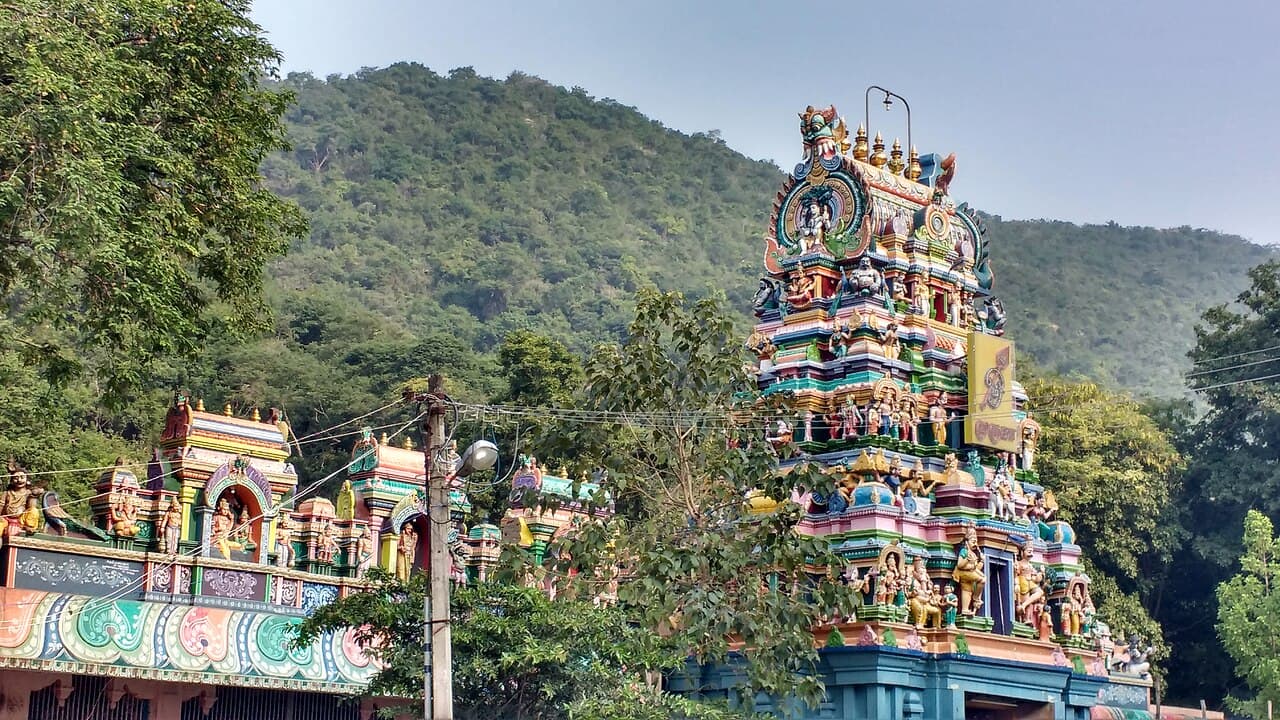
Pazhamudircholai Murugan
Alagar Koil, Madurai, Tamil Nadu
The sixth and last of Murugan's six abodes — a fruit-ripe grove high in the Alagar hills above Madurai, where the god tested the poet Avvaiyar with a riddle about a roasted fruit.

Kukke Subrahmanya
Subrahmanya, Dakshina Kannada district, Karnataka
Kartikeya as Subrahmanya, lord of serpents — the great Karnataka shrine on the Kumaradhara, where Vasuki took refuge under the Lord and the sarpa-dosha rites are kept to this day.
Frequently Asked Questions
What is the Arupadai Veedu?+
The Arupadai Veedu are the six abodes of Murugan — Thiruparankundram, Tiruchendur, Palani, Swamimalai, Thiruthani and Pazhamudircholai — all in Tamil Nadu. The name means 'six battle camps', stations of the god who commanded the divine armies, and the set is fixed by Nakkirar's Sangam-era Tirumurugatruppadai.
Where are the six abodes of Murugan?+
All six lie in Tamil Nadu. Thiruparankundram and Pazhamudircholai flank Madurai; Tiruchendur stands on the Bay of Bengal in Thoothukudi district; Palani rises on a hill in Dindigul district; Swamimalai is near Kumbakonam in the Kaveri delta; and Thiruthani is in Thiruvallur district, north of Chennai.
Which of the six abodes is on the seashore?+
Tiruchendur, called Tiruchiralaivai in the Tirumurugatruppadai, is the only one of the six that stands at the sea rather than on a hill — the shore where tradition places Murugan's assault on Surapadman.
When is the best time to visit Murugan's temples?+
Skanda Sashti, on the sixth day of the waxing moon in Aippasi (October–November), is the great festival, with the Soorasamharam re-enacted at Tiruchendur; Thaipusam in Thai (January–February) fills Palani with kavadi-bearing pilgrims walking in from across the state, and Vaikasi Visakam marks Murugan's birth star. October to March is the pleasant season across the circuit.