

First of the six abodes of Murugan — a sanctum quarried out of the living rock of Skandamalai, where the god wed Deivanai after the Surasamharam.
- Deity
- Murugan (Subramaniya Swamy)
- Location
- Thiruparankundram, Madurai, Tamil Nadu
- Category
- Murugan
- Established
- Rock-cut cave shrines of the early Pandya period (8th c.); halls and gopuram added by the Madurai Nayakas (16th c.)
- Setting
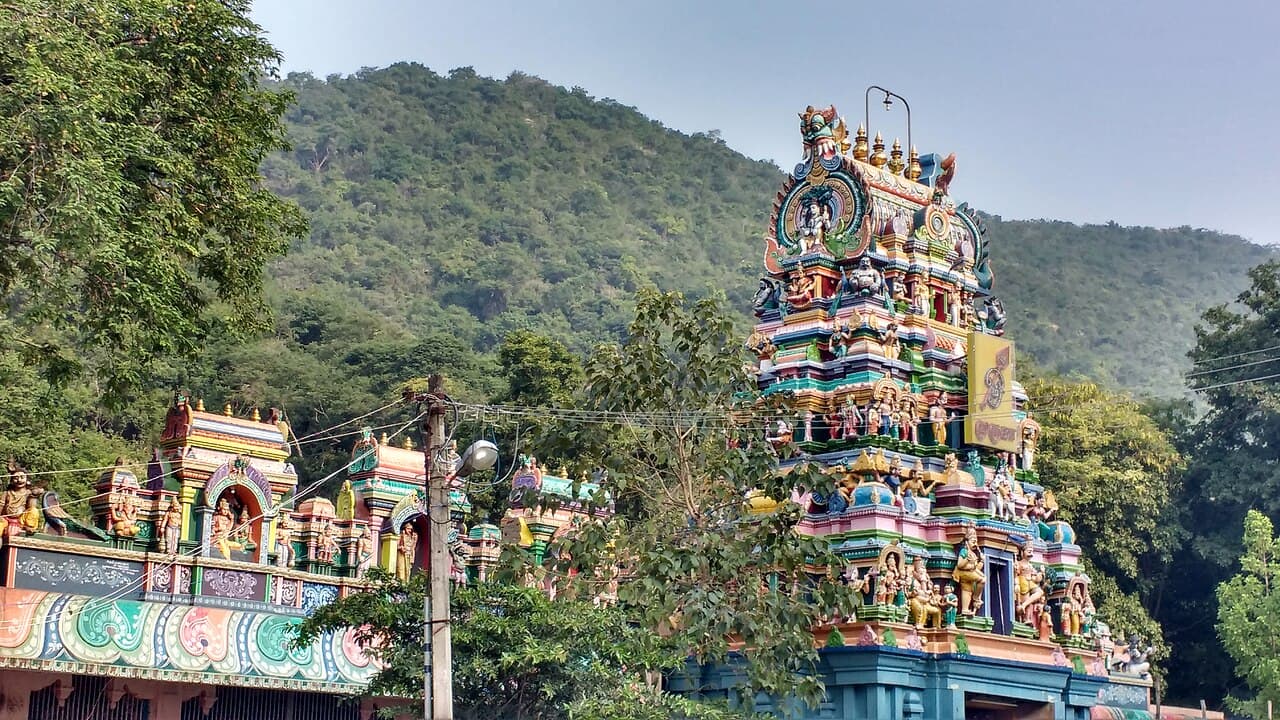
- At the foot of the 320 m granite Thiruparankundram (Skanda) hill, southwest of Madurai
- Best Time to Visit
- October to March; Skanda Shashti (Aippasi) and the Panguni Uttiram festival
- First of the six Arupadai Veedu abodes of Murugan
- Sanctum cut into the living rock of Skandamalai hill
- Where Murugan wed Deivanai after the Surasamharam
- Shiva, Vishnu, Durga and Vinayaka share one wall of rock
- Shiva and Vishnu face each other in the main shrine — a rarity
- Cave shrines dated to the early Pandya period (8th c.)
- Seven-tiered rajagopuram ~46 m high; 16th-c. Nayaka halls
- Kasi Viswanathar shrine atop the 320 m granite hill
Significance
Of the six abodes, this is the wedding place. When Murugan had destroyed Surapadman at Tiruchendur — the Surasamharam — Indra gave him his daughter Deivanai, also called Devasena, and the marriage was solemnised at Thiruparankundram; here too, tradition says, Murugan worshipped his own father as Parangirinathar. Every Panguni the wedding is performed again over a fortnight of festival, and unmarried women and newly married couples come in their thousands to see it.
What astonishes visitors is the sanctum itself. Cell after cell is cut into the same wall of rock, so that Murugan, Durga, Vinayaka, Shiva and Vishnu are all worshipped in a single unbroken face of the hill — and in a rare arrangement, Shiva and Vishnu stand facing one another. The image of Murugan in the inner sanctum is carved from one stone, and panels of Shiva's dance of bliss are cut outside it.
The great occasion is Skanda Shashti in the Tamil month of Aippasi, when the slaying of Surapadman is enacted on the sixth day and the festive image is carried around the temple streets on different mounts. Karthigai Deepam is marked by a lamp lit on the summit, Vaikasi Visakam recalls Murugan's birth, and in Chittirai the temple's Murugan and Perumal travel to Madurai for Meenakshi's wedding — a courtesy between two shrines that has been kept for centuries.
History
Thiruparankundram stands about eight kilometres south-west of Madurai, at the northern foot of a vast granite dome that the devout call Skandamalai, the hill of Skanda. The Sangam-era poem Tirumurugatruppadai, attributed to Nakkirar and by tradition composed here, sings of six war-camps of Murugan — the Arupadai Veedu — and the first it names is this one; ever since, Thiruparankundram has been counted at the head of the six.
The heart of the temple is a rock-cut shrine. Its cave sanctums are reckoned an eighth-century work of the early Pandyas, hollowed straight into the hillside, and tradition credits the restoration of worship here to Gajapathy, minister to a later Pandya king. The hill itself carries far older marks: natural caverns with Jain stone beds and Tamil-Brahmi inscriptions going back to about the first century BCE.
Sambandar sang of the Shiva of this hill in the seventh-century Tevaram, which places the temple among the 276 Paadal Petra Sthalams, and Arunagirinathar praised it later in the Tiruppugazh. The long pillared halls and the towering gateway that visitors meet first were the gift of the Madurai Nayakas in the sixteenth century. The temple is administered today by the Tamil Nadu Hindu Religious and Charitable Endowments Department.
Architecture
The living rock governs everything. A flight of six steps, the Shadashara Padigal, lifts the pilgrim towards three halls set at rising levels — the Kambathadi, Ardha and Maha mandapams — and the reliefs along the way, Mahishasuramardini, Karpaga Vinayagar, Andarabaranar and Uggirar, are all cut from the hill rather than built against it.
Outside, the Aasthana Mandapam of carved pillars leads to a seven-tiered rajagopuram some forty-six metres high, its life-size Nayaka sculpture from the sixteenth century. Before the flagstaff stand Nandi, peacock and mouse together; a tank where pilgrims feed the fish lies beyond the wall, one of five sacred waters here, and the Kasi Viswanathar shrine crowns the hill three hundred and twenty metres above.
Festivals
Timings
Open daily from about 5:30 AM to 1:00 PM and 4:00 PM to 9:00 PM, with the three principal pujas — Kalasanthi in the morning, Uchikalam at noon and Sayarakshai in the evening; hours extend during Skanda Shashti and the Panguni festival. Confirm current timings with the temple.
The temple is a suburb of Madurai and easily reached from it. Madurai airport is about twelve kilometres away and Madurai Junction about eight; Thiruparankundram has its own small railway station roughly a kilometre and a half from the temple, and city buses run constantly. Most pilgrims pair the visit with the Meenakshi Amman temple in Madurai and with Pazhamudircholai, the sixth abode, on the hills north of the city.
Timings are indicative — please confirm with the temple trust before travelling.
Videos
Nearby Temples


Frequently Asked Questions
Where is Thiruparankundram Murugan Temple located?+
Thiruparankundram Murugan Temple is in Thiruparankundram, Madurai, Tamil Nadu, India.
Which deity is worshipped at Thiruparankundram Murugan Temple?+
Thiruparankundram Murugan Temple is dedicated to Murugan (Subramaniya Swamy).
Which tradition does Thiruparankundram Murugan belong to?+
Thiruparankundram Murugan is one of the Murugan temples dedicated to Murugan (Kartikeya).
What are the timings of Thiruparankundram Murugan Temple?+
Open daily from about 5:30 AM to 1:00 PM and 4:00 PM to 9:00 PM, with the three principal pujas — Kalasanthi in the morning, Uchikalam at noon and Sayarakshai in the evening; hours extend during Skanda Shashti and the Panguni festival. Confirm current timings with the temple.
What is the best time to visit Thiruparankundram Murugan Temple?+
October to March; Skanda Shashti (Aippasi) and the Panguni Uttiram festival
When was Thiruparankundram Murugan Temple established?+
Thiruparankundram Murugan Temple — Rock-cut cave shrines of the early Pandya period (8th c.); halls and gopuram added by the Madurai Nayakas (16th c.).
Sources & further reading
Photo: Itsmanibharathi · CC BY-SA 4.0