
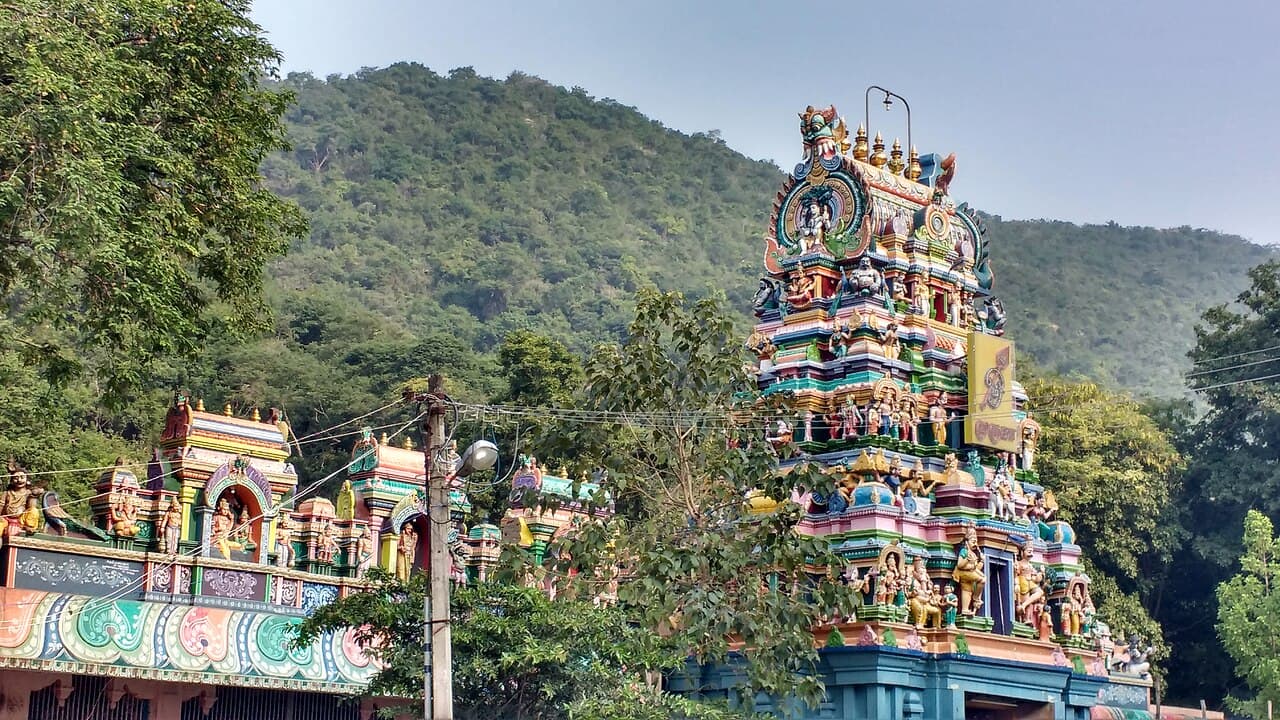
The sixth and last of Murugan's six abodes — a fruit-ripe grove high in the Alagar hills above Madurai, where the god tested the poet Avvaiyar with a riddle about a roasted fruit.
- Deity
- Murugan (Subramanya), with Valli and Deivanai
- Location
- Alagar Koil, Madurai, Tamil Nadu
- Category
- Murugan
- Established
- Ancient — praised in the Sangam-age Tirumurukarruppadai; present structures much later
- Setting
- Atop Solaimalai in the Alagar hills (~335 m), in dense forest above Alagar Koil
- Best Time to Visit
- October to March; Vaikasi Visakam (May–June) and Skanda Sashti (October–November)
- The sixth and last of the Arupadai Veedu, Murugan's six abodes
- Its name means 'the grove where ripe fruit falls' (pazham-udir-cholai)
- Where Murugan tested Avvaiyar with the riddle of the roasted fruit
- Only the vel — the Gnanavel, an ancient stone spear — was worshipped here at first
- Murugan enshrined with both consorts, Valli and Deivanai
- Sung by Nakkeerar in the Sangam-age Tirumurukarruppadai
- The Nupura Gangai spring above feeds Alagar Koil's Vishnu temple below
Significance
The story every Tamil child knows happened here. Avvaiyar, the aged poet-saint, rested under a naaval tree, and a cowherd boy in its branches asked whether she would like sutta pazham or sudatha pazham — roasted fruit or unroasted. Amused at such nonsense from a village child, she asked for the unroasted; he shook the branch, the fruit fell in the dust, and as she blew the sand away he said gravely, 'Grandmother, is the fruit too hot?' A lifetime of learning had not saved her from being caught, and the boy stood revealed as Murugan. From those scattered fruits the grove takes its name.
Here alone among the six abodes, the temple's own tradition holds, Murugan is enshrined with both his consorts — Valli of the hills and Deivanai of the heavens — beside the Gnanavel and a shrine to Ganesha. The temple's naaval tree is said to fruit out of its season, at Skanda Sashti rather than in high summer.
Higher on the hill rises the Nupura Gangai, the 'anklet Ganga', a perennial spring named for the drops that fell from Vishnu's anklet when Brahma washed the foot of Trivikrama. Its water runs down all year to Alagar Koil below, where Kallazhagar — Vishnu — has his great Divya Desam, sung by Periyalvar and by Andal; once a year in the month of Aippasi that god is carried up the hill to the spring for his oil-bath. Few hills in the south hold Murugan and Vishnu so close together, and pilgrims here commonly worship at both.
History
Pazhamudircholai crowns Solaimalai, a densely wooded shoulder of the Alagar hills about twenty-five kilometres north of Madurai and some four kilometres up the ghat road above Alagar Koil. It is the sixth and last of the Arupadai Veedu, the six abodes of Murugan, and the only one where the god is felt to dwell not on a bare peak or by the sea but inside a forest — its very name a description of the place: pazham, fruit; udir, to shed or scatter; cholai, a grove. The grove where ripe fruit falls.
Its antiquity is literary before it is architectural. Nakkeerar sang of it in the Tirumurukarruppadai, the Sangam-age guide-poem that names the six hills of Murugan and closes with this one; the Cilappatikaram knows the hill as Thirumaliruncholai; and Arunagirinathar later filled his Tiruppugazh with its praise.
For long ages only the vel was worshipped here — the Gnanavel, a plain ancient stone spear that remains the oldest object of devotion on the hill. The shrines to Ganesha and to Murugan with his consorts Valli and Deivanai came later. The temple is administered today by the Hindu Religious and Charitable Endowments Department of the Government of Tamil Nadu.
Architecture
The temple is small by Tamil standards and makes no attempt at grandeur: a brightly painted gopuram opening straight off the hill road, a compact walled court behind it, and three sanctums within — Vinayagar near the entrance, Murugan with Valli and Deivanai, and the Gnanavel in its own dark cell, the oldest worship on the hill. The naaval tree stands as the sthala vriksham, the temple's sacred tree.
What the place has instead of scale is its setting. The forest of the Alagar reserve presses in on every side, monkeys work the stalls along the road, and the springs of the hill — the Nupura Gangai and the Rakkayi Amman shrine beside it, above the temple — are as much a part of the pilgrimage as the sanctum itself.
Festivals
Timings
Open daily from about 6:00 AM to 6:00 PM, usually without a midday break; some reports give evening darshan continuing to about 8:00 PM, and hours extend for Vaikasi Visakam and Skanda Sashti. Confirm current timings locally.
Pazhamudircholai lies about twenty-five kilometres north of Madurai, whose junction is the nearest railhead and whose airport is some forty kilometres away by road. Town buses run from Madurai's Periyar bus stand to Alagar Koil at the foot of the hill, and from there share-vans and buses climb the last four kilometres of ghat road to the temple. Most pilgrims see Kallazhagar's temple below on the same trip.
Timings are indicative — please confirm with the temple trust before travelling.
Nearby Temples


Frequently Asked Questions
Where is Pazhamudircholai Murugan Temple located?+
Pazhamudircholai Murugan Temple is in Alagar Koil, Madurai, Tamil Nadu, India.
Which deity is worshipped at Pazhamudircholai Murugan Temple?+
Pazhamudircholai Murugan Temple is dedicated to Murugan (Subramanya), with Valli and Deivanai.
Which tradition does Pazhamudircholai Murugan belong to?+
Pazhamudircholai Murugan is one of the Murugan temples dedicated to Murugan (Kartikeya).
What are the timings of Pazhamudircholai Murugan Temple?+
Open daily from about 6:00 AM to 6:00 PM, usually without a midday break; some reports give evening darshan continuing to about 8:00 PM, and hours extend for Vaikasi Visakam and Skanda Sashti. Confirm current timings locally.
What is the best time to visit Pazhamudircholai Murugan Temple?+
October to March; Vaikasi Visakam (May–June) and Skanda Sashti (October–November)
When was Pazhamudircholai Murugan Temple established?+
Pazhamudircholai Murugan Temple — Ancient — praised in the Sangam-age Tirumurukarruppadai; present structures much later.
Sources & further reading
Photo: Santhoshlife91 · CC BY-SA 4.0