
Hanuman
The Rambhakta — Mahavir, Bajrangbali, Sankat Mochan — whose whole strength is laid at Shri Rama's feet, and whose dhams stand from the Shekhawati sand to a Himalayan summit.
6 TemplesHanuman is the bhakta by whom every other bhakta is measured. Mahavir, the great hero; Bajrangbali, whose limbs are the thunderbolt; Pavanputra, son of the wind, and Anjaniputra, son of Anjani; Sankat Mochan, the one who loosens what binds. Strength beyond measuring was given to him, and he kept none of it for himself: he laid the whole of it at the feet of Shri Rama, and so the Rambhakta's own glory and his Lord's name became one thing. Ask him for anything and he gives it in Rama's name; praise him, and he turns the praise over to the one he serves. Tradition holds him to be an avatar of Rudra — Mahadev descending into the form that could serve, since the lord of all lords would take no higher station in Rama's court than a servant's — and so the Shaiva and the Rama-bhakta bow at the same threshold here. He is chiranjivi, deathless: wherever the Ramkatha is sung he is believed to be present, seated somewhere in the assembly with folded palms and brimming eyes, and a seat is kept for him at every path of the Ramayana. That is the shape of this tradition. It does not gather the houses of a god who waits to be worshipped; it gathers the houses of the servant who is still at work, and who stands nearest of all the great ones to whoever calls.
His murtis are unmistakable. Sindoor covers them from head to foot, orange-red and thick, renewed as a chola over the whole body — and the temples tell why: seeing Sita put sindoor in the parting of her hair for her Lord's long life, Hanuman covered himself in it entirely, reasoning that if a little gives so much, the whole of it must give more. A bhakta's arithmetic became the offering that never changes, and sindoor, chameli oil, a red flower and a laddoo are still what is carried in. He is worshipped as the child on Anjani's lap and as the hero who carried the mountain; kneeling with folded palms before Rama's throne, and tearing open his own chest to show whose name was written within. The katha of Ahiravana gives him the Panchamukhi form, five faces turned to the five directions at once, so that five lamps could be put out in a single breath and Rama and Lakshmana brought back from the nether world. Tuesday and Saturday are his days, kept across Bharat with fasting, red flowers and a reading of the Hanuman Chalisa — and the Chalisa is itself the thread that binds two of the great houses gathered here: Goswami Tulsidas, who began the Ramcharitmanas at Ayodhya and completed it at Kashi, and to whom long tradition gives the Chalisa's forty verses, is remembered as having had darshan of Hanuman where Sankat Mochan stands today.
The dhams of this tradition run from the Shekhawati sand to a Himalayan summit. At Salasar in Churu he is Balaji, and the darshan is like no other: a face of sindoor bearing beard and moustache, risen — as the temple tells it — under a farmer's plough at Asota and enthroned where the bullocks halted on a dune. South-east of it, at Ghata Mehandipur in Dausa, Balaji is worshipped in his child form between two low hills, and to that darbar people have brought the afflictions of body and of mind for longer than anyone can date. In Ayodhya he keeps the gate: Hanuman Garhi is a fort on a mound above Ramkot, and the city's own order of precedence sends the pilgrim up its steps before the darshan of Ram Lalla — the courtesy a bhakta owes the greatest of bhaktas. In Kashi he is Sankat Mochan in a walled grove beside the Assi, his murti turned towards Rama and his bhog the besan laddoo. Outside Patna Junction, Mahavir Mandir holds twin murtis in a single sanctum and keeps hospitals out of what its naivedyam earns. And above Shimla, on the peak that took the rishi Yaksha's name, Jakhu remembers not the Sanjivani flight but the promise that turned it back.
The Pilgrimage Circuit
There is no set order here, and none is needed: Hanuman is sought wherever a devotee stands, and a red flower, a little sindoor and the Chalisa are the whole of the offering. What the six dhams make is not a circuit but a spread — Salasar and Mehandipur in Rajasthan, the first of them paired with Khatu Shyam in the classic Shekhawati darshan; Hanuman Garhi at Ayodhya and Sankat Mochan at Kashi, the two ends of the Ramcharitmanas' own journey; Mahavir Mandir in the square outside Patna Junction, where the trains set a traveller down at the temple door; and Jakhu on its summit above Shimla, reached by the old climb through the deodars or in six minutes by the ropeway. Tuesdays and Saturdays fill all six every week of the year, and Hanuman Jayanti fills them to overflowing — kept on the Chaitra full moon across the north, and on Kartik Krishna Chaturdashi where the Ramanandi reckoning is followed.
Hanuman Temples
See all on the map →A hand-researched beginning, not a full count — more great temples of this tradition are added as our research completes.
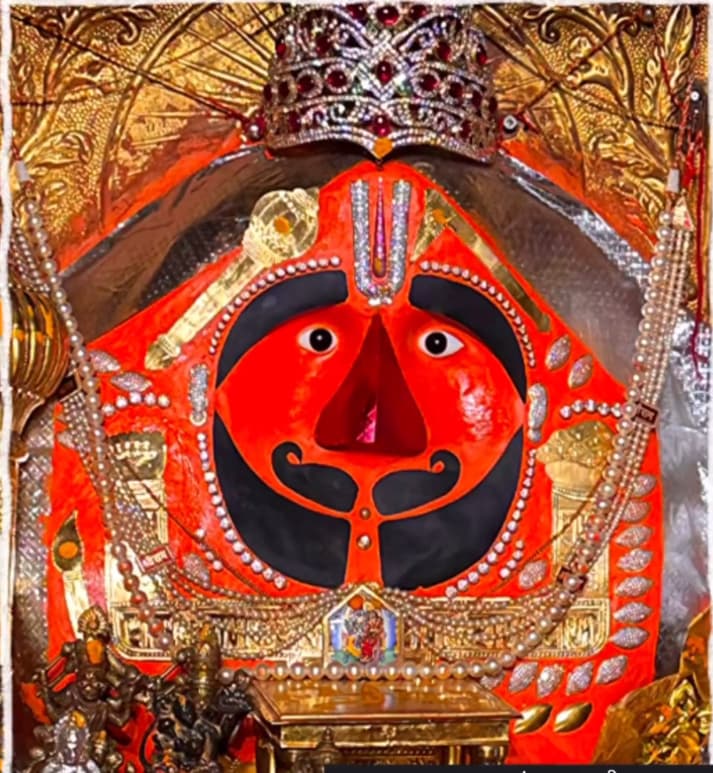
Salasar Balaji, Salasar
Salasar, Churu, Rajasthan
Hanuman as Balaji of Salasar — the Rambhakta in the one murti that bears beard and moustache, risen under a farmer's plough at Asota and enthroned on a dune of Shekhawati, where Mohandas ji's flame still burns.

Mehandipur Balaji
Mehandipur, Dausa, Rajasthan
The Balaji of Ghata Mehandipur — Hanuman in his child form, self-manifest between two low hills of the Dausa uplands, to whose darbar the afflicted of body and mind are brought.

Hanuman Garhi, Ayodhya
Ayodhya, Uttar Pradesh
The fort-temple on its mound in the heart of Ayodhya, where Pavanputra Hanuman keeps watch over Ramkot — seventy-six steps up, and by long custom the first darshan of the city, taken before Ram Lalla's.

Sankat Mochan Hanuman Mandir, Kashi
Varanasi, Uttar Pradesh
Hanuman as Sankat Mochan, the reliever of troubles — a grove-shaded temple beside the Assi, raised where Goswami Tulsidas is held to have had darshan of him, its murti turned towards Rama.

Mahavir Mandir, Patna
Patna, Bihar
Hanuman as Sankat Mochan in the square outside Patna Junction — twin murtis in one sanctum, a naivedyam laddoo whose earnings pay for hospitals, and a Ram Navami queue that runs for kilometres into the city.

Jakhu Temple, Shimla
Shimla, Himachal Pradesh
Shimla's highest peak, where the Sanjivani flight came down to a rishi at his tapasya — and where a swayambhu murti rose, the temple tells, the moment Hanuman had kept his word.
Frequently Asked Questions
Which temples belong to the Rambhakta Hanuman Dham tradition?+
The great houses of Hanuman across Bharat — Salasar Balaji and Mehandipur Balaji in Rajasthan, Hanuman Garhi at Ayodhya and Sankat Mochan at Kashi in Uttar Pradesh, Mahavir Mandir outside Patna Junction in Bihar, and Jakhu on Shimla's highest peak in Himachal Pradesh. More are added as the research completes: Hanuman is the most widely worshipped of all, and no listing of his dhams is ever finished.
Why is Hanuman worshipped with sindoor?+
The temples tell it this way: Hanuman saw Sita put sindoor in the parting of her hair for her Lord's long life, and reasoned that if so little gives so much, then covering himself in it entirely must give more — so he did. From that day the chola of sindoor, often laid on with chameli oil, has been his own offering, renewed over the whole body of the murti, and it is why his images across Bharat are that deep orange-red.
When is Hanuman Jayanti, and which days of the week are his?+
Tuesday and Saturday are Hanuman's days everywhere, kept with fasting, red flowers and a reading of the Hanuman Chalisa; the queues at every dham on this page are longest on those two. Hanuman Jayanti is kept across the north on the full moon of Chaitra (March–April) — that is Ayodhya's day at Hanuman Garhi and Salasar's great mela — while temples following the Ramanandi reckoning, Patna's Mahavir Mandir among them, keep it on Kartik Krishna Chaturdashi. Each house states its own reckoning, and both are old.
When is the best time to seek Hanuman's darshan?+
October to March is the kindest season across the plains, and Tuesdays and Saturdays are his own days in every week of the year. Hanuman Jayanti brings the greatest gatherings and the heaviest crowds — the Chaitra full moon at Ayodhya, Kashi, Salasar and Mehandipur, and Kartik Krishna Chaturdashi at Patna, where Ram Navami is the greater day still. Salasar keeps a second mela on the Sharad full moon of Ashvin, Kashi holds its Sangeet Samaroh with Hanuman Jayanti, and Jakhu on its Himalayan summit is best from March to June and September to November.