
Temples in Rajasthan
7 Temples*
A hand-researched beginning, not a full count — more great temples of this state are added as our research completes.
Rajasthan is the land where kings ruled as servants of their deities. In Mewar the covenant is explicit: at Kailashpuri, about 22 kilometres north of Udaipur, Shiva reigns as Eklingji — a four-faced image in black marble within a walled complex of a hundred and eight shrines. The tradition preserved in the Ekalinga Mahatmya traces the temple's founding to Bappa Rawal in the eighth century, the present murti to Rana Raimal's fifteenth-century rebuilding, and to this day the Maharana of Mewar holds the kingdom as Eklingji's dewan, his minister; Maha Shivaratri is kept there with night-long worship. Jaipur made the same covenant with Krishna. Govind Dev Ji — the Vrindavan image that tradition attributes to Bajranabh, Shri Krishna's great-grandson, and that Rupa Goswami brought to light at Vrindavan — was carried out of Braj when Aurangzeb's age threatened it, and Sawai Jai Singh II enthroned him within the City Palace complex as the true sovereign of his new city; the ruling house has served him since, the curtain opens seven times a day for jhanki, and Janmashtami fills the courtyards past counting.
North of Jaipur, in the Shekhawati region of Sikar district, stands Khatu Shyam Ji — Barbarika of the Mahabharata, Ghatotkacha's son, who gave Shri Krishna his sheesh, his own head, before Kurukshetra and received the boon that in Kali Yuga he would be worshipped by Krishna's own name, Shyam. Devotees call him Haare ka Sahara, the refuge of the defeated, and in the lakkhi mela around Falgun Shukla Ekadashi the road from Ringas fills with barefoot pilgrims carrying nishan flags to his court. Deep in the desert at Deshnoke, south of Bikaner, Karni Mata — the Charan mystic revered as an incarnation of the Devi, and guardian goddess of the Bikaner royal house — is served behind the marble facade and silver gates given by Maharaja Ganga Singh, where the kabas, her Charan devotees reborn in her care, move through the sanctum as honoured kin. Jaipur is the gateway, with the state's principal airport and a major rail junction: Khatu is about 80 kilometres away, with Ringas Junction its railhead 17 kilometres from the temple; Bikaner lies about 330 kilometres northwest and Udaipur about 400 kilometres south — the two far anchors of the circuit.
Vishnu Desam
New to this tradition? Read the overview →
Khatu Shyam Ji, Khatu
Khatu, Sikar, Rajasthan
Barbarika, Ghatotkacha's son, who gave Shri Krishna his sheesh before Kurukshetra and received the Lord's own name in return — Shyam, Haare ka Sahara, the refuge of the defeated, enthroned in marble at Khatu.

Shri Govind Dev Ji, Jaipur
Jaipur, Rajasthan
Krishna as Govind Dev, in the image tradition ascribes to Bajranabh's own hand — carried out of Braj in the Aurangzeb era and enthroned by Sawai Jai Singh II as Jaipur's true sovereign, whose court sits seven times a day beside the City Palace.
Shiva Mahadev
New to this tradition? Read the overview →

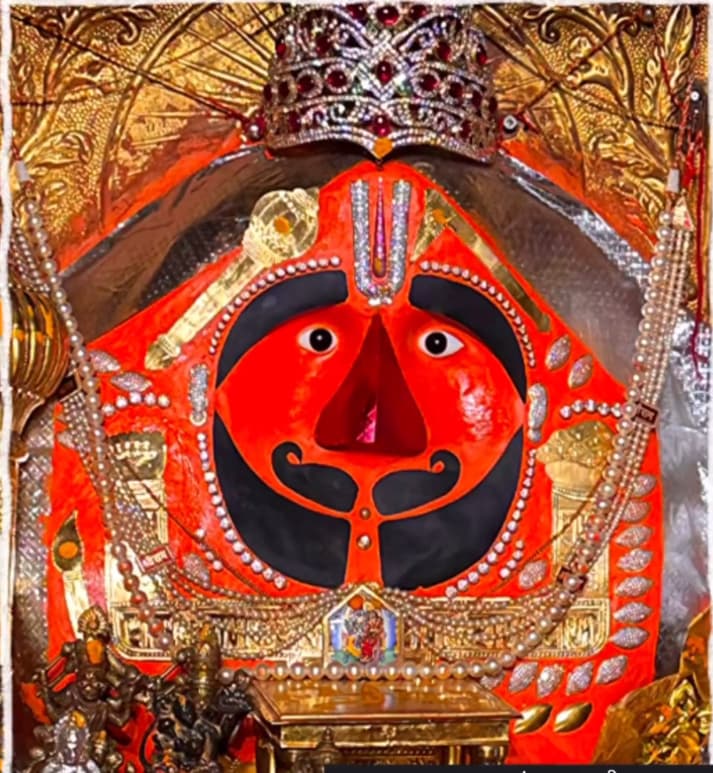
Salasar Balaji, Salasar
Salasar, Churu, Rajasthan
Hanuman as Balaji of Salasar — the Rambhakta in the one murti that bears beard and moustache, risen under a farmer's plough at Asota and enthroned on a dune of Shekhawati, where Mohandas ji's flame still burns.

Mehandipur Balaji
Mehandipur, Dausa, Rajasthan
The Balaji of Ghata Mehandipur — Hanuman in his child form, self-manifest between two low hills of the Dausa uplands, to whose darbar the afflicted of body and mind are brought.

Frequently Asked Questions
How many major temples are listed in Rajasthan on MereMandir?+
Four — Khatu Shyam Ji in Sikar district's Shekhawati, Karni Mata at Deshnoke near Bikaner, Eklingji at Kailashpuri north of Udaipur, and Govind Dev Ji in the City Palace complex at Jaipur. Between them they cover three of the traditions on MereMandir: two homes of Krishna — Shyam of Khatu, worshipped by Krishna's own name, and Govind Dev, whom Jaipur's ruling house serves as its true sovereign — the Shiva Mahadev seat of Mewar's ruling deity, and the Devi shrine of the guardian goddess of the Bikaner royal house.
Who is Khatu Shyam Ji, and why is he called Haare ka Sahara?+
He is Barbarika of the Mahabharata — Ghatotkacha's son and Bhima's grandson — whose sheesh, his own head, Shri Krishna asked of him in daan before the war of Kurukshetra. Pleased with that unmatched offering, Krishna granted that in Kali Yuga Barbarika would be worshipped by Krishna's own name, Shyam. Enshrined in the form of his sheesh, Baba Shyam is called Haare ka Sahara, the refuge of the defeated: the faith of Khatu is that whoever comes to his court with nowhere left to turn is sent home with shelter. It is this faith the nishan flags declare, carried on foot from Ringas to Khatu.
Can Rajasthan's temples be covered in one trip?+
They divide naturally into three directions from Jaipur, the gateway with the state's principal airport and a major rail junction. Govind Dev Ji stands in the city itself, and Khatu is about 80 kilometres away — Ringas Junction its railhead, 17 kilometres from the temple — so the two pair easily. Karni Mata lies about 330 kilometres northwest towards Bikaner, with Deshnoke about 30 kilometres south of that city and a small station of its own on the Bikaner line. Eklingji is at the far southern end, 22 kilometres north of Udaipur, which has flights and trains of its own. Two or three unhurried journeys cover the state.
What is the best season to visit temples in Rajasthan?+
October to March, when the desert is at its kindest. The lakkhi mela at Khatu fills the days around Falgun Shukla Ekadashi (February–March) — the year's great gathering, when the Ringas road becomes a river of nishan flags; Karni Mata's two fairs fall in the Chaitra and Ashwin Navratras; Janmashtami is Jaipur's great night at Govind Dev Ji, and Maha Shivaratri is Mewar's at Eklingji. Summer is fierce in the desert, so early-morning darshan is best then.