

Barbarika, Ghatotkacha's son, who gave Shri Krishna his sheesh before Kurukshetra and received the Lord's own name in return — Shyam, Haare ka Sahara, the refuge of the defeated, enthroned in marble at Khatu.
- Deity
- Shyam Baba (Barbarika, worshipped by Shri Krishna's own name)
- Location
- Khatu, Sikar, Rajasthan
- Category
- Vishnu Desam
- Established
- First temple by tradition 1027 CE, built by Roopsingh Chauhan, ruler of Khatu; present marble temple from the renovation of 1720 credited to Diwan Abhai Singh at the behest of the ruler of Marwar
- Setting
- Khatu village in the Shekhawati region of Sikar district, beside the Shyam Kund — about 17 km from Ringas and 80 km from Jaipur
- Best Time to Visit
- October to March; the Falgun Lakkhi Mela (February–March) is the greatest gathering — and by far the most crowded; every month's Shukla Ekadashi also fills the town
- Barbarika — Ghatotkacha's son, Bhima's grandson — Teen Baan Dhari, bearer of the three infallible arrows
- Gave his sheesh to Shri Krishna in dana before Kurukshetra; the head beheld the whole war from a hill
- Krishna's boon: worshipped in the Kali Yuga by the Lord's own name — Shyam
- Haare ka Sahara — the refuge of the defeated; Sheesh ke Dani; Lakhdatar
- The sheesh emerged at Shyam Kund, where a cow poured her milk over the spot; a dip in the kund is held to heal
- First temple by tradition 1027 CE (Roopsingh Chauhan); present marble form from the 1720 renovation credited to Diwan Abhai Singh
- Falgun Lakkhi Mela — lakhs of devotees; nishan flags carried ~17 km on foot from Ringas and offered at the shikhar
- Five daily aartis — Mangala, Shringar, Bhog, Sandhya, Shayan — with the Shri Shyam Aarti and Shri Shyam Vinati
Significance
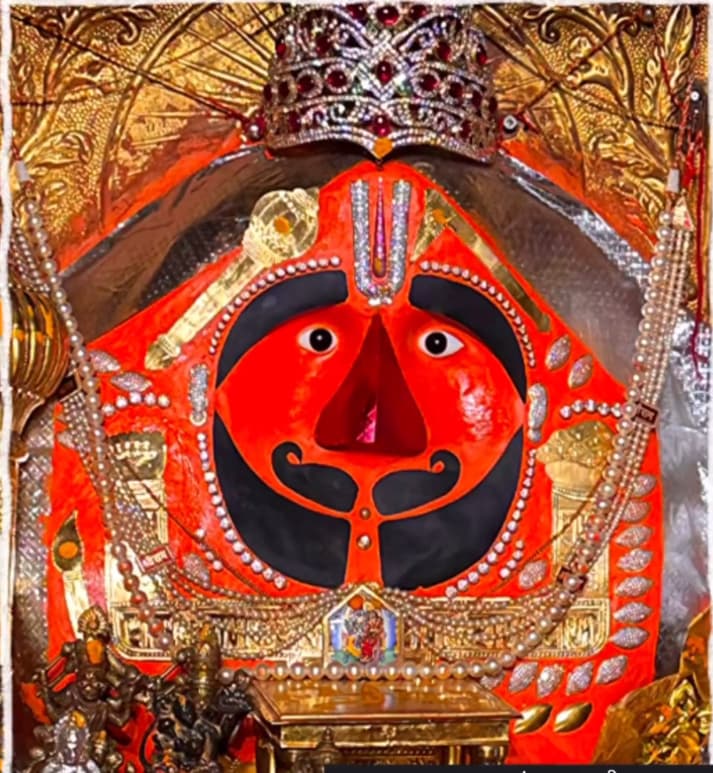
What Khatu holds out is a single immense act of grace: the warrior who gave everything received in return the name of God. Elsewhere Krishna is worshipped; here Krishna's own name is worn by his bhakta — and with it, devotees hold, a promise: no one who comes to Shyam with a true heart is turned away. From that promise rises the line sung across the north — Haare ka Sahara, the refuge of the defeated. This is where people bring what has failed, and Shyam Baba is loved by the names his giving earned: Sheesh ke Dani, giver of his own head; Lakhdatar, the giver by lakhs; Morvi Nandan; Teen Baan Dhari, bearer of the three arrows.
What stands in the sanctum is the sheesh itself, and beside the temple lies the Shyam Kund, the pond that yielded it; a dip in its water is held to heal, and the kund fills with bathers through the fair.
The year turns on Falgun. In that month's bright half the lakkhi mela gathers — a fair named for its own attendance, for the devotees come in lakhs, in some years tens of lakhs. As Falgun Shukla Ekadashi draws near — the mela's great day, with Dwadashi to close it — every road into Khatu runs saffron with nishan padyatras: devotees walking, many barefoot, the seventeen kilometres from the railhead at Ringas, each party carrying a nishan, a flag raised on a long pole, to be offered at the temple's shikhar. Bhajans run through those nights, and one cry carries the whole town: Jai Shri Shyam. Kartik Shukla Ekadashi — the Dev Uthani Ekadashi — is kept as Shyam Janmotsav, Baba's appearance day, with a gathering of its own; and every month's Shukla Ekadashi, the gyaras, fills Khatu again.
History
Khatu is a village of the Shekhawati region of Sikar district, and its lord enters the story on the eve of Kurukshetra. Barbarika, son of Ghatotkacha and grandson of Bhima, bore three infallible arrows granted by divine boon — power enough, tradition holds, to end the war alone — and he was bound by a word given to his mother: he would always take the side of the weaker. Shri Krishna, knowing that vow would leave no army standing, came to the young warrior as a Brahmin and asked of him the greatest dana of all — his head. Barbarika gave it, asking only to see the battle; the Lord set the sheesh upon a hill overlooking the field, and granted a boon without parallel: in the Kali Yuga this bhakta would be worshipped by Krishna's own name — Shyam.
The sheesh, tradition continues, was consigned to the river Rupawati and lay hidden at Khatu until the age turned. Then a cow began to pour her milk over one spot of earth; digging villagers found the head; and Roopsingh Chauhan, the ruler of Khatu, was told in a dream to enshrine it. The first temple is dated by tradition to 1027 CE, and the present marble temple to a renovation of 1720, credited to Diwan Abhai Singh at the behest of the ruler of Marwar; the Shri Shyam Mandir Committee serves the shrine today.
Architecture
The temple is Rajasthani work in white Makrana marble, raised with lime mortar and tiles. Its great hall, the Jagmohan, opens before the sanctum, its walls painted with scenes of the katha; the entrance and exit gates are marble, their brackets cut with floral design; and the shutters of the garbhagriha are sheathed in silver. The sheesh of Shyam Baba, cut in rare stone, is enthroned within, dressed and garlanded anew for each day's shringar darshan.
Festivals
Timings
Open in two sessions — in winter about 5:30 AM to 1:00 PM and 5:00 to 9:00 PM, in summer about 4:30 AM to 12:30 PM and 4:00 to 10:00 PM — with five aartis through the day: Mangala at opening, Shringar, Bhog at noon, Sandhya at sunset and Shayan before the doors close. Hours stretch greatly on Ekadashis and through the Falgun mela — confirm with the Shri Shyam Mandir Committee.
Khatu lies in Sikar district about eighty kilometres from Jaipur, whose airport is the nearest; the railhead is Ringas Junction, some seventeen kilometres away on the lines from Jaipur and Delhi, with cabs and shared jeeps waiting outside the station. By road the way from Jaipur runs via Ringas off the Jaipur–Sikar highway, and buses ply from Jaipur to Khatu; through the Falgun days the road itself becomes the mela, walked end to end by the padyatris.
Timings are indicative — please confirm with the temple trust before travelling.
Nearby Temples



Frequently Asked Questions
Where is Khatu Shyam Ji, Khatu Temple located?+
Khatu Shyam Ji, Khatu Temple is in Khatu, Sikar, Rajasthan, India.
Which deity is worshipped at Khatu Shyam Ji, Khatu Temple?+
Khatu Shyam Ji, Khatu Temple is dedicated to Shyam Baba (Barbarika, worshipped by Shri Krishna's own name).
Which tradition does Khatu Shyam Ji, Khatu belong to?+
Khatu Shyam Ji, Khatu is one of the Vishnu Desam temples dedicated to Vishnu.
What are the timings of Khatu Shyam Ji, Khatu Temple?+
Open in two sessions — in winter about 5:30 AM to 1:00 PM and 5:00 to 9:00 PM, in summer about 4:30 AM to 12:30 PM and 4:00 to 10:00 PM — with five aartis through the day: Mangala at opening, Shringar, Bhog at noon, Sandhya at sunset and Shayan before the doors close. Hours stretch greatly on Ekadashis and through the Falgun mela — confirm with the Shri Shyam Mandir Committee.
What is the best time to visit Khatu Shyam Ji, Khatu Temple?+
October to March; the Falgun Lakkhi Mela (February–March) is the greatest gathering — and by far the most crowded; every month's Shukla Ekadashi also fills the town
When was Khatu Shyam Ji, Khatu Temple established?+
Khatu Shyam Ji, Khatu Temple — First temple by tradition 1027 CE, built by Roopsingh Chauhan, ruler of Khatu; present marble temple from the renovation of 1720 credited to Diwan Abhai Singh at the behest of the ruler of Marwar.
Sources & further reading
Photo: Indrapal Jangid · CC BY-SA 3.0