
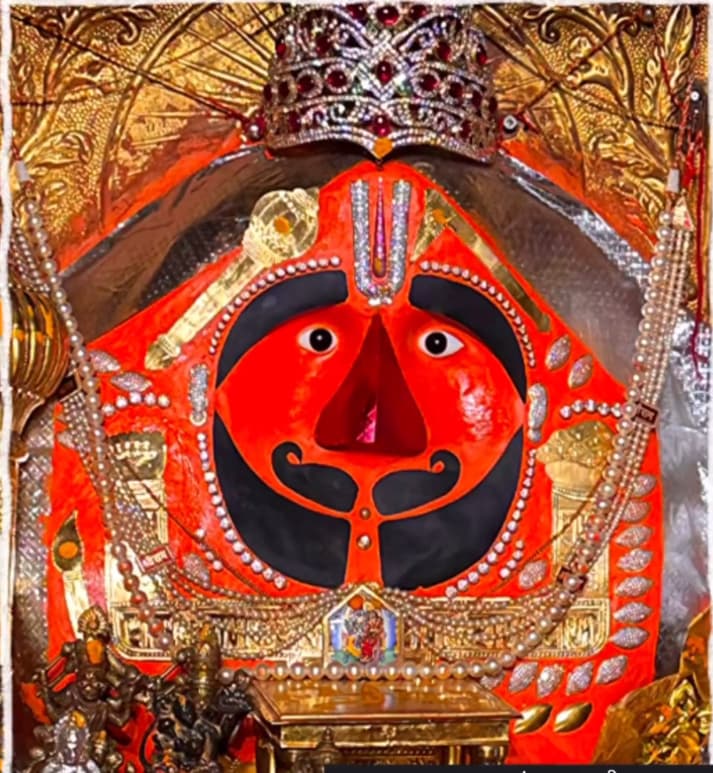
Hanuman as Balaji of Salasar — the Rambhakta in the one murti that bears beard and moustache, risen under a farmer's plough at Asota and enthroned on a dune of Shekhawati, where Mohandas ji's flame still burns.
- Deity
- Hanuman (Balaji — Shri Balaji Maharaj)
- Location
- Salasar, Churu, Rajasthan
- Category
- Hanuman
- Established
- Murti enthroned by tradition on Shravan Shukla Navami, Samvat 1811 (1754–55 CE); temple raised in Samvat 1815 (1759) by the craftsmen Noor Mohammad and Dau; the white-marble rebuilding credited to Rao Devi Singh, jagirdar of Sikar; the present complex largely of the 1990s
- Setting
- Salasar town in the sand of Shekhawati, Sujangarh tehsil of Churu district, on the Jaipur–Bikaner road — about 27 km from Sujangarh and 100 km from Khatu
- Best Time to Visit
- October to March; the Chaitra Purnima mela (Hanuman Janmotsav) and the Ashvin/Sharad Purnima mela are the great gatherings — and by far the most crowded; Tuesdays, Saturdays and every Purnima also fill the town
- The one murti of Hanuman worshipped with beard and moustache — the form, the temple tells, in which he came to Mohandas ji in a dream
- Found by a Jat farmer's plough in a field at Asota in Nagaur on a Shravan Shukla Navami, Samvat 1811
- The farmer's wife cleaned the image with her odhni; the bajre ka churma of that midday meal is Balaji's bhog to this day
- The bullocks halted on a sand dune and there the murti was enthroned; the temple was raised in Samvat 1815 by the craftsmen Noor Mohammad and Dau
- Mohandas ji Maharaj, the founding sadhak, took jeevit samadhi on a Vaishakh Shukla Trayodashi; his samadhi and his sister Kanhi Dadi's stand at the entrance
- Mohandas ji ka dhuna at the south gate — the fire of his tapasya, never let die; the akhand jyot has burned since the installation
- Manoti — a coconut bound with moli in the precinct; no coconut so tied is ever put to another use
- Savamani — sava mani, one and a quarter — about fifty kilos of food offered to Balaji and then given away
- Anjani Mata's temple stands a kilometre off on the Laxmangarh road; the darshan is complete only with the mother's
- Rajasthan's account calls the murti swayambhu and the place a Shakti Sthal; the Chaitra and Ashvin Purnima melas draw six to seven lakh, and the shrine is served through the Shri Balaji Mandir by the Shri Hanuman Seva Samiti
Significance
Hanuman is the perfect bhakta, and his greatness is that he sought none of his own: strength past measure laid whole at Shri Rama's feet, so that the Rambhakta's glory and his Lord's name are one thing. Salasar knows him as Balaji, and this darshan is like no other — a face of sindoor bearing beard and moustache, for it was in that form, the temple tells, that he came to Mohandas ji in sleep. Rajasthan's own account calls the murti swayambhu and the place a Shakti Sthal.
Two flames measure the years here: the jyot kindled at the installation, burning unbroken since, and at the south gate Mohandas ji ka dhuna, the ground of his tapasya, whose fire has never been let die. At the entrance stands the Samadhi Sthal of Mohandas ji and his sister Kanhi Dadi, and Salasar holds no darshan finished until one has bowed there; a kilometre off on the Laxmangarh road is Anjani Mata's temple, where the same rule keeps — the mother first, then her son.
A coconut bound with moli in the precinct is the manoti, the wish laid before Baba, and no coconut so tied is ever put to another use. A savamani is cooked — sava mani, one and a quarter — some fifty kilos of churma, dal-baati, boondi and laddoo offered to Balaji and then given away; in the hall the Sundarkand and Hanuman Chalisa run for hours.
Tuesdays and Saturdays are his, and every Purnima; but the year turns on two. Chaitra Purnima, kept as Hanuman Janmotsav, and Ashvin Purnima, the Sharad full moon, bring melas of six and seven lakh, when the samiti routes the crowds along a walking path of some six kilometres through the town. From here the pilgrim turns east: Khatu Shyam lies about a hundred kilometres off, and the two together are the great darshan of Shekhawati.
History
Salasar stands in the sand of Shekhawati, in Churu district, on the road from Jaipur to Bikaner; and its lord came out of the earth. On a Shravan Shukla Navami of Samvat 1811, tradition holds, a Jat farmer of Asota in Nagaur was ploughing when the share struck stone and rang. He dug, and lifted out a murti of Balaji caked with soil. His wife had come to the field with his midday meal; she cleaned the image with her odhni, and he offered it the bajre ka churma she had carried — and from that offering to this day, churma is Balaji's bhog.
That night the Thakur of Asota dreamed of Balaji, who bade him send the murti to Salasar in Churu; the same night Mohandas ji, a bhakta of Hanuman at Salasar, was shown the same thing, and when his message reached Asota naming what he had never seen, the Thakur knew whose work it was. The murti was set on a bullock cart with the word that where the bulls halted the Lord would be enthroned; they stopped on a dune, and that sand is Salasar Dham. In Samvat 1815 the temple was raised by the craftsmen Noor Mohammad and Dau — a brotherhood Salasar tells with pride. Mohandas ji gave the seva to his nephew Udayram and took jeevit samadhi on a Vaishakh Shukla Trayodashi; Udayram's line serves still, beside the Shri Hanuman Seva Samiti.
Architecture
The garbhagriha of Samvat 1811 was raised in mud and stone; the rebuilding in white marble is credited to Rao Devi Singh, jagirdar of Sikar. Sanctum and prayer hall are worked in silver and gold — the silver walls carved with scenes of the Ramayana, gates and windows silver-plated, the marble entrance cut with floral design. The wider complex is largely of the 1990s, a bridge named Ram Setu carrying the queues.
Festivals
Timings
Darshan runs from before dawn until late evening, with Mangala Aarti about 4:30 AM and Sandhya Aarti about 7:30 PM in summer, shifting to about 5:00 AM and 7:00 PM in winter; dry fruits are offered as the midday bhog. Hours stretch greatly through the Chaitra and Ashvin Purnima melas — confirm with the Shri Hanuman Seva Samiti.
Salasar sits on the Jaipur–Bikaner highway, Laxmangarh some thirty kilometres east and Sikar fifty-seven south. Sujangarh, about twenty-seven kilometres west, is the nearest railhead, with Sikar, Didwana, Ratangarh and Jaipur the other rail approaches; Jaipur airport is nearest at about a hundred and seventy kilometres. Roadways buses run from Delhi, Jaipur and Bikaner; Khatu is about a hundred kilometres away.
Timings are indicative — please confirm with the temple trust before travelling.
Nearby Temples


Frequently Asked Questions
Where is Salasar Balaji, Salasar Temple located?+
Salasar Balaji, Salasar Temple is in Salasar, Churu, Rajasthan, India.
Which deity is worshipped at Salasar Balaji, Salasar Temple?+
Salasar Balaji, Salasar Temple is dedicated to Hanuman (Balaji — Shri Balaji Maharaj).
Which tradition does Salasar Balaji, Salasar belong to?+
Salasar Balaji, Salasar is one of the Hanuman temples dedicated to Rambhakta Hanuman.
What are the timings of Salasar Balaji, Salasar Temple?+
Darshan runs from before dawn until late evening, with Mangala Aarti about 4:30 AM and Sandhya Aarti about 7:30 PM in summer, shifting to about 5:00 AM and 7:00 PM in winter; dry fruits are offered as the midday bhog. Hours stretch greatly through the Chaitra and Ashvin Purnima melas — confirm with the Shri Hanuman Seva Samiti.
What is the best time to visit Salasar Balaji, Salasar Temple?+
October to March; the Chaitra Purnima mela (Hanuman Janmotsav) and the Ashvin/Sharad Purnima mela are the great gatherings — and by far the most crowded; Tuesdays, Saturdays and every Purnima also fill the town
When was Salasar Balaji, Salasar Temple established?+
Salasar Balaji, Salasar Temple — Murti enthroned by tradition on Shravan Shukla Navami, Samvat 1811 (1754–55 CE); temple raised in Samvat 1815 (1759) by the craftsmen Noor Mohammad and Dau; the white-marble rebuilding credited to Rao Devi Singh, jagirdar of Sikar; the present complex largely of the 1990s.
Sources & further reading
Photo: Kush333 · CC BY-SA 4.0