

Murugan as Dhandayuthapani — the boy-god turned renunciate, shorn of ornament and holding only a staff — on Sivagiri hill, third of the six Arupadai Veedu and for many devotees the foremost.
- Deity
- Murugan (Dhandayuthapani)
- Location
- Palani, Dindigul district, Tamil Nadu
- Category
- Murugan
- Established
- Ancient; hill shrine traditionally restored by a Chera ruler (c. 2nd–5th c. CE); expanded by Cholas, Pandyas and Vijayanagara
- Setting
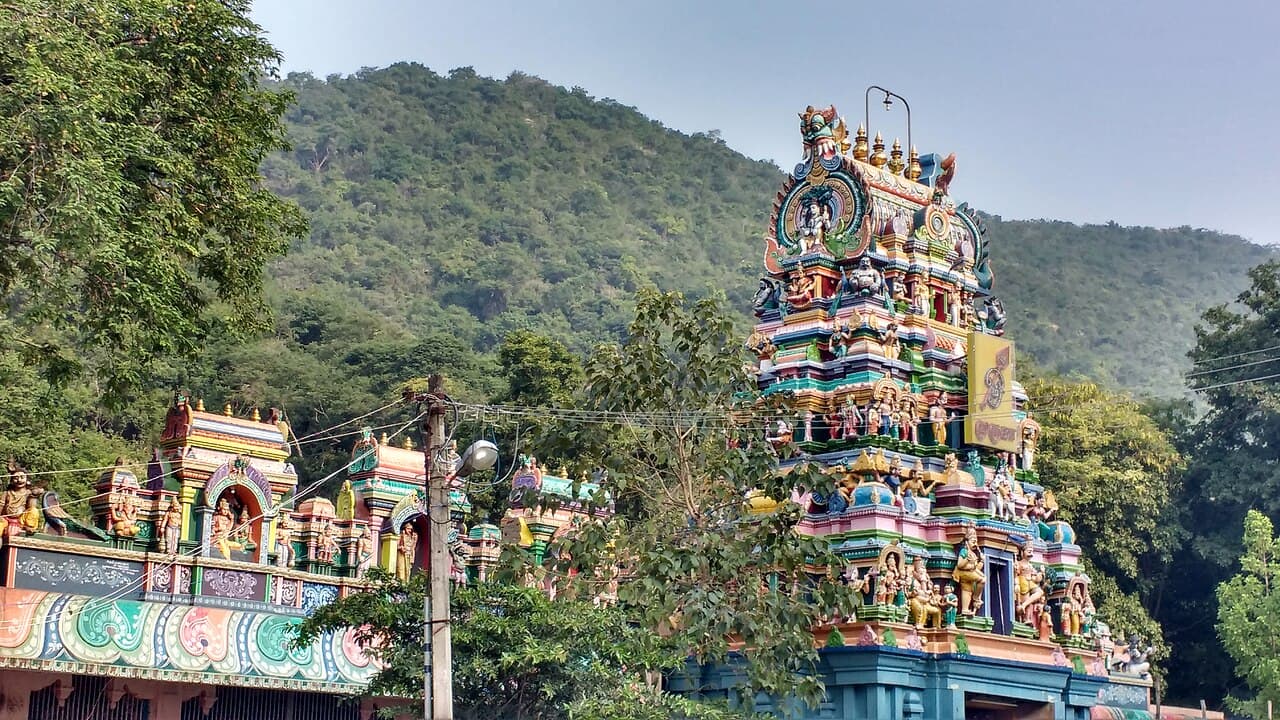
- Atop Sivagiri hill, above Palani town in the foothills of the Palani Hills
- Best Time to Visit
- October to March; Thaipusam (January–February) is the greatest festival
- The third of the six Arupadai Veedu — for many devotees the foremost
- Murugan as Dhandayuthapani: a renunciate with shorn head, loincloth and staff (danda)
- Named from 'pazham nee' — 'you are the fruit' — after the gyana-pazham contest
- Idumban bore Sivagiri and Sakthigiri here slung on a pole — the origin of the kavadi
- Tradition holds the murti was made by the siddha Bogar from navapashanam, nine herbs
- Palani panchamirtham: the first temple prasadam in India to win a GI tag (2019)
- Reached by a rock-cut stairway, three winch (funicular) tracks and a rope car
Significance
The form worshipped here comes from the tenderest of the Murugan stories. Narada brought the gyana-pazham, the fruit of wisdom, to Kailasa, and Shiva — told it could not be divided — offered it to whichever son first circled the world three times. Murugan set off on his peacock; Ganesha, reasoning that his parents were the world entire, walked round them and won. Stung that his labour was wasted, he left Kailasa, put off his ornaments and came to this hill as a hermit. The words spoken to console him — pazham nee, 'you are the fruit' — are held to have named the place: Pazhani, which became Palani.
A second legend explains why pilgrims come bent under a burden. Sage Agastya charged the asura Idumban with carrying two hills, Sivagiri and Sakthigiri, to the south; Idumban slung them at either end of a pole and set them down at Palani to rest. When he tried to lift them again they would not move, and a boy stood upon the hill barring him. They fought, Idumban was overcome and then pardoned, and the burden he bore became the kavadi — his shrine stands part-way up, saluted before the summit.
Vows are the substance of worship here — tonsuring the head in imitation of the shorn Lord, the barefoot walk from distant towns, the kavadi borne at Thaipusam, the pots of theertha carried up for abhishekam. What comes down is prized in turn: sandal paste left overnight on the image and given out as rakkala chandanam, and the panchamirtham of banana, ghee, honey, jaggery and cardamom with dates and sugar candy, made without water or preservative — in 2019 the first temple prasadam in India granted a Geographical Indication.
History
The hill temple of Palani crowns Sivagiri, the higher of two hills rising from the plain in Dindigul district, where the Palani Hills fall towards the Kongu plains. Murugan is worshipped here as Dhandayuthapani, 'he who bears the danda' — the staff — and the shrine is counted the third of the Arupadai Veedu, the six abodes of the god. At the foot of the hill stands the older shrine of Thiruavinankudi, named in Nakkirar's Sangam poem, the Tirumurugatruppadai.
Tradition ascribes the image in the sanctum to Bogar, one of the eighteen siddhas, said to have made and consecrated it from navapashanam, an amalgam of nine herbs held to be a lasting medicine. Worship on the hill is said to have lapsed and the image to have been lost to the forest until a Chera king, benighted after a hunt, was told in a dream to restore it; the Cheras ruled this region between about the second and fifth centuries.
Cholas of the tenth century and Pandyas of the thirteenth left grants and old Tamil inscriptions on its walls; Vijayanagara and the Madurai Nayaks carried the patronage on, and in the fifteenth century Arunagirinathar sang his Thiruppugazh here. The temple is run by Tamil Nadu's Hindu Religious and Charitable Endowments Department and draws upwards of seven million pilgrims a year.
Architecture
The sanctum is early Dravidian work, its covered ambulatory showing Pandyan hands; a golden vimanam rises over it, and the image may be approached only by the hereditary Gurukkal priests of Palani. The first precinct holds shrines to Shiva, Parvati and Bogar; the second, a Ganapati shrine and the chariot houses, among them the golden car brought out in the evening.
The ascent is part of the pilgrimage. A stairway is cut into the rock — commonly counted at 693 steps — beside the broad yanai-padhai, the elephant path. Three winch tracks, funicular railways worked by cable, run up the hillside, with a rope car beside them, so the old and the infirm reach the summit in minutes while others still climb.
Festivals
Timings
Open daily ~6:00 AM – 8:00 PM (from ~4:30 AM on festival days), through six kala poojas from the Vila pooja at 6:30 AM to the Rakkala pooja at 8:00 PM. The winch runs from 6:00 AM (4:00 AM on festival days); the rope car ~7:00 AM – 12:30 PM and 1:30 – 5:00 PM, both closing after the night pooja. Confirm current timings with the temple.
Palani lies in Dindigul district, about a hundred kilometres south-east of Coimbatore and some hundred and twenty north-west of Madurai, with Dindigul sixty kilometres east and Kodaikanal a similar distance away. Coimbatore is the nearest airport, Madurai a little further; Palani has its own station on the broad-gauge line between Coimbatore and Rameswaram, and buses run in from across Tamil Nadu.
Timings are indicative — please confirm with the temple trust before travelling.
Nearby Temples


Frequently Asked Questions
Where is Dhandayuthapani, Palani Temple located?+
Dhandayuthapani, Palani Temple is in Palani, Dindigul district, Tamil Nadu, India.
Which deity is worshipped at Dhandayuthapani, Palani Temple?+
Dhandayuthapani, Palani Temple is dedicated to Murugan (Dhandayuthapani).
Which tradition does Dhandayuthapani, Palani belong to?+
Dhandayuthapani, Palani is one of the Murugan temples dedicated to Murugan (Kartikeya).
What are the timings of Dhandayuthapani, Palani Temple?+
Open daily ~6:00 AM – 8:00 PM (from ~4:30 AM on festival days), through six kala poojas from the Vila pooja at 6:30 AM to the Rakkala pooja at 8:00 PM. The winch runs from 6:00 AM (4:00 AM on festival days); the rope car ~7:00 AM – 12:30 PM and 1:30 – 5:00 PM, both closing after the night pooja. Confirm current timings with the temple.
What is the best time to visit Dhandayuthapani, Palani Temple?+
October to March; Thaipusam (January–February) is the greatest festival
When was Dhandayuthapani, Palani Temple established?+
Dhandayuthapani, Palani Temple — Ancient; hill shrine traditionally restored by a Chera ruler (c. 2nd–5th c. CE); expanded by Cholas, Pandyas and Vijayanagara.
Sources & further reading
Photo: Spsarvana · CC BY-SA 4.0