

Meenakshi the fish-eyed goddess — a Pandya princess crowned queen of Madurai, who met Shiva in battle and married him; among the greatest Devi temples of Bharat.
- Deity
- Devi Meenakshi (with Shiva as Sundareswarar)
- Location
- Madurai, Tamil Nadu
- Category
- Devi
- Established
- Oldest masonry under Sadayavarman Kulasekaran I (1190–1216); rebuilt from 1378 and expanded by the Madurai Nayaks, 16th–17th c.
- Setting
- In the heart of Madurai, on the southern bank of the Vaigai
- Best Time to Visit
- October to March; and the Chithirai festival (April–May)
- One of the greatest Devi temples of Bharat — Meenakshi, the 'fish-eyed' goddess
- Parvati born as Tadaatagai, the Pandya princess who ruled Madurai as warrior queen
- The goddess comes first — her shrine is visited before Sundareswarar's
- Meenakshi Thirukalyanam, the celestial wedding, is the heart of the Chithirai festival
- 14 gopurams; the southern tower is tallest at ~170 ft (52 m), late 16th century
- Ayirakkal mandapam: 985 carved pillars, an art museum, and the musical pillars beside it
- Porthamarai Kulam, the Golden Lotus tank, where the Sangam academy judged Tamil verse
- Destroyed in Malik Kafur's raid of 1311; rebuilt from 1378 and by the Madurai Nayaks
Significance
The Thiruvilaiyadal Puranam tells how King Malayadhwaja Pandya and Queen Kanchanamalai performed a sacrifice for a son and received instead a girl who stepped from the fire with three breasts; a voice bade them raise her, promising the third would vanish when she met her husband. Crowned as her father's successor, Tadaatagai ruled Madurai and led her armies across the directions until, at Kailasa, she stood before Shiva. The third breast vanished, and she knew herself for Meenakshi, Parvati herself. He followed her home as Sundareswarar, and their wedding, with Vishnu her brother giving her away, is the event this temple exists to remember.
Here the Goddess is sovereign, not consort: pilgrims enter her shrine before his. As the scholar William Harman observed, for most devotees of Madurai's divine couple she matters more than Shiva; she is addressed as amman, Mother, he more formally as nayakan, Lord. She was born in this city; he came from elsewhere to rule beside her. A Tamil saying names the three great goddesses in one breath — Kanchi Kamakshi, Madurai Meenakshi, Kashi Visalakshi.
Every Chithirai the marriage is performed again: fifteen days that carry Meenakshi through coronation and conquest to the Thirukalyanam and the great temple car, after which Kallazhagar rides down from the Alagar hills into the Vaigai — a dawn that drew some ten lakh people in 2026. Each night, more quietly, Sundareswarar is carried to her bed-chamber for the Palliarai pooja.
History
Madurai is among the oldest living cities of Bharat — capital of the Pandyas and seat of the Tamil Sangam, described in Sangam-era texts. The temple stands at its heart, on the southern bank of the Vaigai, the old city laid out in concentric streets radiating from its walls. A shrine stood here by the mid-sixth century, and the Nayanars sang of it in the Tevaram — making this a Paadal Petra Sthalam, one of the 276 temples of the Tamil Shaiva canon.
Under the Pandyas, Meenakshi is described as the divine ruler of Madurai. The oldest masonry still standing — the core of her shrine, and the gopuram before Sundareswarar's — belongs to Sadayavarman Kulasekaran I (1190–1216); his successors kept adding gopurams and corridors through the thirteenth century.
In 1311 Malik Kafur's raid destroyed the temple and carried its gold to Delhi, and the shrine lay closed some sixty years. Vijayanagara took Madurai in 1378, and Kumara Kampana — urged, the Madhura Vijayam says, by his queen Gangadevi — reopened and rebuilt it, restoring the images hidden away. Nearly all that stands today is later: Vishwanatha Nayak (1529–1564) fortified the complex and gilded the vimana above Meenakshi's shrine, his minister Ariyanatha Mudaliar raised the thousand-pillared hall, the great southern tower went up late in the sixteenth century, and Tirumalai Nayak (1623–1655) added the Vasantha mandapa beyond the eastern gate.
Architecture
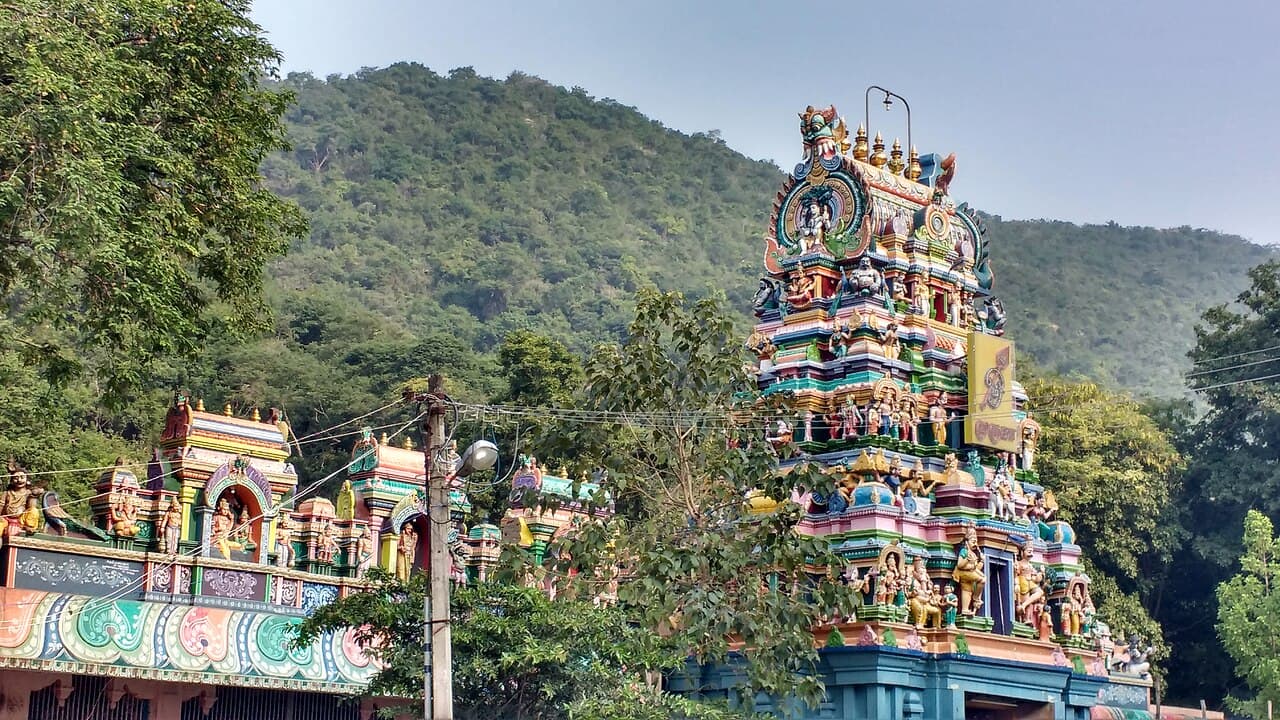
The complex covers some fourteen acres, its twin shrines set within concentric walled prakaras, and fourteen gopurams rise over its gateways — four of nine storeys, one of seven, five of five and two of three, besides two gold-gilded towers over the sanctums. The southern gopuram, raised late in the sixteenth century, is the tallest at about a hundred and seventy feet, some fifty-two metres; the stucco figures on the four outer towers carry close to four thousand stories, and the western gopuram is the model for Tamil Nadu's state emblem.
Before Meenakshi's shrine lies the Porthamarai Kulam, the Golden Lotus tank — roughly fifty metres by thirty-seven, a gilded lotus at its centre — on whose water, tradition holds, the Sangam academy floated Tamil works: the unworthy sank. North-east stands the Ayirakkal mandapam, the thousand-pillared hall, which in fact carries 985 carved pillars, ranks of yali beasts, Ariyanatha Mudaliar on horseback at its door and an art museum within; just west of it are the musical pillars, which sound notes when struck.
Festivals
Timings
Open daily, commonly from about 5:00 AM to 12:30 PM and 4:00 PM to 10:00 PM, with six pujas through the day — from the dawn Thiruvanandal to the Palliarai pooja at night, when Sundareswarar is carried to Meenakshi's chamber. Confirm current timings locally.
The temple stands in the heart of Madurai, on the southern bank of the Vaigai, ringed by the market streets that grew around it. Madurai Airport is about twelve kilometres south, and Madurai Junction barely two kilometres away — an autorickshaw ride, or a walk. Thirupparankundram lies some eight kilometres south-west and Pazhamudircholai about twenty kilometres north, in the Alagar hills.
Timings are indicative — please confirm with the temple trust before travelling.
Videos
Nearby Temples


Frequently Asked Questions
Where is Meenakshi, Madurai Temple located?+
Meenakshi, Madurai Temple is in Madurai, Tamil Nadu, India.
Which deity is worshipped at Meenakshi, Madurai Temple?+
Meenakshi, Madurai Temple is dedicated to Devi Meenakshi (with Shiva as Sundareswarar).
Which tradition does Meenakshi, Madurai belong to?+
Meenakshi, Madurai is one of the Devi temples dedicated to Devi (Adi Shakti).
What are the timings of Meenakshi, Madurai Temple?+
Open daily, commonly from about 5:00 AM to 12:30 PM and 4:00 PM to 10:00 PM, with six pujas through the day — from the dawn Thiruvanandal to the Palliarai pooja at night, when Sundareswarar is carried to Meenakshi's chamber. Confirm current timings locally.
What is the best time to visit Meenakshi, Madurai Temple?+
October to March; and the Chithirai festival (April–May)
When was Meenakshi, Madurai Temple established?+
Meenakshi, Madurai Temple — Oldest masonry under Sadayavarman Kulasekaran I (1190–1216); rebuilt from 1378 and expanded by the Madurai Nayaks, 16th–17th c..
Sources & further reading
Photo: Vyacheslav Argenberg · CC BY 4.0