
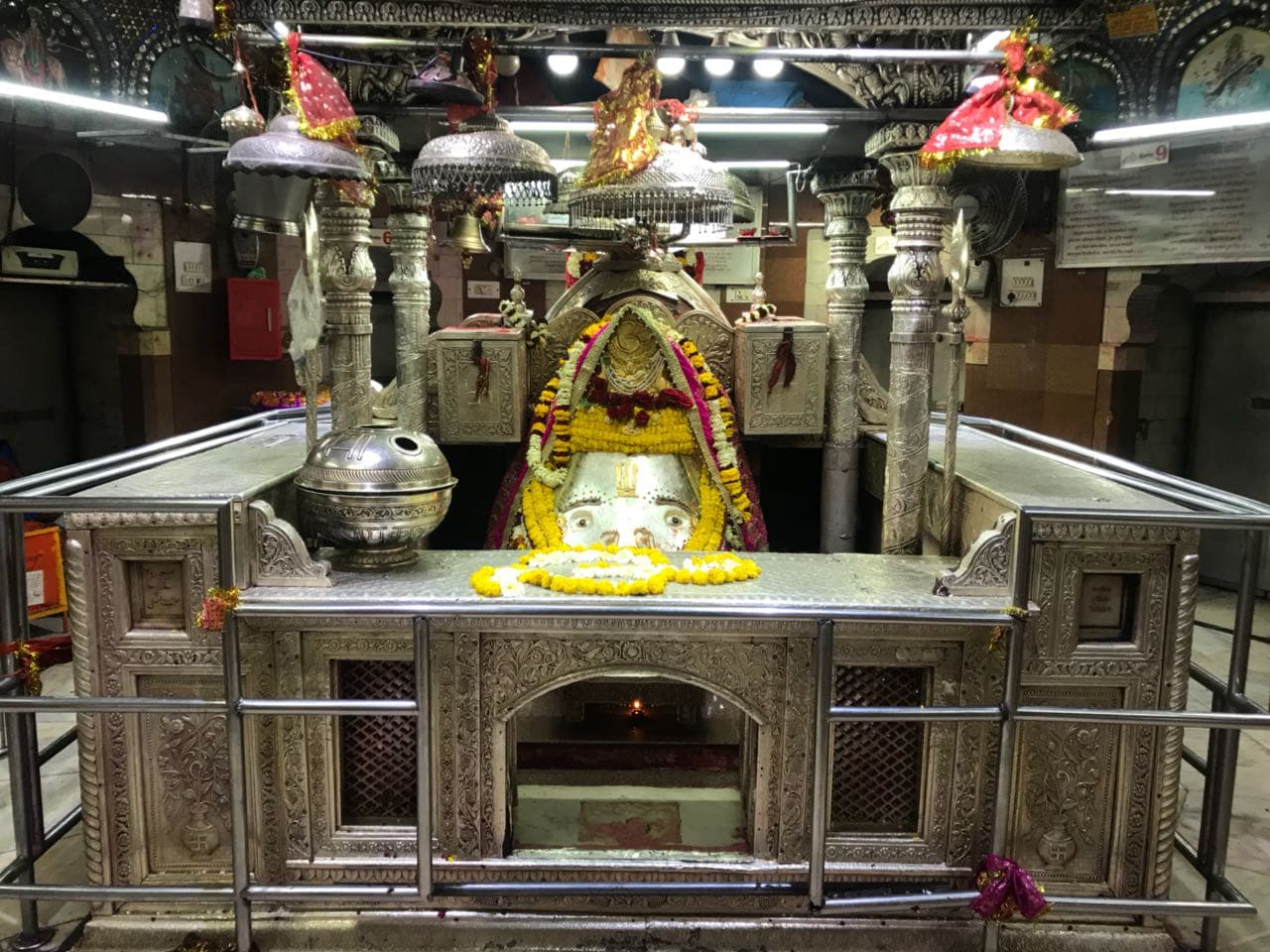
Kalika of the Aravalli ridge — the self-manifested pindi on Suryakuta hill, where Delhi has carried its manokamna, its heart's wish, through every age of the city.
- Deity
- Devi Kalka (Kalika) — Suryakuta-nivasini
- Location
- Kalkaji, New Delhi, Delhi
- Category
- Devi
- Established
- Tradition places the shrine in Satya-yuga; the oldest parts of the present structure are commonly dated not earlier than 1764 CE (Marathas), with additions in 1816 by Mirza Raja Kidar Nath, and the central shrine rebuilt in the mid-19th century
- Setting
- On Suryakuta hill, a rise of the Aravalli range in south Delhi, opposite Nehru Place and a short walk from the Lotus Temple
- Best Time to Visit
- October to March; both Navratris — Chaitra in spring and Ashwin in autumn — bring the melas and the largest crowds
- Devi Kalka on Suryakuta hill, a rise of the Aravalli in south Delhi — the locality took its name from her
- The image is self-manifested, not carved: the svayambhu pindi on a silver-clad altar under a silver chhatra
- Government of Delhi's account: the shrine dates to Satya-yuga, when Kalika killed the asura Raktabija and his host
- The katha: Kaushiki rose from Parvati, and Kalika from Kaushiki's brow, to drink the blood that raised new asuras
- Her verse names her Suryakot-nivasini — she who dwells on Suryakuta
- By the temple's tradition Shri Krishna worshipped her here with the Pandavas at the founding of Indraprastha
- Oldest parts of the present structure commonly dated not earlier than 1764 (Marathas); additions 1816 by Mirza Raja Kidar Nath
- The central shrine was rebuilt in the mid-19th century; the earliest dharamshala plaque is a Farsi inscription of 1845
- The committee calls this seat the siddha peetha of Jayanti Kali — a local standing, not a canonical Shakti Peetha
- Both Navratris bring a very great mela to the ridge, and jagran is counted among the shrine's own ways of sadhana
Significance
Delhi calls her Kalka Maharani. The temple's committee names this seat the siddha peetha of Jayanti Kali — a standing locally held, not a place in the canonical reckoning of the Shakti Peethas — and what the city means by it is simpler than any list: here the manokamna is accomplished. Thousands come daily with flowers, coconut and chunni, and the committee sets down that there is no caste at this door.
Navratri is the great season, and it comes twice: Chaitra in spring, Ashwin in autumn, nine days each, when a very great mela takes the ridge and the approach becomes one lane of stalls. Jagran belongs to the shrine's own account of itself: the all-night singing is named with smaran, dhyan, upasana and kirtan among the ways the Mother has been kept through the yugas.
History
Kalkaji stands on Suryakuta, a rise of the Aravalli in south Delhi; the locality takes its name from the temple, not the other way about. The katha the shrine tells begins with the devas here harried by two asuras. Brahma sent them to Parvati; from Parvati came Kaushiki, who struck the two down — but every drop of blood that touched the earth raised another host. Then from Kaushiki's brow rose Kalika, who drank the blood as it fell and made an end of them. After the victory the Devi stayed where she had fought. The Government of Delhi's own account sets the shrine in Satya-yuga, when Kalika came down and killed the asura Raktabija and his host.
The image is not carved. Delhi's district administration puts it plainly: the form of the Goddess Kalka here is a self-manifested one. The temple's committee remembers that the Mother appeared at this place, and that the svayambhu pindi has been seated in her house ever since; her own verse calls her Suryakot-nivasini, she who dwells on Suryakuta. By the temple's tradition, at the founding of Indraprastha Shri Krishna worshipped her on that hill with the Pandavas beside him — tradition, the shrine's own, not dated history.
Of the building, less is certain. The account most often repeated gives the oldest parts of the present structure to the eighteenth century — not earlier than 1764, raised by the Marathas — with additions in 1816 by Mirza Raja Kidar Nath, Peshkar of Akbar II. The published study of the site is more cautious: the central shrine was rebuilt in the mid-nineteenth century and ringed with dharamshalas that wealthy devotees gave the pujaris to house pilgrims at the two annual fairs; the earliest legible plaque among them is a Farsi inscription of 1845. The shrine has been reclad twice in living memory as jirnoddhar, sacred renewal — in the 1980s, and again lately in white Kishangarh marble.
Architecture
The masonry is brick, finished in plaster and marble under a pyramidal tower. The central chamber is twelve-sided and about twenty-four feet across, a doorway in each side — twelve for the twelve rashis, as the committee reckons them — with thirty-six more in the outer circuit and the main door facing east; the pindi sits on a silver-clad altar beneath a silver chhatra.
Around it the complex is a palimpsest. A small Shivalaya clings to the right of the main entrance on the outer parikrama: they meant to move it while the Mother's house was building, dug for the base of the lingam and found no end to it, and were told in a dream to raise Shiva's shrine where it stood. Ganesha stands to the north, Bhairav and Hanuman a little beyond, and two stone lions carrying eighty-four bells before the gate; the dharamshalas keep their lakhori brick and donor plaques in Hindi, Farsi, Sanskrit and Urdu.
Festivals
Timings
Open daily. The temple's own committee gives the day as: doors open 4:00 AM; Ganesh Vandana 5:00 AM; shringar 5:30–6:30 AM (closed); morning aarti 6:30–7:00 AM; bhog at 12 noon (closed 11:45 AM–12:15 PM); closed 3:00–4:00 PM for cleaning; evening Ganesh Vandana 7:00 PM; shringar 7:30–8:30 PM (closed); evening aarti 8:30–9:00 PM; sajja at 11:30 PM, after which the doors close until 4:00 AM. The committee notes the hours shift a little with the muhurat. Day-to-day management rests with an Administrator appointed by the Delhi High Court, and jagrans and religious programmes in the precinct are held with the Administrator's permission.
The Delhi Metro comes closest: Kalkaji Mandir station — the elevated Violet Line meeting the underground Magenta across a long footbridge — is a few minutes' walk from the gate. The district administration gives the address as Ma Anandmayee Marg, Block 9, Kalkaji; Nehru Place bus terminus is beside it, Okhla the nearest railway station, Hazrat Nizamuddin about four kilometres north, and Indira Gandhi International the airport. The Lotus Temple stands less than half a kilometre away.
Timings are indicative — please confirm with the temple trust before travelling.
Nearby Temples


Frequently Asked Questions
Where is Kalkaji Mandir Temple located?+
Kalkaji Mandir Temple is in Kalkaji, New Delhi, Delhi, India.
Which deity is worshipped at Kalkaji Mandir Temple?+
Kalkaji Mandir Temple is dedicated to Devi Kalka (Kalika) — Suryakuta-nivasini.
Which tradition does Kalkaji Mandir belong to?+
Kalkaji Mandir is one of the Devi temples dedicated to Devi (Adi Shakti).
What are the timings of Kalkaji Mandir Temple?+
Open daily. The temple's own committee gives the day as: doors open 4:00 AM; Ganesh Vandana 5:00 AM; shringar 5:30–6:30 AM (closed); morning aarti 6:30–7:00 AM; bhog at 12 noon (closed 11:45 AM–12:15 PM); closed 3:00–4:00 PM for cleaning; evening Ganesh Vandana 7:00 PM; shringar 7:30–8:30 PM (closed); evening aarti 8:30–9:00 PM; sajja at 11:30 PM, after which the doors close until 4:00 AM. The committee notes the hours shift a little with the muhurat. Day-to-day management rests with an Administrator appointed by the Delhi High Court, and jagrans and religious programmes in the precinct are held with the Administrator's permission.
What is the best time to visit Kalkaji Mandir Temple?+
October to March; both Navratris — Chaitra in spring and Ashwin in autumn — bring the melas and the largest crowds
When was Kalkaji Mandir Temple established?+
Kalkaji Mandir Temple — Tradition places the shrine in Satya-yuga; the oldest parts of the present structure are commonly dated not earlier than 1764 CE (Marathas), with additions in 1816 by Mirza Raja Kidar Nath, and the central shrine rebuilt in the mid-19th century.
Sources & further reading
- Kalka Mandir, Delhi — District South East, Government of NCT of Delhi
- Shri Kalkaji Mandir Prabandhak Sudhar Committee (the temple's own committee)
- Deborah Sutton, Sacred architectures as monuments: a study of the Kalkaji Mandir, Delhi — arq: Architectural Research Quarterly, Cambridge University Press (open access)
Photo: Shrikalkajimandir · CC BY-SA 4.0