

Mahamaya of Ratanpur — Kosaleshwari, the goddess of old Kosala — worshipped as the twin presence of Lakshmi and Saraswati in the Kalachuri capital, and the first great Devi shrine of Chhattisgarh.
- Deity
- Devi Mahamaya (Kosaleshwari)
- Location
- Ratanpur, Bilaspur, Chhattisgarh
- Category
- Devi
- Established
- Founding traditionally ascribed to the Kalachuri Raja Ratnadeva I (c. 1050 CE); the standing temple dated by other accounts to the 12th–13th century, with a later structure of Raja Bahar Sai (Vikram Samvat 1552) and a Maratha-period courtyard
- Setting
- In Ratanpur, the old Kalachuri capital of Dakshina Kosala, north of Bilaspur
- Best Time to Visit
- October to March; and the Chaitra and Sharad Navratras
- Kosaleshwari — the presiding goddess of old Dakshin Kosal, today's Chhattisgarh
- Twin presence: Mahalakshmi below, Mahasaraswati above and to her right, in one sanctum
- Founding ascribed to Raja Ratnadeva I of the Kalachuris, who founded Ratanpur itself
- Local tradition: Sati's right shoulder fell here — the seat is called Kaumari
- The shrine's own name for itself is Siddh Shaktipeeth; its trust dates from 1982
- Custom sends pilgrims to Bhairav Baba's shrine before the Mother's darshan
- Tens of thousands of manokamna jyoti kalash burn through each Navratra
- Nagara-style, north-facing shrine on sixteen stone pillars beside a great tank
Significance
Mahamaya is Kosaleshwari, sovereign of Dakshin Kosal — the old name of this land — and the presiding goddess of Ratanpur's kings. To Chhattisgarh she is Adi Shakti herself, and hers is the shrine at which the state's Devi worship begins.
Her twin presence is what devotees come for. In the sanctum Mahalakshmi is seated below and Mahasaraswati above and to her right, so that wealth and wisdom are given in a single darshan; Mahakali, honoured with them in the older temple, keeps her own place among the lesser shrines of the complex. It is a rare arrangement — one seat, two visible forms, and a third remembered.
Ratanpur is honoured across Chhattisgarh as a Shakti Peetha. Local tradition holds that Sati's right shoulder fell here and names the seat Kaumari, and the Bhairava who guards it is worshipped a short way down the road, so that custom sends the pilgrim to Bhairav Baba first and counts the darshan incomplete without him. The pan-Indian lists of the fifty-one or the fifty-two seats are told differently in different books, and Ratanpur's place in them varies with the telling; what is not in question is the standing the shrine holds in its own land, where its name for itself is Siddh Shaktipeeth.
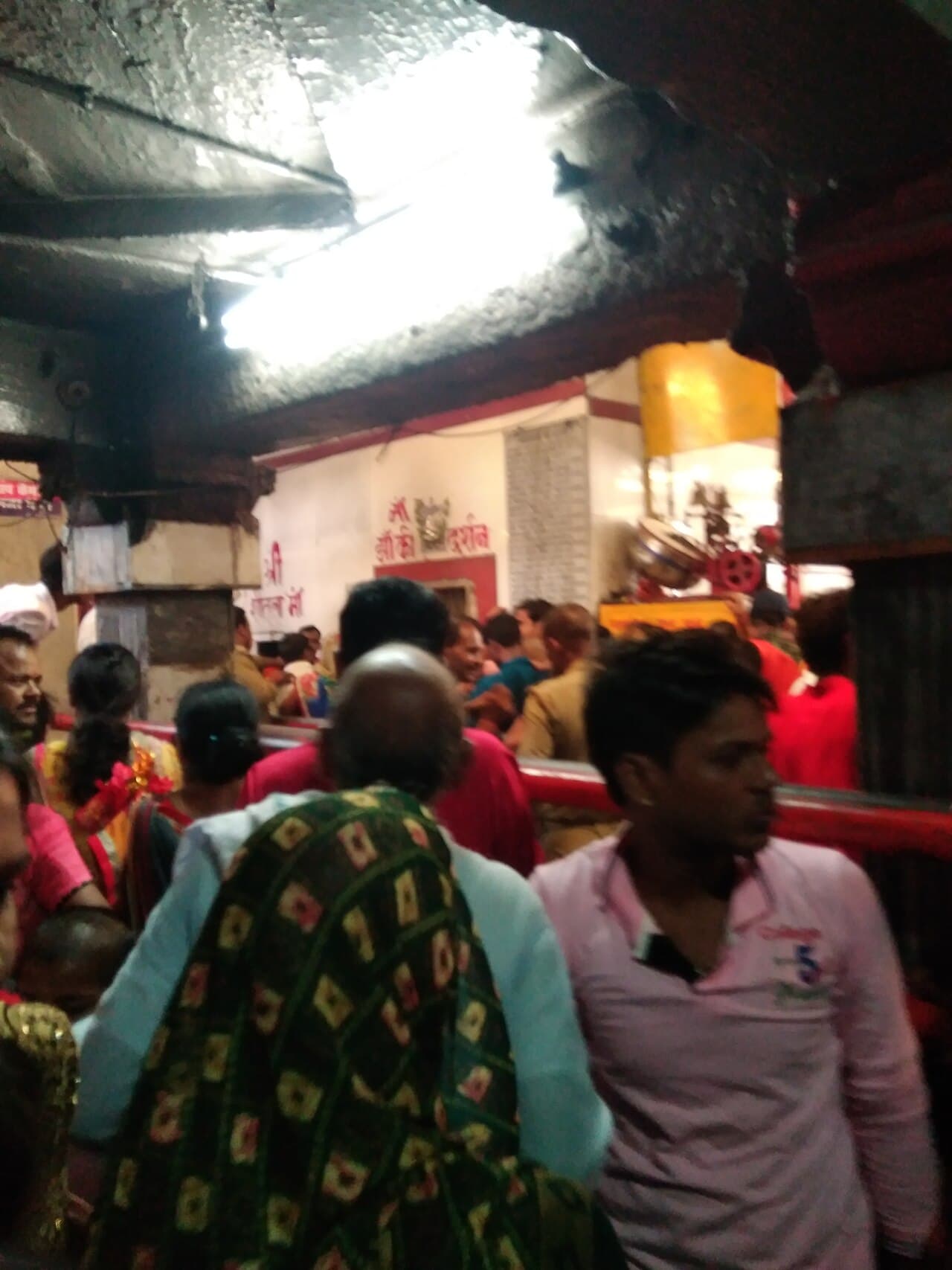
Twice a year, in Chaitra and again in Sharad, the town fills. Devotees offer the akhand manokamna jyoti kalash — the unbroken lamp of a wish — and tens of thousands burn together through the nine nights while darshan runs on towards midnight.
History
Ratanpur — Ratnapura, the city of jewels — was the seat of the Kalachuris of Dakshina Kosala for the better part of seven centuries. Kalingaraja, of a branch of the Kalachuris of Tripuri, won this region about the turn of the eleventh century; it was his grandson Ratnadeva I who founded Ratnapura and gave it his name, and from here his line held Chhattisgarh until the Marathas came in 1758. The town calls itself Chaturyugi Nagri, the city that has stood through all four ages.
The goddess, in the telling, is older than the dynasty. Tradition holds that Ratnadeva, halting here on a hunt, saw a light in the forest and the Devi at the heart of it, and raised her temple where he had seen her; the district administration dates that first shrine to about 1050 CE. Art-historical accounts read the standing temple later, in the twelfth and thirteenth centuries of Kalachuri rule. Both datings stand in the record together, and the honest reading is of an eleventh-century seat whose fabric is largely of the centuries after.
The old temple is remembered as holding all three great forms of the Devi; a further structure for Mahalakshmi and Mahasaraswati was raised by Raja Bahar Sai in Vikram Samvat 1552, given variously as 1492 and 1495 CE. The walled courtyard about the sanctum is of the Maratha period, late in the eighteenth century. The Archaeological Survey has since conserved the complex, and the shrine has been administered since 1982 by the Siddh Shaktipeeth Shri Mahamaya Devi Mandir Trust.
Architecture
The temple is built in the Nagara manner, facing north beside a great tank, its sanctum and mandapa carried on sixteen stone pillars and its shikhara rising in close-worked tiers above a courtyard now paved in marble. The enclosing wall and courtyard came with the Marathas, and around the sanctum stand lesser shrines to Mahakali, Bhadrakali, Surya, Vishnu, Hanuman, Bhairav and Shiva; the approach is through a carved gateway crowned by the seven horses of the sun's chariot.
Ratanpur keeps more than one monument. Near the temple stands the Kanthi Deval, an old stone shrine protected by the Archaeological Survey and ascribed by tradition to an ascetic named Santosh Giri in 1039, and the ruined Kalachuri fort lies close by.
Festivals
Timings
Open daily from about 6:00 AM to 8:30 PM, with a short break around midday; through the Chaitra and Sharad Navratras darshan runs on until midnight. Confirm current timings with the temple trust.
Ratanpur lies about twenty-five kilometres north of Bilaspur on the highway towards Ambikapur (NH-130), with buses through the day, roughly one an hour. The nearest railhead is Bilaspur Junction, some twenty-five to thirty kilometres away; Bilasa Devi Kevat Airport at Chakarbhata, about thirty-seven kilometres off, carries a few scheduled flights, and Raipur's Swami Vivekananda airport, around a hundred and sixty kilometres south, is the usual gateway.
Timings are indicative — please confirm with the temple trust before travelling.
Nearby Temples
Frequently Asked Questions
Where is Mahamaya Devi, Ratanpur Temple located?+
Mahamaya Devi, Ratanpur Temple is in Ratanpur, Bilaspur, Chhattisgarh, India.
Which deity is worshipped at Mahamaya Devi, Ratanpur Temple?+
Mahamaya Devi, Ratanpur Temple is dedicated to Devi Mahamaya (Kosaleshwari).
Which tradition does Mahamaya Devi, Ratanpur belong to?+
Mahamaya Devi, Ratanpur is one of the Devi temples dedicated to Devi (Adi Shakti).
What are the timings of Mahamaya Devi, Ratanpur Temple?+
Open daily from about 6:00 AM to 8:30 PM, with a short break around midday; through the Chaitra and Sharad Navratras darshan runs on until midnight. Confirm current timings with the temple trust.
What is the best time to visit Mahamaya Devi, Ratanpur Temple?+
October to March; and the Chaitra and Sharad Navratras
When was Mahamaya Devi, Ratanpur Temple established?+
Mahamaya Devi, Ratanpur Temple — Founding traditionally ascribed to the Kalachuri Raja Ratnadeva I (c. 1050 CE); the standing temple dated by other accounts to the 12th–13th century, with a later structure of Raja Bahar Sai (Vikram Samvat 1552) and a Maratha-period courtyard.
Sources & further reading
Photo: Ms Sarah Welch · CC0 1.0