

Ma Tara of Birbhum — the Siddhapeeth on the Dwarka where the Mother is worshipped in stone as she gives her breast to Shiva, and where the sadhak Bamakhepa kept his vigil.
- Deity
- Devi Tara (Ma Tara)
- Location
- Tarapith, Birbhum, West Bengal
- Category
- Devi
- Established
- Present brick temple of the early 19th century — local accounts credit Jagannath Ray of Mallarpur, Bengali year 1225 (1818 CE); worship at the site is far older
- Setting
- On the Dwarka (Babla) river in Birbhum, with the mahashmashan below the town
- Best Time to Visit
- October to February; Kaushiki Amavasya (the new moon of Bhadra) and Kali Puja bring the largest gatherings
- Ma Tara — Tara, second of the ten Mahavidyas — on the Dwarka river in Birbhum
- Called a Siddhapeeth in every account; local tradition places Sati's nayan tara (third eye) here
- The primordial stone image shows Tara suckling Shiva; a metal image of her fierce form stands before it
- Legend: Shiva drank the halahala poison, and the Mother gave him her breast to draw the burning away
- Sadhak Bamakhepa (1837–1911) kept his sadhana here; his samadhi is in the temple courtyard
- The mahashmashan on the river is counted part of the pith, not something beside it
- Pilgrims bathe at the Jivit Kunda tank before darshan
- The bhog carries rice with mutton and shol fish — an offering few temples in India make
- Kaushiki Amavasya, the new moon of Bhadra, is the great gathering; worship continues even through Ambubachi
Significance
The heart of this shrine is that stone. Two images stand in the sanctum: the primordial shila of Tara suckling Shiva, and before it a metal image about a metre high of her fierce aspect, four-armed, silver-crowned, wrapped in a sari and heaped with marigolds. It is the fierce form the pilgrim sees; it is the mother in stone behind it that the temple was built for, and the worship here is offered to draw that motherly aspect forward.
No one is more bound to this place than Bamakhepa. Born Bamacharan Chattopadhyay at Atla village nearby in 1837, a year after Sri Ramakrishna, he left home young for Kailashpati Baba's guidance and the cremation ground, and took his seat at the panchamundi asana beneath the white shimul tree; on a Kaushiki Amavasya night, tradition says, the Mother gave him her darshan there and took him to her breast. He kept none of the temple's rules, and when he was struck for eating the bhog before it was offered, she is said to have told the Maharani of Natore in a dream to feed him first, for he was her son. He passed in 1911; his samadhi stands in the temple courtyard, on the ground where he was cremated.
The mahashmashan lies below the town at the river's edge — a working cremation ground where Birbhum gives its dead to the fire, and held to be the Mother's own dwelling; Bengal counts it part of the pith, not something beside it, and sadhaks have kept their vigils there for generations. The temple's day is steady: pilgrims bathe first at the Jivit Kunda, mangal aarti before dawn, bhog at midday and aarti again in the evening, with the Shakta bali kept as it always has been. The great day is Kaushiki Amavasya, the new moon of Bhadra, when lakhs come by night to the Mother.
History
Tarapith stands on the bank of the Dwarka, six kilometres from Rampurhat in Birbhum. The goddess here is Tara, second of the ten Mahavidyas, and Bengal gives her no title grander than Tara Ma — not the twin Tara and Tarini of Ganjam in Odisha, but Bengal's own Tara of the Dwarka.
Bengali tradition tells the Sati katha here as elsewhere — the Mother's body borne by the grieving Shiva and parted by Vishnu's chakra — and holds that her nayan tara, the third eye, fell here and turned to stone; the village, once Chandipur, took its name from it. The classical reckoning of the fifty-one peethas, however, names four other Birbhum shrines — Attahas, Bakreshwar, Kankalitala and Nandikeshwari — and not this one. What every account says of Tarapith, Bengali and scholarly alike, is that it is a Siddhapeeth: the seat where sadhana bears fruit.
The oldest story is Vasishtha's. His austerities bore no fruit until the Buddha taught him the vamachara way and named this place as the goddess's abode. He recited her mantra three hundred thousand times, and when she appeared he asked to see her as she had been at the churning of the ocean — when Shiva drank the halahala poison to save the worlds and the Mother took him to her breast as a child to draw the burning away. She showed him that form, and it stayed as stone. The present brick temple is of the early nineteenth century, credited locally to Jagannath Ray of Mallarpur in the Bengali year 1225 (1818 CE).
Architecture
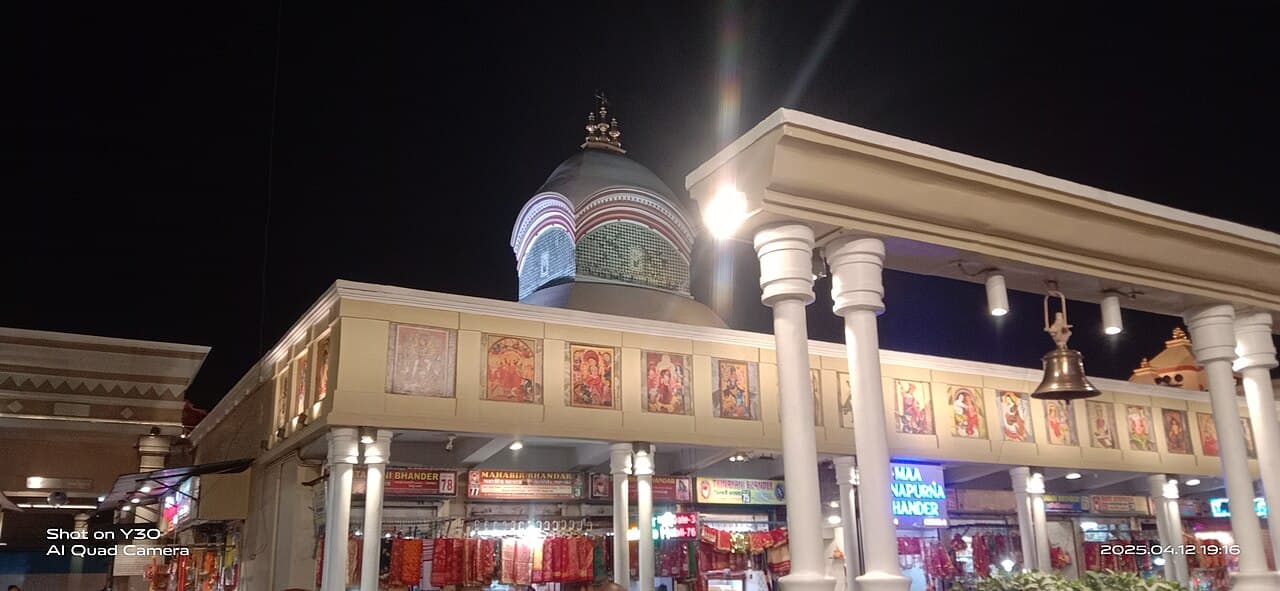
The temple is a compact shrine in the chala manner of Bengal, red brick under heavy walls, its covered passages rising through arch and tier to a spire above the sanctum, where the image stands under the eaves.
The courtyard holds the Chandrachur Shiva temple, a Bajrangbali shrine to Hanuman, a Ma Shashthi shrine and Bamakhepa's samadhi; the Jivit Kunda tank lies before the gate, and the mahashmashan beyond the houses on the river.
Festivals
Timings
Open daily from early morning until about 9:00 PM or 10:00 PM, with a midday closure while the bhog is offered; published hours differ between accounts, so confirm on the day. Amavasya nights — above all Kaushiki Amavasya — are the most crowded.
Rampurhat Junction, six kilometres away, is the railhead — 207 kilometres from Howrah by the shortest route, with autos, taxis and buses for the last stretch. The Birbhum district portal gives Kazi Nazrul Islam airport near Durgapur as the nearest, about a hundred kilometres off; buses run from Kolkata, and Bolpur with Santiniketan lies some eighty kilometres south.
Timings are indicative — please confirm with the temple trust before travelling.
Nearby Temples

Frequently Asked Questions
Where is Tarapith Temple located?+
Tarapith Temple is in Tarapith, Birbhum, West Bengal, India.
Which deity is worshipped at Tarapith Temple?+
Tarapith Temple is dedicated to Devi Tara (Ma Tara).
Which tradition does Tarapith belong to?+
Tarapith is one of the Devi temples dedicated to Devi (Adi Shakti).
What are the timings of Tarapith Temple?+
Open daily from early morning until about 9:00 PM or 10:00 PM, with a midday closure while the bhog is offered; published hours differ between accounts, so confirm on the day. Amavasya nights — above all Kaushiki Amavasya — are the most crowded.
What is the best time to visit Tarapith Temple?+
October to February; Kaushiki Amavasya (the new moon of Bhadra) and Kali Puja bring the largest gatherings
When was Tarapith Temple established?+
Tarapith Temple — Present brick temple of the early 19th century — local accounts credit Jagannath Ray of Mallarpur, Bengali year 1225 (1818 CE); worship at the site is far older.
Sources & further reading
Photo: Tarunsamanta · CC BY-SA 4.0