

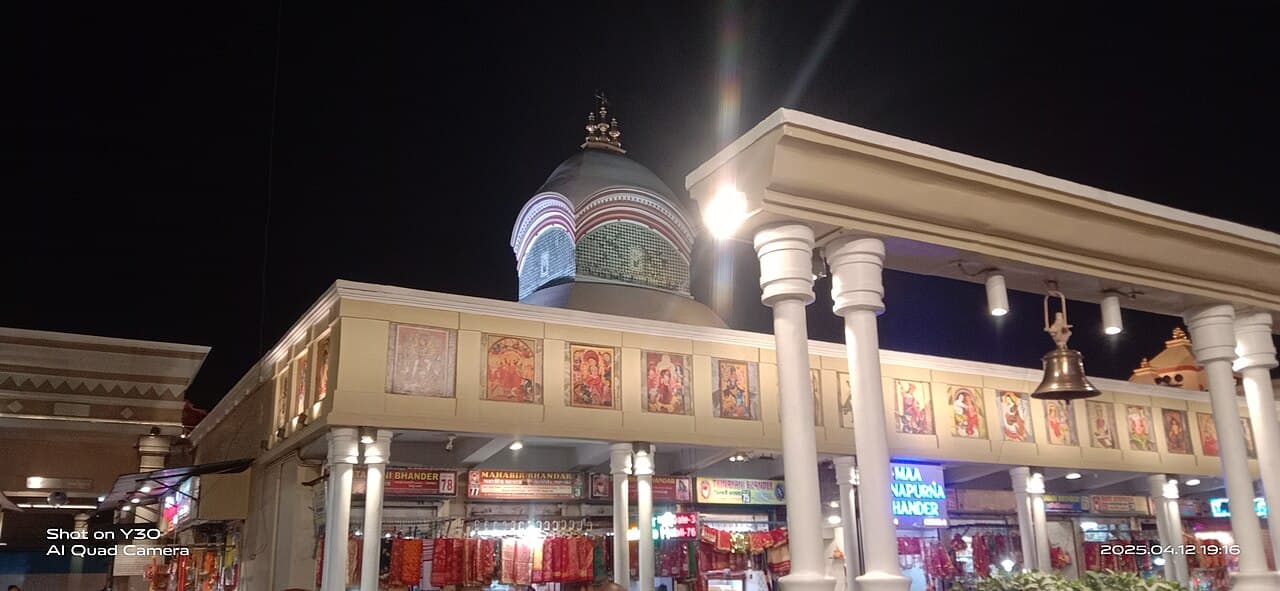
Rani Rashmoni's nine-spired temple on the Hooghly, where Ma Bhavatarini is worshipped and where Sri Ramakrishna Paramahamsa kept the Mother's service for thirty years.
- Deity
- Devi Kali (Bhavatarini)
- Location
- Dakshineswar, Kolkata, West Bengal
- Category
- Devi
- Established
- Built 1847–1855 by Rani Rashmoni; consecrated 31 May 1855, the Snana Yatra day
- Setting
- On the eastern bank of the Hooghly at Dakshineswar, north of Kolkata
- Best Time to Visit
- October to February; Dipanwita Kali Puja (Diwali) and Durga Puja
- Founded by Rani Rashmoni; the image installed on 31 May 1855, the Snana Yatra day
- The Devi is worshipped as Bhavatarini — 'she who carries her children across the ocean of existence'
- Navaratna (nine-spired) Bengal temple, ~14 m square and over 30 m high
- Twelve aat-chala Shiva temples line the Hooghly front, with a Radha-Krishna temple in the compound
- Sri Ramakrishna Paramahamsa served here some thirty years; his room, the Panchavati and the panchamundi seat are preserved
- Sri Sarada Devi lived in the nahabat, the music tower by the river
- Belur Math stands across the Hooghly — ferries cross from the temple ghat
- Three Kali Pujas a year: Ratanti (Magh), Phalaharini (Jyeshtha) and Dipanwita (Diwali)
Significance
The Mother here is Bhavatarini, she who carries her children across the ocean of worldly existence — and Bengal calls her by that name, not the temple's. Within a year of the consecration Ramkumar died, and the worship passed to his younger brother Gadadhar — Sri Ramakrishna Paramahamsa — who remained at Dakshineswar some thirty years. Priestly routine gave way in him to a longing not consoled until, before that image, he knew the Divine Mother's living presence; and under the Panchavati, the grove of five trees raised at his own hands, he took up one path after another — Tantra, Vaishnava bhakti, the Vedanta taught him by Totapuri, the ways of Islam and of Christ — and from that came his teaching that as many faiths, so many paths to God.
His room in the north-western corner of the courtyard, its semicircular verandah facing the river, is kept as he left it; here the young men who became his monastic disciples first sat with him, Narendranath among them — Swami Vivekananda. Sri Sarada Devi lived in a small ground-floor room of the nahabat, the music tower by the river, and on the night of Phalaharini Kali Puja Sri Ramakrishna worshipped her as the Divine Mother herself. Both rooms are shrines today, and the order that grew from those years keeps its headquarters at Belur Math, on the far bank in sight of Dakshineswar and reached by the ferry from the temple's ghat.
Kali Puja is kept three times in the year — Ratanti in Magh, Phalaharini in Jyeshtha, and Dipanwita on the Kartik new-moon night of Diwali, when the courtyard becomes a sea of lamps — while Snana Yatra, the tithi on which the Mother was installed, remains the temple's founding day.
History
Dakshineswar stands on the eastern bank of the Hooghly just north of Kolkata: the great nineteenth-century Kali temple of Bengal, hallowed less by antiquity than by the life lived within it.
Its founder was Rani Rashmoni of Janbazar, a Mahishya zamindar's widow who ran her estates herself and gave Calcutta some of its best-known Ganga ghats. Setting out on pilgrimage to Kashi, she was turned back — so tradition holds — by a dream in which the Mother bade her go no farther, but install her image in a temple on the Ganga's bank and arrange for worship there.
She bought the land in 1847, and the building took eight years and some nine lakh rupees. On 31 May 1855, the Snana Yatra day, the image of Sri Sri Jagadishwari Kalimata Thakurani was installed, a lakh of brahmins invited to the consecration. Because the Rani was not brahmin-born, learned opinion had hesitated over who might make the offering; the endowment was dedicated to her family guru, and Ramkumar Chattopadhyay of Kamarpukur took the office of first priest. Rashmoni settled a zamindari on the temple for its upkeep and passed away in February 1861; the Debottar Estate she endowed holds it still.
Architecture
The temple is a navaratna — the nine-spired form of later Bengal building — three-storeyed and south-facing on a high plinth, about fourteen metres square and rising more than thirty, its nine shikharas set over the upper two storeys. In the garbhagriha the Mother stands upon the breast of the reclining Shiva, both borne on a thousand-petalled lotus of silver, with a nat-mandir before the sanctum.
Along the river front runs a row of twelve identical east-facing Shiva temples in the aat-chala manner of Bengal, the bathing ghats set between them; to the north-east stands the Radha-Krishna temple, Radhakanta, where Vishnu is served as Krishna with Radha in small silver images. Fourteen temples in all stand in a compound of some twenty-five acres, with the Panchavati and the panchamundi seat.
Festivals
Timings
Open daily, generally 6:30 AM to 12:30 PM and 3:30 PM to 7:30 PM, with Mangal aarti about 4:00 AM, bhog offered at midday and Sandhya aarti about 6:30 PM; the trust may vary the hours. Confirm current timings with the temple trust.
Dakshineswar is the northern terminus of the Kolkata Metro's Blue Line, and its railway station on the Sealdah–Dankuni chord stands beside it; a skywalk named for Rani Rashmoni carries pilgrims from both to the temple gate. The same line runs south to Kalighat, joining Kolkata's two great Kali temples in a day. Netaji Subhas Chandra Bose International Airport lies about nine kilometres east; the Vivekananda Setu crosses the Hooghly beside the temple, and ferries run from the ghat to Belur Math on the far bank.
Timings are indicative — please confirm with the temple trust before travelling.
Nearby Temples

Frequently Asked Questions
Where is Dakshineswar Kali Temple located?+
Dakshineswar Kali Temple is in Dakshineswar, Kolkata, West Bengal, India.
Which deity is worshipped at Dakshineswar Kali Temple?+
Dakshineswar Kali Temple is dedicated to Devi Kali (Bhavatarini).
Which tradition does Dakshineswar Kali belong to?+
Dakshineswar Kali is one of the Devi temples dedicated to Devi (Adi Shakti).
What are the timings of Dakshineswar Kali Temple?+
Open daily, generally 6:30 AM to 12:30 PM and 3:30 PM to 7:30 PM, with Mangal aarti about 4:00 AM, bhog offered at midday and Sandhya aarti about 6:30 PM; the trust may vary the hours. Confirm current timings with the temple trust.
What is the best time to visit Dakshineswar Kali Temple?+
October to February; Dipanwita Kali Puja (Diwali) and Durga Puja
When was Dakshineswar Kali Temple established?+
Dakshineswar Kali Temple — Built 1847–1855 by Rani Rashmoni; consecrated 31 May 1855, the Snana Yatra day.
Sources & further reading
Photo: Kinjal bose 78 · CC BY-SA 4.0