

The goddess who feeds Kashi — Annapurna with her ladle and her bowl of rice, a few steps from Vishwanath in the old lanes, where Shiva himself once came holding a beggar's bowl.
- Deity
- Annapurna (Parvati as the giver of food)
- Location
- Varanasi, Uttar Pradesh
- Category
- Devi
- Established
- Present temple raised by the Maratha Peshwa Baji Rao I (sources give 1725 and 1729); worship of Annapurna in Kashi far older
- Setting
- Vishwanath Gali, about fifteen metres north-west of the Kashi Vishwanath Dham, Varanasi
- Best Time to Visit
- October to March; Dhanteras to Annakut for the golden darshan, and Sharad Navratri
- Annapurna — anna (food) and purna (filled): the goddess who gives food
- Fifteen metres north-west of Kashi Vishwanath, in Vishwanath Gali
- Present temple raised by the Maratha Peshwa Baji Rao I (sources give 1725 and 1729)
- Adi Shankaracharya's twelve-verse Annapurna Stotra is traditionally held to have been composed here
- Shiva came to Kashi as a bhikshuk and took alms from her hand
- The golden vigraha is shown only from Dhanteras to Annakut each year
- Khazana prasad: a year's offered coins with lava, kept in the money box and the kitchen
- The math's annakshetra kitchens feed over twenty thousand people a day
- Worshipped as Mahagauri on the eighth day of Kashi's Navadurga yatra
Significance
Varanasi is Shiva's city, but its nourishment is hers. Annapurna is the sovereign of Kashi's kitchen, and the city's old assurance is that within its bounds nobody goes hungry — a promise made concrete every afternoon at her annakshetra. Pilgrims commonly take her darshan straight after Vishwanath's: the lord who grants liberation and the goddess who grants food, moksha and anna in one quarter of lanes.
Adi Shankaracharya is remembered as having stood here; the twelve-verse Annapurna Stotra attributed to him is traditionally held to have been composed at this shrine. Its refrain is among the best-known lines of Sanskrit devotion — Annapurne sadapurne shankara-prana-vallabhe, jnana-vairagya-siddhyartham bhiksham dehi cha Parvati: Annapurna, ever full, beloved of Shankara, give me alms, that I may win knowledge and dispassion. It is Shiva's own gesture repeated — the hand held out, but not for food alone.
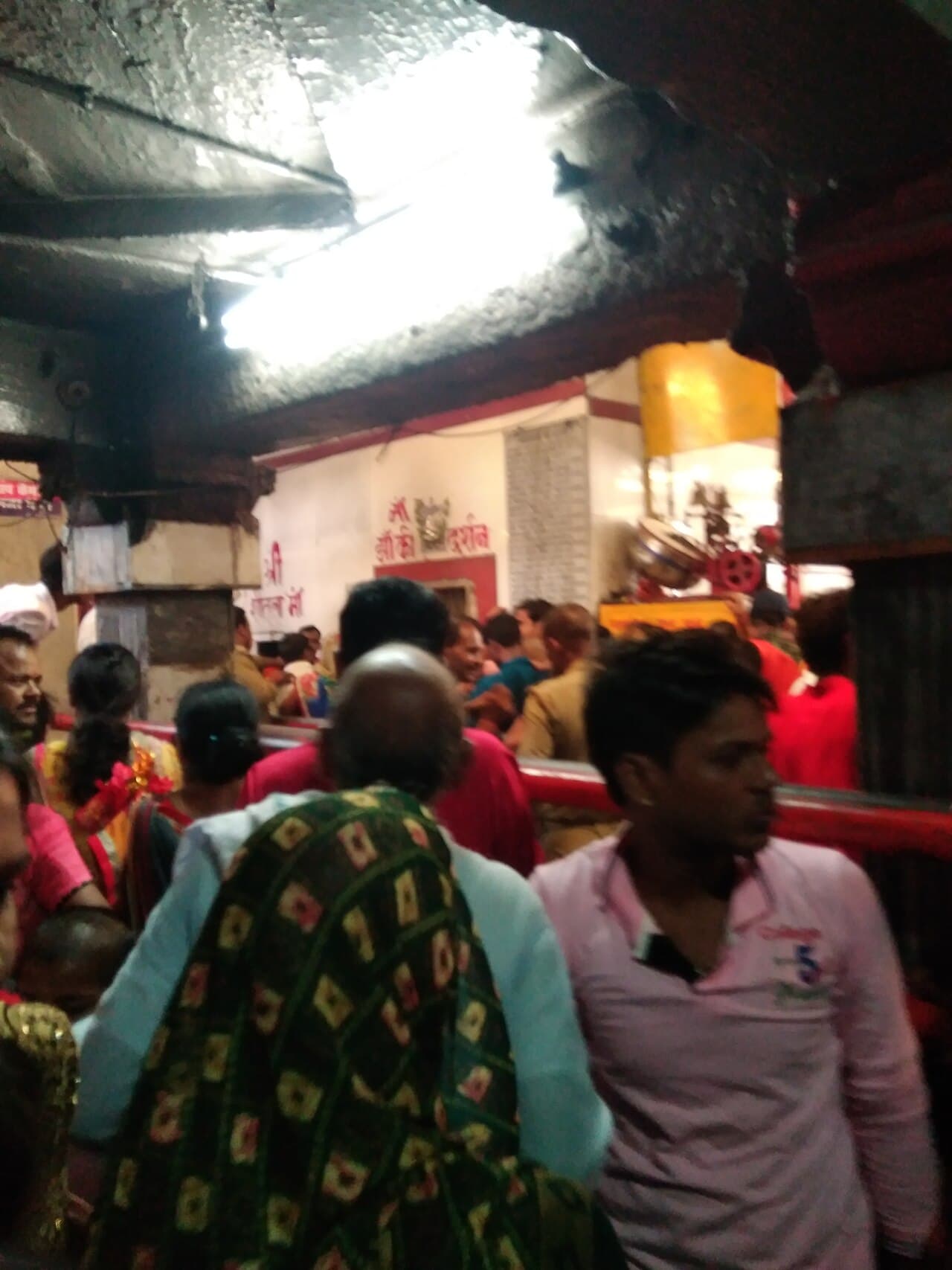
Her great darshan comes once a year. The image worshipped daily is of brass; above it, on the upper storey, stands the golden Annapurna, whose darbar opens only across the four or five days from Dhanteras to Annakut, when the queue runs down the gali. With it goes the khazana, the goddess's treasure: coins offered through the whole year are handed back to devotees with lava, puffed paddy, to be kept in the money box and the kitchen so that neither empties. At Sharad Navratri she takes her other place, as the Mahagauri of Kashi's Navadurga yatra, worshipped on the eighth day.
History
The story Kashi tells of her begins with an argument. Shiva, discoursing on the nature of things, called the world of matter — food among it — mere maya; and Parvati, to show what a world without her would be, withdrew from it. The rains failed, and gods and men went hungry. Then she relented, and set up her kitchen in Kashi as Annapurna — anna, food, and purna, filled — and there Shiva came at last with a begging bowl and took alms from her hand. The lord of renunciation depends on the goddess of nourishment: that is the lesson Kashi keeps, and it has held her ever since.
Her shrine stands in Vishwanath Gali, some fifteen metres north-west of the Kashi Vishwanath temple, deep in the old city's lanes. The worship is far older than any wall around it; the building now standing was raised by the Maratha Peshwa Baji Rao I, whose date the sources give variously as 1725 and 1729 — half a century before Ahilyabai Holkar built the Vishwanath temple next door. Small shrines to Kuber, Surya and Dhundhiraj Ganesh keep it company.
It is also a math, and its kitchens are its second life. What began in 1997 as a puri-sabzi service grew into the Annapurna annakshetra — one kitchen off Kalika Gali from 2003, a second at Bansphatak from 2014, the stoves lit at four in the morning and burning until midnight. The math reckons it feeds over twenty thousand people a day, and more than thirty-five thousand on Shivaratri.
Architecture
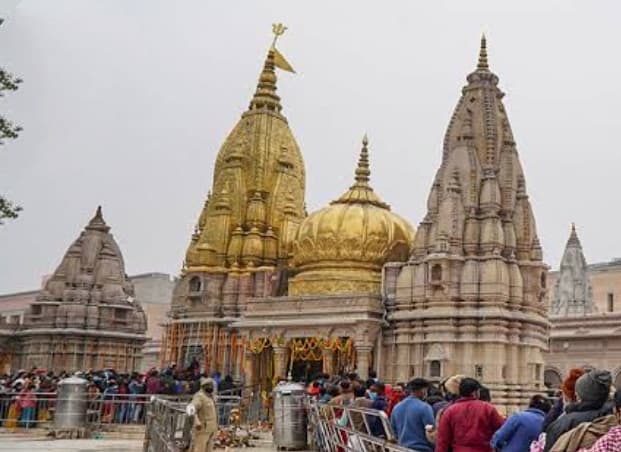
From the lane the temple is easy to miss: a painted frontage with a verse to Bhavani above the grille, a low doorway under it, squat domes over the parapet. Inside it opens into the Nagara pattern of its century — a broad pillared porch before a modest sanctum, a courtyard around it, and an upper storey where the golden darbar is set out.
The goddess is shown seated and richly dressed, a ladle in one hand and a jewelled vessel of rice in the other — the only implements she needs. Barely fifteen metres off, the granite of the Kashi Vishwanath Dham, opened in 2021, begins; Annapurna's shrine kept its old gali frontage, and the gap between them is the gap between Kashi's two centuries.
Festivals
Timings
Open daily from about 4:00 AM to 10:00 PM, with aartis early morning, at noon and at 8:30 and 10:00 PM; annadaan is served at the temple through the afternoon. Published timings differ — the Ministry of Tourism listing gives 5:00 AM–1:30 PM and 3:30–10:00 PM — so confirm before you go. The golden Annapurna darbar upstairs opens only from Dhanteras to Annakut.
Lal Bahadur Shastri International Airport at Babatpur is about twenty-five kilometres out, Varanasi Junction (Cantt) some five kilometres from the shrine. Vehicles get no closer than the Godowlia crossing; from there it is a walk of roughly five hundred metres along Dashashwamedh Road into Vishwanath Gali, which reaches Annapurna's door a few steps before Vishwanath's. Pilgrims coming up from the ghats through the Vishwanath Dham reach the same lanes.
Timings are indicative — please confirm with the temple trust before travelling.
Nearby Temples


Frequently Asked Questions
Where is Annapurna Devi Mandir, Kashi Temple located?+
Annapurna Devi Mandir, Kashi Temple is in Varanasi, Uttar Pradesh, India.
Which deity is worshipped at Annapurna Devi Mandir, Kashi Temple?+
Annapurna Devi Mandir, Kashi Temple is dedicated to Annapurna (Parvati as the giver of food).
Which tradition does Annapurna Devi Mandir, Kashi belong to?+
Annapurna Devi Mandir, Kashi is one of the Devi temples dedicated to Devi (Adi Shakti).
What are the timings of Annapurna Devi Mandir, Kashi Temple?+
Open daily from about 4:00 AM to 10:00 PM, with aartis early morning, at noon and at 8:30 and 10:00 PM; annadaan is served at the temple through the afternoon. Published timings differ — the Ministry of Tourism listing gives 5:00 AM–1:30 PM and 3:30–10:00 PM — so confirm before you go. The golden Annapurna darbar upstairs opens only from Dhanteras to Annakut.
What is the best time to visit Annapurna Devi Mandir, Kashi Temple?+
October to March; Dhanteras to Annakut for the golden darshan, and Sharad Navratri
When was Annapurna Devi Mandir, Kashi Temple established?+
Annapurna Devi Mandir, Kashi Temple — Present temple raised by the Maratha Peshwa Baji Rao I (sources give 1725 and 1729); worship of Annapurna in Kashi far older.
Sources & further reading
- Maa Annapurna Temple, Varanasi — Incredible India (Ministry of Tourism)
- Temples of Importance — District Varanasi, Government of Uttar Pradesh
- Annapurna Mandir — Kashi Official Web Portal
- Sri Annapurna Mandir Charitable Trust, Kashi (official)
- Shri Kashi Vishwanath Temple Trust — Dham corridor context (official)
Photo: juggadery · CC BY-SA 2.0