

Chamunda Nandikeshwar Dham — the Devi and Mahadev keeping one house above the Baner Khad, where the Mother came down from her snow-peak to be within her people's reach.
- Deity
- Devi Chamunda (with Shiva as Nandikeshwar)
- Location
- Kangra, Himachal Pradesh
- Category
- Devi
- Established
- Present temple traditionally raised about four centuries ago, when the image was brought down from Aadi Himani Chamunda; the district administration places it with a 16th-century raja
- Setting
- On the right bank of the Baner Khad below the Dhauladhar, on the Dharamshala–Palampur road
- Best Time to Visit
- March–June and September–November; both Navaratras
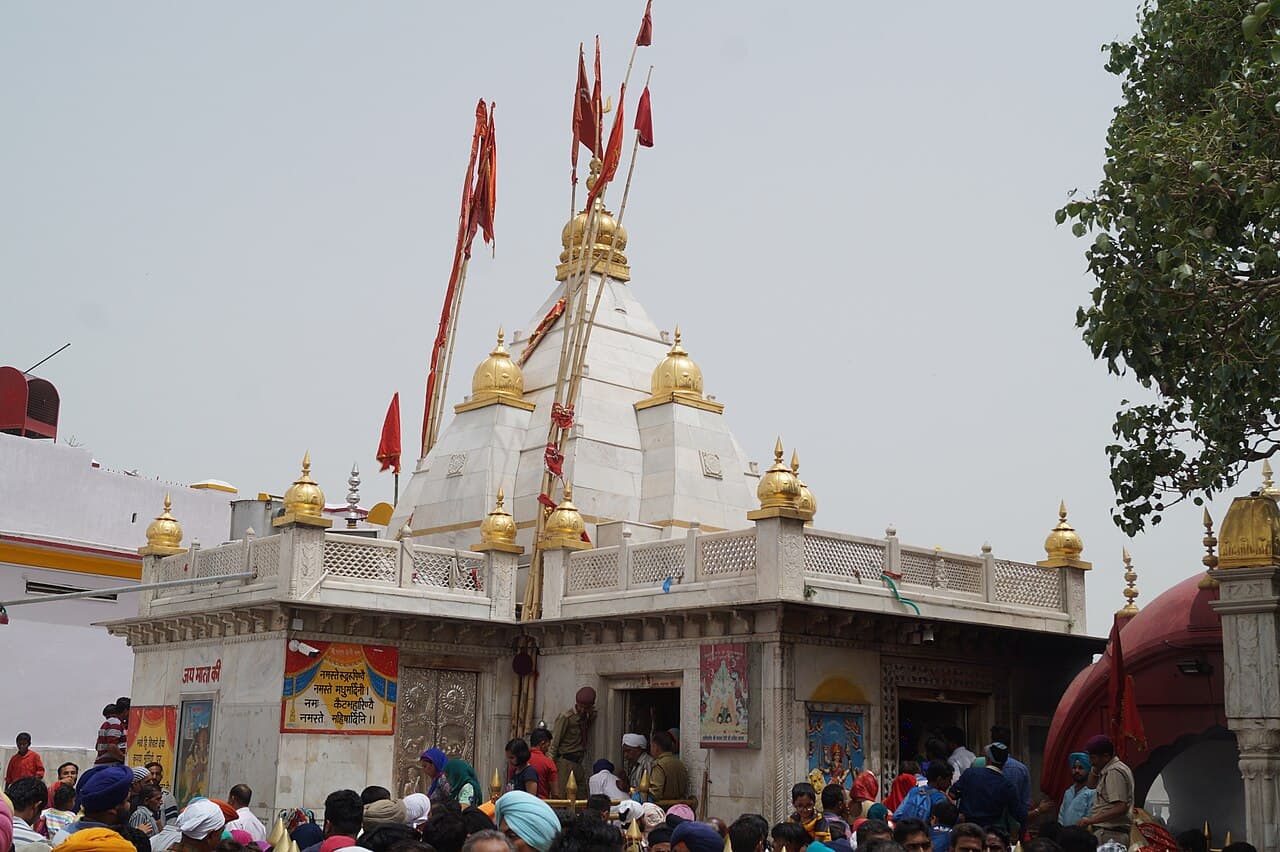
- Chamunda Nandikeshwar Dham — the Devi in the sanctum, Shiva as Nandikeshwar in the rock behind
- The name is from the Devi Mahatmya — Chamunda, for Chanda and Munda whom she overcame
- On the right bank of the Baner Khad below the Dhauladhar, on the Dharamshala–Palampur road
- Tradition: the image was brought down some 400 years ago from Aadi Himani Chamunda (~3,185 m)
- The Devi gave her consent in the priest's dream and named the ground to dig
- Not among the canonical 51 Shakti Peethas; revered as one of Himachal's five great Shakti shrines
- A station of the Nau Devi circuit — Jwala Ji, Brajeshwari and Chintpurni lie in the same hills
- Marble stair to a self-manifested lingam; Hanuman and Bhairav guard the sanctum door
- The trust's Trigarat Sanskrit Mahavidyalaya has taught Sanskrit and Vedic ritual free since 1972
Significance
What makes this a dham and not a mandir only is the second presence. Behind the main shrine a marble stair descends to a cave-like scoop in the rock where Shiva is worshipped as Nandikeshwar, in a lingam held to be self-manifested, so that one who has bowed before the Mother goes down a few steps to bow before Mahadev. Her image is kept veiled in red cloth, and Hanuman and Bhairav guard the sanctum door.
Chamunda is not counted among the fifty-one Shakti Peethas of the Kalika Purana and the Devi Bhagavata, and makes no such claim; what it holds is a living place in the Devi-bhoomi of Kangra. It is revered as one of Himachal's five great Shakti shrines with Jwala Ji of the eternal flame, Brajeshwari at Kangra, Chintpurni and Naina Devi, and it is a station of the Nau Devi circuit that families from across the north make together.
The river is part of the worship: a sacred kund set about with images, a bathing ghat and a small shrine across the footbridge draw pilgrims to the water before darshan, and — in a usage reaching back to the oldest strand of Chamunda's worship — the last rites are still performed on this bank for the peace of the departed. The trust also keeps the Trigarat Sanskrit Mahavidyalaya, teaching Sanskrit and Vedic ritual without fee since 1972.
History
Below the wall of the Dhauladhar, where the Baner Khad comes down out of the mountains, stands the temple Himachal calls Shri Chamunda Nandikeshwar Dham — on the river's right bank, some fifteen kilometres from Dharamshala and about ten west of Palampur. The Kangra district administration gives it that name because it is not the Devi's house alone: Shakti and Shiva are worshipped here together, the Mother in the sanctum, Mahadev in the rock behind her.
Her name comes from the Devi Mahatmya. In the battle told there, Ambika — Kaushiki — brought forth from her brow a dark and blazing form who overcame the asura commanders Chanda and Munda; and the Devi, receiving their heads, gave her the name the world has used ever since. The hills tell that victory in their own land: the Mother cast the two down from the snow-line above this valley, and one of the fallen boulders is still shown above the Shiva shrine by the river.
That snow-line holds the older shrine — Aadi Himani Chamunda, the first abode, about 3,185 metres up in the Dhauladhar. Some four centuries ago — the district administration places it in the sixteenth century — a raja and his purohit prayed for the Mother's leave to bring her worship down to her people. She consented in the priest's dream and named the ground to dig. The ancient image found there would not be lifted by the raja's men; she told the priest they had handled it as a common stone, and, bathed and freshly clothed, he raised alone what a crowd could not. It is the image in the sanctum today.
Architecture
The building belongs to the hills and not to the plains: a Himachali temple of dressed stone and timber under sloping slate, carved woodwork about its openings and whitewashed walls around a paved courtyard. There is no soaring shikhara and no great carved gateway; what the eye is given instead is the Dhauladhar rising behind, the Baner Khad running below and the fields of Dadh across the water.
The plan is simple and layered — the sanctum with its veiled image and its two guardians, the marble stair descending to the Nandikeshwar cave, the kund with its sculptures, and the ghat and footbridge over the khad.
Festivals
Timings
Open daily — the district administration gives roughly 6:00 AM to 7:00 or 8:00 PM, while other listings show darshan from about 6:00 AM to noon and 1:00 PM to 9:00 PM with a midday break; hours lengthen through the Navaratras. Confirm current timings locally.
The temple stands on the Dharamshala–Palampur road, about fifteen kilometres from Dharamshala and some ten west of Palampur, served by HRTC and private buses and by taxis. Kangra (Gaggal) airport is roughly twenty-five kilometres off, with flights from Delhi and Chandigarh; Kangra station on the narrow-gauge Kangra Valley Railway is about fourteen, and Pathankot Junction, the nearest broad-gauge railhead, around ninety. The climb to Aadi Himani Chamunda, nine to thirteen kilometres from Jia or Jadrangal, is open only from about mid-March to mid-November.
Timings are indicative — please confirm with the temple trust before travelling.
Nearby Temples


Frequently Asked Questions
Where is Chamunda Devi, Kangra Temple located?+
Chamunda Devi, Kangra Temple is in Kangra, Himachal Pradesh, India.
Which deity is worshipped at Chamunda Devi, Kangra Temple?+
Chamunda Devi, Kangra Temple is dedicated to Devi Chamunda (with Shiva as Nandikeshwar).
Which tradition does Chamunda Devi, Kangra belong to?+
Chamunda Devi, Kangra is one of the Devi temples dedicated to Devi (Adi Shakti).
What are the timings of Chamunda Devi, Kangra Temple?+
Open daily — the district administration gives roughly 6:00 AM to 7:00 or 8:00 PM, while other listings show darshan from about 6:00 AM to noon and 1:00 PM to 9:00 PM with a midday break; hours lengthen through the Navaratras. Confirm current timings locally.
What is the best time to visit Chamunda Devi, Kangra Temple?+
March–June and September–November; both Navaratras
When was Chamunda Devi, Kangra Temple established?+
Chamunda Devi, Kangra Temple — Present temple traditionally raised about four centuries ago, when the image was brought down from Aadi Himani Chamunda; the district administration places it with a 16th-century raja.
Sources & further reading
Photo: Guptaele · CC BY-SA 4.0