

The goddess as living flame — a temple with no idol, where eternal fires burn from the rock in the Kangra hills.
- Deity
- Devi Jwalamukhi
- Location
- Kangra, Himachal Pradesh
- Category
- Shakti Peethas
- Established
- Ancient shrine (traditionally Raja Bhumi Chand); gilded roof attributed to Maharaja Ranjit Singh
- Setting
- In the lower Himalaya of Kangra, at Jawalamukhi
- Best Time to Visit
- March–June and September–November; the two Navaratras
- One of the 51 Shakti Peethas — tradition: Sati's tongue fell here
- No idol — the goddess is worshipped as eternal natural flames
- Nine flames, each named for a goddess, burn from the rock
- Gilded roof attributed to Maharaja Ranjit Singh; silver doors from his sons
- Famed for the legend of Akbar's failed attempt to douse the flame
- Rot bread is the customary prasad; aartis sung several times daily
- In Kangra, near the Devi shrines of Brajeshwari and Chintpurni
Significance
To worship a fire that no one lit and no one feeds, burning on unbroken through the centuries, is the whole meaning of Jwala Ji; of all the ways the Goddess is shown across India, few are as elemental as this. It is counted among the fifty-one Shakti Peethas and is one of the most visited shrines of the western Himalaya.
Pilgrims come to bow before the flames, to hear the aartis sung several times a day, and to offer the thick rot bread that is the customary prasad. The natural fires have drawn wonder from rulers and travellers for centuries — the Akbar story only the most famous of the tales — and to sceptic and devotee alike the flame remains the quiet marvel at the temple's heart.
A short way off, at the spot called Gorakh Tibbi, another vent heats a tank of water tied in legend to the yogi Gorakhnath, and pilgrims visit it as part of the darshan. The temple is one of a ring of Devi shrines in Kangra, and many complete a circuit that takes in Brajeshwari at Kangra and Chintpurni nearby in the same journey — so that Jwala Ji sits at the heart of one of the north's great goddess pilgrimages.
History
Jwala Ji, the flame goddess, is worshipped in the little Himalayan town of Jawalamukhi in Kangra district, and hers is among the strangest and most striking of all the Shakti Peethas: there is no image of the deity at all. In the sanctum, natural flames issue endlessly from clefts in the rock, fed by gas from deep below, and it is these eternal fires — not any idol — that are revered as the Mother.
By the Shakti Peetha tradition it is here that Sati's tongue fell, and the flame is her living presence. Nine flames are honoured, each given the name of a goddess — Mahakali, Annapurna, Chandi, Hinglaj, Vindhyavasini, Mahalakshmi, Saraswati, Ambika and Anji Devi — burning together in the dim shrine.
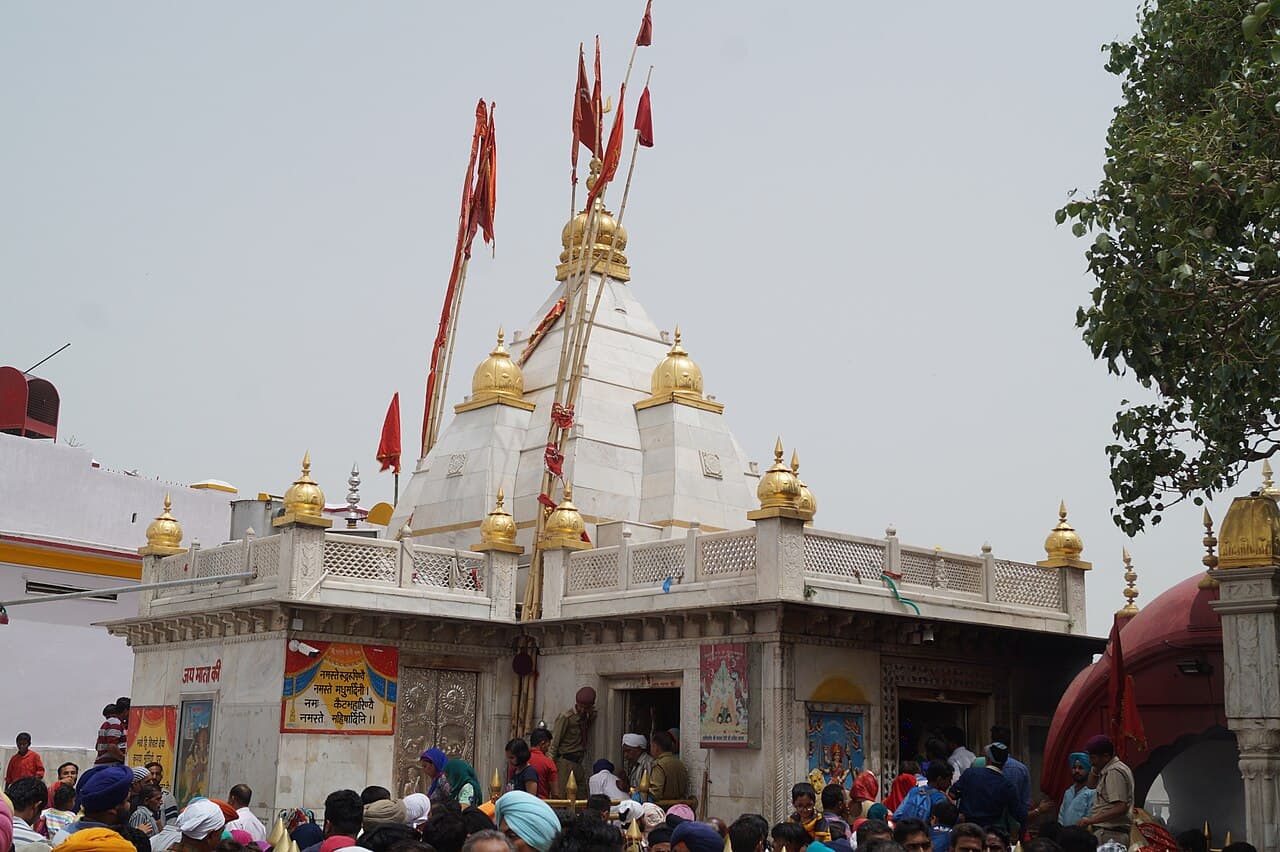
The temple is very old, its early building credited by tradition to Raja Bhumi Chand of the Katoch line; its gilded roof is remembered as the gift of Maharaja Ranjit Singh and its silver-plated doors as that of his sons. Best-known is the legend of the Emperor Akbar, who is said to have tried to douse the flames with a channel of water and failed — and then to have offered a golden parasol that, the story goes, turned to a lesser metal, a sign of the goddess's power.
Architecture
The shrine is modest in scale and unusual in form, shaped around the fire rather than any sanctum image: a square building with a small dome — gilded, by tradition, at Ranjit Singh's expense — and a central hollowed-stone pit where the chief flame burns, with silver-plated folding doors at the entrance, while lesser flames flicker in niches around it.
There is little of the carved grandeur of the great stone temples here; the architecture serves only to shelter and frame the living fire, and the effect, in the dim, flame-lit interior, is powerful for its very plainness. A sacred tank and subsidiary shrines lie within the walled complex on the hillside.
Festivals
Timings
Open daily, roughly 6:00 AM to 10:00 PM in summer and about 7:00 AM to 9:30 PM in winter, with several aartis through the day. Confirm current timings locally.
Jawalamukhi lies in the lower hills of Kangra district, about fifty kilometres from Dharamshala. The nearest airport is Gaggal (Kangra), roughly fifty kilometres away, and the main broad-gauge railhead is Pathankot, about a hundred and twenty kilometres off, with the narrow-gauge Kangra line closer; buses and taxis run to the town. Pilgrims often visit Jwala Ji together with the other Devi shrines of Kangra, such as Brajeshwari and Chintpurni.
Timings are indicative — please confirm with the temple trust before travelling.
Nearby Temples


Frequently Asked Questions
Where is Jwala Ji Temple located?+
Jwala Ji Temple is in Kangra, Himachal Pradesh, India.
Which deity is worshipped at Jwala Ji Temple?+
Jwala Ji Temple is dedicated to Devi Jwalamukhi.
Which tradition does Jwala Ji belong to?+
Jwala Ji is one of the Shakti Peethas temples dedicated to Devi (Shakti).
What are the timings of Jwala Ji Temple?+
Open daily, roughly 6:00 AM to 10:00 PM in summer and about 7:00 AM to 9:30 PM in winter, with several aartis through the day. Confirm current timings locally.
What is the best time to visit Jwala Ji Temple?+
March–June and September–November; the two Navaratras
When was Jwala Ji Temple established?+
Jwala Ji Temple — Ancient shrine (traditionally Raja Bhumi Chand); gilded roof attributed to Maharaja Ranjit Singh.
Photo: Nswn03 · CC BY-SA 3.0