About this circuit
This planner covers the Bade Char Dham — the four national dhams set by Adi Shankaracharya at the compass points: Badrinath in the north, Puri in the east, Rameshwaram in the south and Dwarka in the west. It is not the Uttarakhand Chota Char Dham (Yamunotri, Gangotri, Kedarnath and Badrinath), the compact Himalayan circuit that shares only Badrinath with this all-India one.
Planning the darshan? See the route guide →How will you do the parikrama?
~18–20 days — One circular journey in the traditional cardinal order, the way the state-run pilgrim train runs it.
The four dhams in this journey's visiting order — tap a marker for the temple.
For the rail circuit Kolkata feeds the Delhi corridor: the Howrah Rajdhani reaches New Delhi in about 17 hours, delivering pilgrims to the Char Dham train's Delhi boarding region. Its own east-coast line also runs direct to Puri in under eight hours, which is why Kolkata's air variant instead begins in the east.
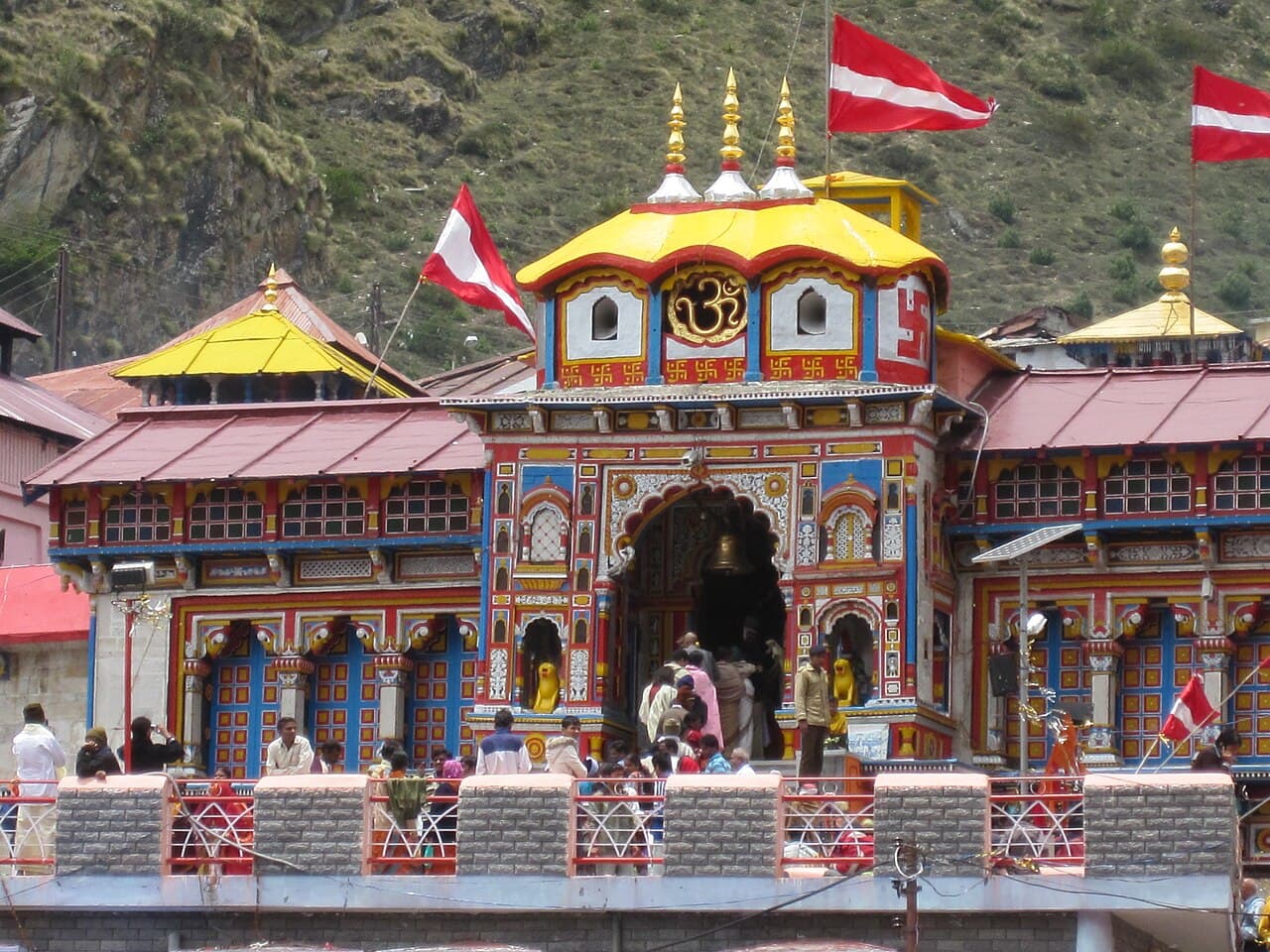
Badrinath is the northern seat, Vishnu as Badrinarayan on the left bank of the Alaknanda beneath the snow-pyramid of Neelkanth. Give it two nights: a first evening for the Tapt Kund hot springs and the ariti, a full morning for the black-stone Badrinarayan darshan before the queues build, and time to breathe at 3,100 m rather than rushing the highest and hardest-won of the four.
From the Haridwar/Rishikesh railhead Badrinath is a long mountain road — about 315 km, ten to twelve hours, climbing the Alaknanda valley through Devprayag, Srinagar, Rudraprayag, Karnaprayag and Joshimath. There is no railway and no airport at the shrine; the nearest airstrip is Jolly Grant at Dehradun, but even after flying in the road up is still a full day, so most pilgrims break the climb with a night at Joshimath or Pipalkoti. In the open season a helicopter service can shorten the last leg.
Stay in Badrinath town itself, within walking reach of the temple and the Tapt Kund. Lodging is simple — GMVN's tourist rest house, dharamshalas and small hotels — and books out fast in the peak May–June and post-monsoon weeks, so reserve ahead. Rooms are unheated; carry warm layers even in summer.
Badrinath is a six-month shrine. For 2026 the kapat (portals) open on 23 April and close in mid-November, the exact closing announced on Vijayadashami; through the snowbound winter Badri Vishal is worshipped at the Narsimha temple in Joshimath. Time the northern leg inside this window, and keep July–August buffer for monsoon landslides on the Rishikesh–Badrinath road.
- 1aMana village
Just 3 km beyond Badrinath sits Mana, the first (long called the last) Indian village on the Indo-Tibet frontier at about 3,200 m. A short walk leads past the Bhim Pul rock bridge and the Vyas and Ganesh caves to the point where the young Saraswati vanishes underground — an easy, atmospheric half-morning add-on to the Badrinath stay.
Down from the Himalaya to the eastern sea: from the Haridwar railhead a daily direct train (the Kalinga Utkal Express) runs roughly 2,360 km to Puri in about 44 hours, skirting the Gangetic plain and Varanasi before turning down the Odisha coast. It is a two-night train leg — the longest single stretch of the cardinal rail loop after the deep-south run.
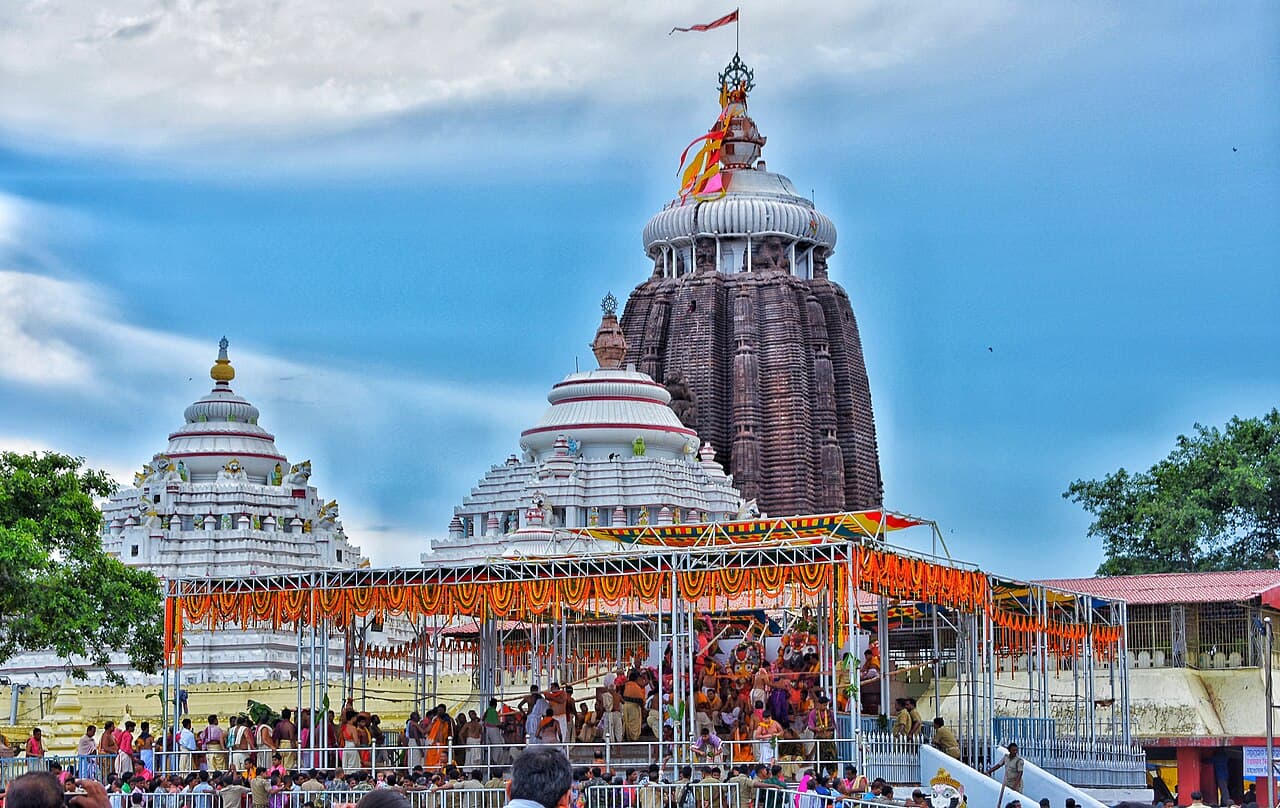
Puri is the eastern seat, Lord Jagannath — Vishnu-Krishna — worshipped with his brother Balabhadra and sister Subhadra as a triad of neem-wood images on the jewelled Ratnavedi atop the Nilachala hill. One unhurried night is enough for the temple: an evening darshan, the dawn queue before the crowds, and a walk on the Bay of Bengal shore that the town runs down to.
Bhubaneswar (BBI) is the gateway airport and a major railhead, about 60 km — an hour and a half by road — from Puri. Puri also has its own railway station, reached directly from the east-coast trunk line, so many pilgrims skip Bhubaneswar altogether and step off within a rickshaw ride of the temple. Either way the last approach is easy coastal plain, not a climb.
Stay in Puri itself, close to the temple and the sea. The town has the widest range of any coastal dham — pilgrim dharamshalas, the state (OTDC) Panthanivas, and beachfront hotels — and fills up hardest around Rath Yatra in the rains, when even a single night needs booking well ahead.
- 2aKonark Sun Temple
About 35 km up the coast from Puri stands the 13th-century Konark Sun Temple, the UNESCO-listed 'Black Pagoda' conceived as the sun god Surya's colossal stone chariot with twelve pairs of carved wheels. It sits naturally on the Puri–Bhubaneswar marine drive and adds half a day to the eastern leg.
Down the eastern seaboard: there is no single direct train, so pilgrims run about 1,900 km in some 35 hours, changing at Khurda Road (for Puri) and again in the south, tracing the coast through Andhra and Tamil Nadu to cross the Pamban bridge onto Rameshwaram island. Reckon it as a second full two-night rail leg.

Rameshwaram is the southern seat, on Pamban island off the Tamil coast — the Ramanathaswamy temple where, by the Ramayana, Rama worshipped Shiva before crossing to Lanka, and which is both a Char Dham and a Jyotirlinga. One night lets you keep the ritual bath at the twenty-two theerthams (well-water poured over you in turn) and walk India's longest temple corridor before the midday heat and crowds.
Madurai (IXM) is the gateway airport and railhead, about 170 km — three to four hours — from Rameshwaram, the last stretch running out over the sea on the Pamban road bridge beside its famous railway cantilever. Rameshwaram also has its own island railway station, so pilgrims coming by train arrive right in the temple town without changing to road at Madurai.
Stay on the island in Rameshwaram town, a short walk from the Ramanathaswamy temple and the theertham bathing ghats. Lodging is modest — pilgrim lodges, the state (TTDC) hotel and small guesthouses — and an early temple start beats both the queues and the fierce coastal sun.
- 3aDhanushkodi
About 18 km down the tapering sandspit at the south-eastern tip of Pamban island lies Dhanushkodi, the ghost town swept away by the 1964 cyclone, where the Bay of Bengal meets the Indian Ocean and, by tradition, Rama's bridge to Lanka began. It is an easy, haunting jeep excursion of a few hours from Rameshwaram.
The long diagonal across the peninsula: the weekly Rameswaram–Okha express is one of Indian Railways' near-longest runs, roughly 3,120 km in about 57 hours from the deep south to the Saurashtra coast, setting pilgrims down at Dwarka just before its Okha terminus. This is the circuit's single biggest haul — a leg to plan the whole rail trip around.
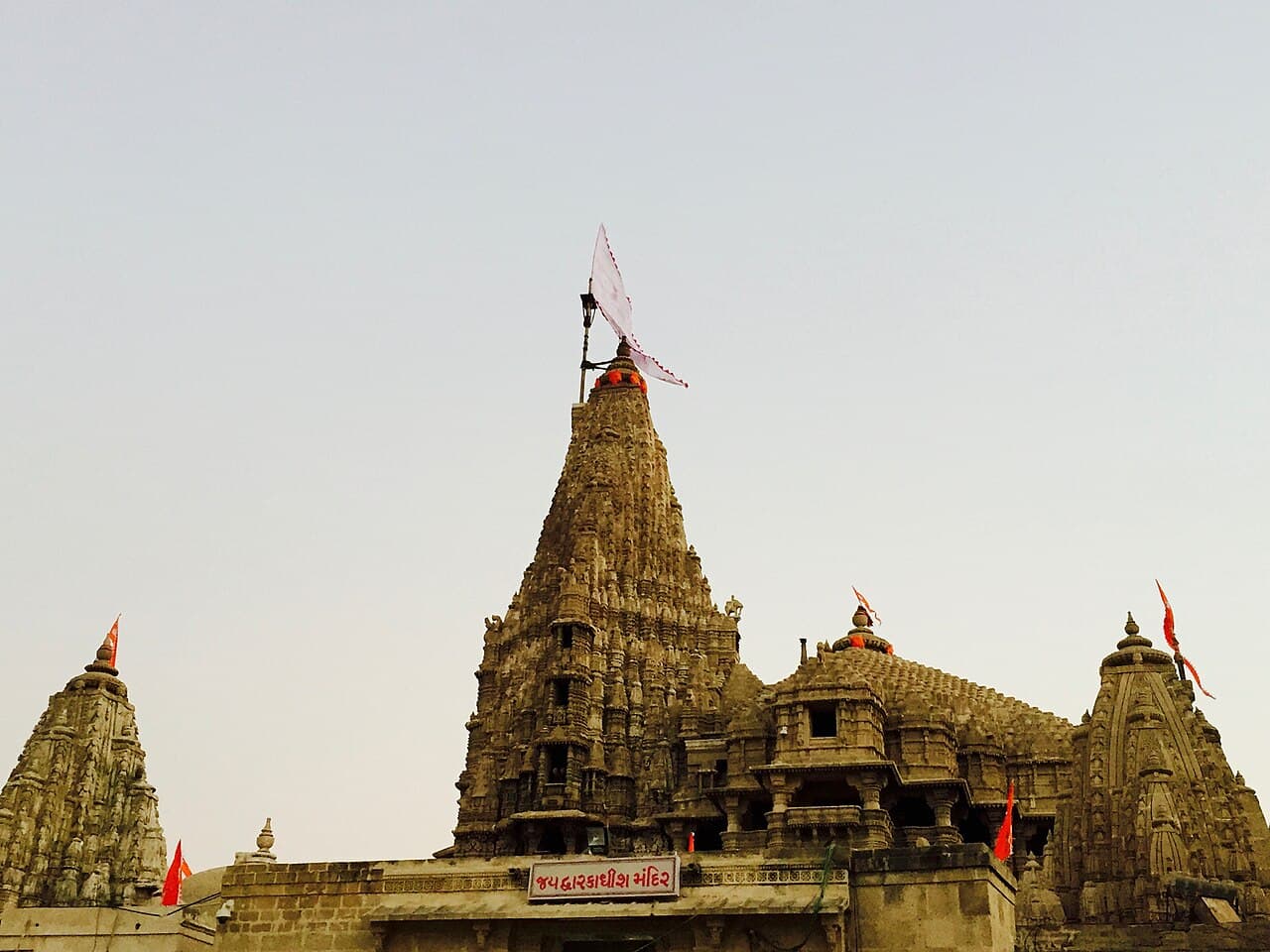
Dwarka is the western seat, Krishna's fabled sea-kingdom where the five-storey Dwarkadhish temple — the Jagat Mandir — rises above the Gomti creek and the Arabian Sea. One night carries the temple comfortably: the flag-changing atop the spire, an evening and a dawn darshan, and a dip at the Gomti ghat where the creek meets the sea.
Jamnagar (JGA) is the nearest airport, about 130–140 km — two and a half to three hours by road — from Dwarka along the Saurashtra coast. Dwarka has its own railway station on the Ahmedabad–Okha line, so pilgrims arriving by train reach the temple town directly; the by-air approach is the one that routes through Jamnagar.
Stay in Dwarka town, near the Jagat Mandir and the Gomti ghat. The temple town has dharamshalas, the state (Gujarat Tourism / TCGL) property and modest hotels; a night here also positions you for the Bet Dwarka boat and the long coastal drive to Somnath.
- 4aSomnath
About 230 km down the Saurashtra coast from Dwarka — five to six hours via Porbandar and Veraval — stands Somnath, the first of the twelve Jyotirlingas, rebuilt after Independence on the Arabian Sea shore. The two great Gujarat shrines are almost always kept together, and many pilgrims give the western leg a second night to hold both.
- 4bBet Dwarka
About 30 km north of Dwarka, off Okha, the island of Bet Dwarka is revered as Krishna's own dwelling and part of the ancient Dvaraka. Once a short boat crossing, it is now reachable by the Sudarshan Setu bridge opened in 2024 — a half-day add-on of temples and Harappan-era shoreline.
The cardinal rail loop ends at Dwarka on the far western coast, and the run home to Kolkata is a long one — roughly two days, about 43 hours on the weekly Okha–Howrah direct train or with a change via the Ahmedabad trunk route, so budget the return generously.
~13–15 days — Fly between the four corners, entering at the dham nearest your city.
The four dhams in this journey's visiting order — tap a marker for the temple.
By air the Kolkata circuit opens on the eastern dham: a non-stop flight of about 1 hour 10 minutes reaches Bhubaneswar (BBI), from where Puri — Kolkata's entry dham — is about 60 km by road. From the east the wheel turns south to Rameshwaram, west to Dwarka and north to Badrinath.
Puri is the eastern seat, Lord Jagannath — Vishnu-Krishna — worshipped with his brother Balabhadra and sister Subhadra as a triad of neem-wood images on the jewelled Ratnavedi atop the Nilachala hill. One unhurried night is enough for the temple: an evening darshan, the dawn queue before the crowds, and a walk on the Bay of Bengal shore that the town runs down to.
Bhubaneswar (BBI) is the gateway airport and a major railhead, about 60 km — an hour and a half by road — from Puri. Puri also has its own railway station, reached directly from the east-coast trunk line, so many pilgrims skip Bhubaneswar altogether and step off within a rickshaw ride of the temple. Either way the last approach is easy coastal plain, not a climb.
Stay in Puri itself, close to the temple and the sea. The town has the widest range of any coastal dham — pilgrim dharamshalas, the state (OTDC) Panthanivas, and beachfront hotels — and fills up hardest around Rath Yatra in the rains, when even a single night needs booking well ahead.
- 1aKonark Sun Temple
About 35 km up the coast from Puri stands the 13th-century Konark Sun Temple, the UNESCO-listed 'Black Pagoda' conceived as the sun god Surya's colossal stone chariot with twelve pairs of carved wheels. It sits naturally on the Puri–Bhubaneswar marine drive and adds half a day to the eastern leg.
The eastern-to-southern hop by air is Bhubaneswar (BBI) to Madurai (IXM), about 1,420 km, almost always with one change at Chennai or Bengaluru — roughly six hours airport-to-airport. Madurai is then the road-and-bridge run onward to Rameshwaram island.
Rameshwaram is the southern seat, on Pamban island off the Tamil coast — the Ramanathaswamy temple where, by the Ramayana, Rama worshipped Shiva before crossing to Lanka, and which is both a Char Dham and a Jyotirlinga. One night lets you keep the ritual bath at the twenty-two theerthams (well-water poured over you in turn) and walk India's longest temple corridor before the midday heat and crowds.
Madurai (IXM) is the gateway airport and railhead, about 170 km — three to four hours — from Rameshwaram, the last stretch running out over the sea on the Pamban road bridge beside its famous railway cantilever. Rameshwaram also has its own island railway station, so pilgrims coming by train arrive right in the temple town without changing to road at Madurai.
Stay on the island in Rameshwaram town, a short walk from the Ramanathaswamy temple and the theertham bathing ghats. Lodging is modest — pilgrim lodges, the state (TTDC) hotel and small guesthouses — and an early temple start beats both the queues and the fierce coastal sun.
- 2aDhanushkodi
About 18 km down the tapering sandspit at the south-eastern tip of Pamban island lies Dhanushkodi, the ghost town swept away by the 1964 cyclone, where the Bay of Bengal meets the Indian Ocean and, by tradition, Rama's bridge to Lanka began. It is an easy, haunting jeep excursion of a few hours from Rameshwaram.
The southern-to-western hop by air is Madurai (IXM) to Jamnagar (JGA), about 1,640 km, the longest of the four and almost always via Mumbai — reckon on seven hours or so airport-to-airport. Jamnagar is then the coastal drive to Dwarka.
Dwarka is the western seat, Krishna's fabled sea-kingdom where the five-storey Dwarkadhish temple — the Jagat Mandir — rises above the Gomti creek and the Arabian Sea. One night carries the temple comfortably: the flag-changing atop the spire, an evening and a dawn darshan, and a dip at the Gomti ghat where the creek meets the sea.
Jamnagar (JGA) is the nearest airport, about 130–140 km — two and a half to three hours by road — from Dwarka along the Saurashtra coast. Dwarka has its own railway station on the Ahmedabad–Okha line, so pilgrims arriving by train reach the temple town directly; the by-air approach is the one that routes through Jamnagar.
Stay in Dwarka town, near the Jagat Mandir and the Gomti ghat. The temple town has dharamshalas, the state (Gujarat Tourism / TCGL) property and modest hotels; a night here also positions you for the Bet Dwarka boat and the long coastal drive to Somnath.
- 3aSomnath
About 230 km down the Saurashtra coast from Dwarka — five to six hours via Porbandar and Veraval — stands Somnath, the first of the twelve Jyotirlingas, rebuilt after Independence on the Arabian Sea shore. The two great Gujarat shrines are almost always kept together, and many pilgrims give the western leg a second night to hold both.
- 3bBet Dwarka
About 30 km north of Dwarka, off Okha, the island of Bet Dwarka is revered as Krishna's own dwelling and part of the ancient Dvaraka. Once a short boat crossing, it is now reachable by the Sudarshan Setu bridge opened in 2024 — a half-day add-on of temples and Harappan-era shoreline.
The western-to-northern hop by air is Jamnagar (JGA) to Dehradun (DED), about 1,185 km, generally with one change at Delhi or Mumbai — roughly six hours airport-to-airport, before the long mountain road climbs from Dehradun to Badrinath.
Badrinath is the northern seat, Vishnu as Badrinarayan on the left bank of the Alaknanda beneath the snow-pyramid of Neelkanth. Give it two nights: a first evening for the Tapt Kund hot springs and the ariti, a full morning for the black-stone Badrinarayan darshan before the queues build, and time to breathe at 3,100 m rather than rushing the highest and hardest-won of the four.
From the Haridwar/Rishikesh railhead Badrinath is a long mountain road — about 315 km, ten to twelve hours, climbing the Alaknanda valley through Devprayag, Srinagar, Rudraprayag, Karnaprayag and Joshimath. There is no railway and no airport at the shrine; the nearest airstrip is Jolly Grant at Dehradun, but even after flying in the road up is still a full day, so most pilgrims break the climb with a night at Joshimath or Pipalkoti. In the open season a helicopter service can shorten the last leg.
Stay in Badrinath town itself, within walking reach of the temple and the Tapt Kund. Lodging is simple — GMVN's tourist rest house, dharamshalas and small hotels — and books out fast in the peak May–June and post-monsoon weeks, so reserve ahead. Rooms are unheated; carry warm layers even in summer.
Badrinath is a six-month shrine. For 2026 the kapat (portals) open on 23 April and close in mid-November, the exact closing announced on Vijayadashami; through the snowbound winter Badri Vishal is worshipped at the Narsimha temple in Joshimath. Time the northern leg inside this window, and keep July–August buffer for monsoon landslides on the Rishikesh–Badrinath road.
- 4aMana village
Just 3 km beyond Badrinath sits Mana, the first (long called the last) Indian village on the Indo-Tibet frontier at about 3,200 m. A short walk leads past the Bhim Pul rock bridge and the Vyas and Ganesh caves to the point where the young Saraswati vanishes underground — an easy, atmospheric half-morning add-on to the Badrinath stay.
The air wheel — Puri, Rameshwaram, Dwarka, Badrinath — ends in the north: after the Badrinath darshan, the road drops to Dehradun (DED) and frequent flights, generally via Delhi, return to Kolkata (CCU) to close the circuit.
One dham at a time
Many pilgrims complete the Char Dham over several trips — a corner at a time, as the tradition freely allows. From Kolkata:
From Kolkata the northern dham is a five-to-six-day trip: a flight to Dehradun (usually via Delhi) or a long train to Haridwar, then the roughly 315 km mountain road up the Alaknanda to Badrinath and a night or two at altitude. The Himalayan distance sets the length.
Badrinath is open only from about late April to mid-November (portals open 23 April in 2026); plan this mini-trip inside that window and keep July–August buffer for monsoon landslides on the mountain road.
From Kolkata, Puri is the nearest dham of all and the easiest weekend: a direct east-coast train reaches Puri in under eight hours, or a short flight lands at Bhubaneswar. Two to three days is ample for Lord Jagannath's darshan, the Nilachala and the sea, with Konark on the coast road.
From Kolkata the southern dham is a three-to-four-day trip: fly to Madurai (usually via Chennai) and take the road across the Pamban bridge, or ride a long east-coast train south to the island station. Time for the Ramanathaswamy temple, the theertham baths and Dhanushkodi.
From Kolkata the western dham is the far corner: a connecting flight to Jamnagar (then 130–140 km on) or a very long cross-country train to Dwarka's own station. Three to four days holds Dwarkadhish and the Gomti ghat, with Bet Dwarka an easy add-on and Somnath a further day down the coast.
Getting there
Kolkata's termini — Howrah, Sealdah and Shalimar — anchor the eastern network. Down the Delhi corridor the Howrah Rajdhani reaches New Delhi in about 17 hours, delivering pilgrims to the Char Dham train's Delhi boarding point; the same coast line also runs direct to Puri in under eight hours.
Netaji Subhas Chandra Bose International Airport (CCU) is the eastern gateway. For the air approach to the eastern dham, frequent non-stop flights of about 1 hour 10 minutes reach Bhubaneswar (BBI); Puri and Lord Jagannath's temple are a further 60–65 km, about an hour and a half, by road.
Official tour options
- IRCTC Char Dham Yatra by Bharat Gaurav Deluxe AC tourist train — the state-run all-India rail package covering all four dhams over 16 nights and 17 days from the Delhi region.IRCTC (Indian Railway Catering & Tourism Corporation)
- GMVN — the Uttarakhand state tourism corporation's fixed-departure Badrinath and Char Dham tours from Delhi and Rishikesh, and its tourist rest houses along the Badrinath road.GMVN (Garhwal Mandal Vikas Nigam, Govt. of Uttarakhand)
Season & festivals
Best window: late April to mid-November. This all-India circuit is governed by Badrinath, a six-month Himalayan shrine — in 2026 its portals open on 23 April and close in mid-November, the exact date announced on Vijayadashami — so the whole yatra is planned inside that season. The three coastal dhams are open year-round but are hot and humid in high summer and wettest in the June–September monsoon; keep July–August buffer for landslides on the Rishikesh–Badrinath mountain road.
Around Krishna Janmashtami (early September) Dwarka celebrates its Lord's janmotsav with flag rituals, abhishek and night-long darshan, and the temple town fills to capacity. If the western leg falls near the festival, expect very long darshan queues and full lodging in Dwarka and Bet Dwarka; book the night well ahead or keep generous buffer.
Around Puri's Rath Yatra (16 July in 2026) the eastern dham draws some of the largest crowds in India, as millions gather to pull Lord Jagannath's chariots to the Gundicha temple. The whole town is at capacity for the nine-day festival; time the eastern leg well clear of it unless the Rath Yatra itself is your purpose, and if so, book months ahead.
Yatri checklist
- Plan the whole circuit inside the Badrinath season (roughly late April to mid-November) — the northern dham is shut the rest of the year, and it, not the coast, sets your dates.
- Pack for two climates at once: warm layers, a windproof and sturdy shoes for Badrinath at 3,100 m (cold even in summer), and light cotton, sun protection and water for the three coastal dhams.
- Give the high Himalaya time to acclimatise — don't rush the Rishikesh–Badrinath climb in a single push if you can break it at Joshimath or Pipalkoti, and keep buffer days for weather closures on that mountain road.
- Wear footwear that slips off easily — it comes off at every temple — and remember Girijatmaj at Lenyadri means about 280 steps on foot.
- Build in buffer days: this is a country-spanning circuit of multi-day train legs or hub-connected flights, and a single missed connection or a closed ghat road can cascade through the rest of the plan.
- Carry a government photo ID and your confirmed train, flight and stay bookings (and any IRCTC/GMVN package voucher) — the long-distance legs and peak-season temple towns leave little room for walk-in arrangements.
Planning FAQs
Kolkata is close to Puri — why doesn't the rail circuit start there?+
It can, in spirit — Puri is only a short east-coast train from Kolkata — but the rail circuit follows the fixed cardinal order that the state-run all-India train uses, boarding in the Delhi region and running Badrinath → Puri → Rameshwaram → Dwarka. That is why Kolkata's rail trip opens with a Delhi-corridor connection, while its air variant begins right next door at Puri and rotates the wheel from the east. Reckon on about 18 to 20 days by rail and 13 to 15 by air.
How long does the all-India Char Dham circuit take?+
For the whole circuit in one go, reckon on about 17 days by train and roughly 13 to 16 days by air (the higher end from the far south). The state-run IRCTC Bharat Gaurav Char Dham train is the benchmark at 16 nights and 17 days from Delhi; starting from another metro adds the feeder days up the Delhi corridor. The air circuit is faster because the long inter-dham legs become half-day hub-connected flights instead of multi-day train runs, but it is not cheap and still needs a buffer for the Himalayan road to Badrinath.
What is the traditional order of the four dhams?+
The traditional clockwise order runs Badrinath (north) → Puri (east) → Rameshwaram (south) → Dwarka (west), the cardinal parikrama the state-run all-India rail train follows. Our rail variant keeps exactly this order for every origin. The air variant covers the same four seats but, to save flying, begins at the dham nearest your city and rotates the same wheel from there.
Can I do the whole Char Dham by train?+
Yes — the fullest way is the state-run IRCTC Bharat Gaurav Char Dham train, a 16-night, 17-day package from the Delhi region that loops all four dhams with hotels, meals and transfers included. You can also self-plan the rail circuit on regular trains, but the legs are long: Haridwar to Puri is about 44 hours, and the deep-south Rameshwaram to Dwarka run is close to 57 hours, so it is genuinely a two-to-three-week undertaking.
When is the circuit open, and what stays open in winter?+
Badrinath governs the calendar: its portals open around late April and close in mid-November each year, so the full circuit runs in that six-month window. Through the snowbound winter Badri Vishal is worshipped at the Narsimha temple in Joshimath, and the three coastal dhams — Puri, Rameshwaram and Dwarka — stay open all year. If you visit in winter you can still do the coastal three; only the Himalayan seat is closed.
Can I visit just one dham instead of the whole circuit?+
Absolutely — each of the four is a complete pilgrimage in itself, and many people take them one at a time over the years. A single coastal dham is usually a two-to-four-day trip from a nearby metro, while Badrinath needs about four to six days for the flight or train plus the long mountain road and a night or two at altitude. Each of our plans lists a mini-trip for every dham with a researched duration for your city.
Is this the same as the Chota Char Dham in Uttarakhand?+
No. This is the Bade (national) Char Dham — Badrinath, Puri, Rameshwaram and Dwarka, spread across the four corners of India and established by Adi Shankaracharya. The Chota Char Dham is the compact Himalayan circuit of Yamunotri, Gangotri, Kedarnath and Badrinath, all within Uttarakhand. The two share only Badrinath; this planner is for the all-India circuit.