
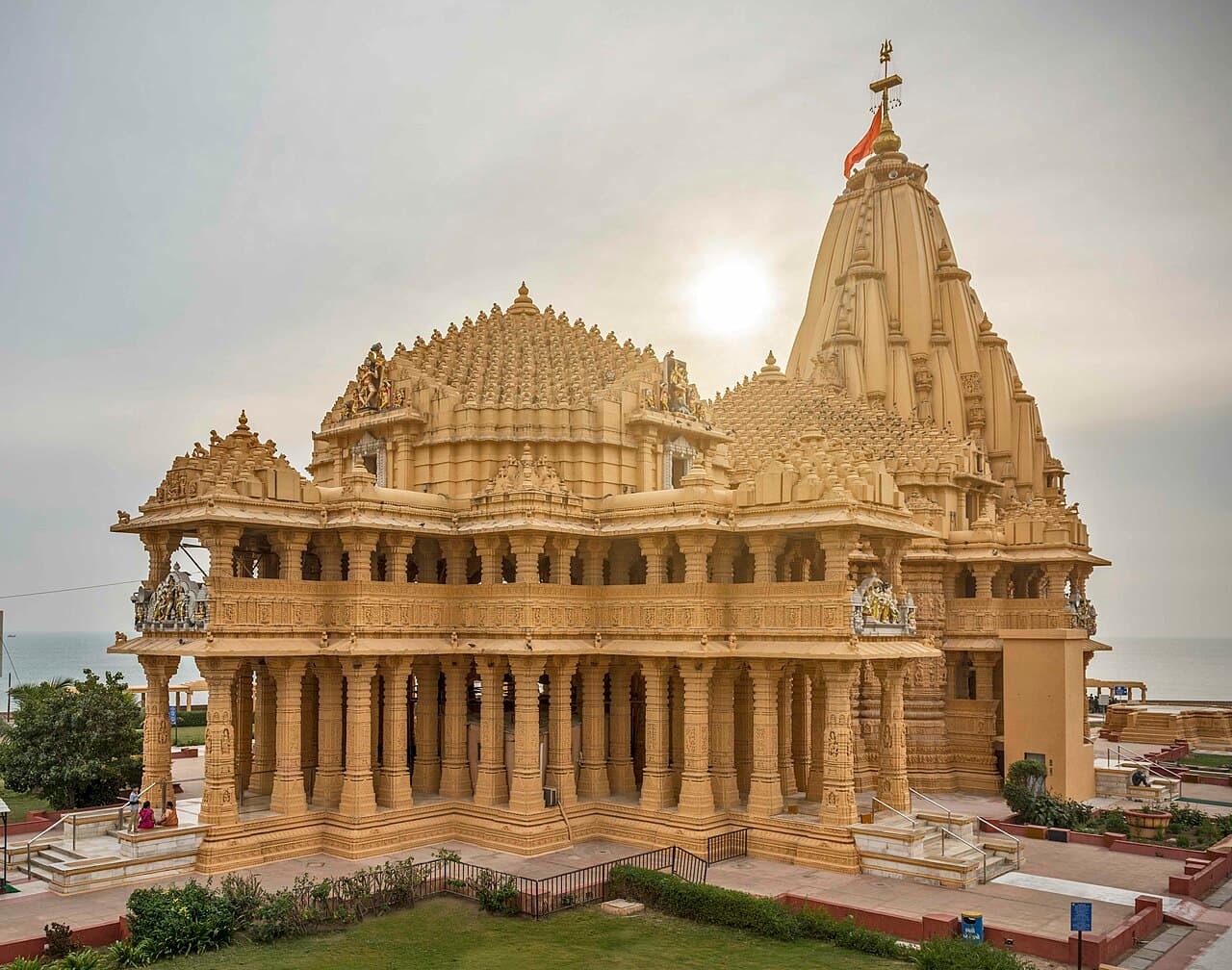
The first of the twelve Jyotirlingas, rising on the Arabian Sea shore — destroyed and rebuilt through the ages as a symbol of faith's endurance.
- Deity
- Shiva
- Location
- Prabhas Patan, Veraval, Gujarat
- Category
- Jyotirlinga
- Established
- Ancient; present temple consecrated 1951
- Setting
- Arabian Sea coast, near the Triveni Sangam
- Best Time to Visit
- October to February, and on Maha Shivaratri
- The first among the twelve Jyotirlingas
- A rare Jyotirlinga on the Arabian Sea shore
- Destroyed and rebuilt many times across a thousand years
- Famously raided by Mahmud of Ghazni in 1024
- Present temple rebuilt after Independence, championed by Sardar Patel (1951)
- Māru-Gurjara style; shikhara rises ~15 m over the sanctum
- Its Baan Stambh bears an inscription claiming an unobstructed sea-path due south
Significance
The name Somnath means 'Lord of the Moon'. By legend Chandra, the moon-god, dimmed by a curse, bathed in the sea here and worshipped Shiva until his light was restored — which is why the moon waxes and wanes, and why the place is also called Prabhasa, 'lustre'. A pilgrimage to Somnath is believed to wash away sin and open the way to liberation.
As the first of the Jyotirlingas and one of the great coastal shrines of India — named in a line with Dwarka, Puri and Rameswaram — Somnath holds a special place at the head of the Shaiva pilgrimage. It stands near the Triveni Sangam, where three rivers are said to meet the sea, a confluence sacred in its own right.
Close by lies Bhalka Tirth, where tradition holds that Krishna was struck by a hunter's arrow and departed the world, and the Prabhas region runs all through the Mahabharata and the Puranas. All of this gathers around Somnath a sense of deep antiquity — of a coast sacred long before the present stone was laid, and of a shrine that has come, in its many rebuildings, to stand for the very continuity of faith.
History
Somnath stands at Prabhas Patan near Veraval on the Saurashtra coast of Gujarat, a rare Jyotirlinga on the very shore of the Arabian Sea. Celebrated in the Puranas as the first and foremost of the twelve, it has been for a thousand years a symbol of endurance — a shrine whose fabled wealth drew invader after invader, and which rose again each time it was cast down.
The most famous of those raids was Mahmud of Ghazni's in 1024, and later damage is ascribed in tradition to the forces of Alauddin Khalji, of the Gujarat sultans, and of Aurangzeb; popular accounts speak of the temple being destroyed and rebuilt as many as seventeen times — a figure better read as a measure of its resilience than an exact count.
The temple standing today was raised after Independence, at the initiative of Sardar Vallabhbhai Patel, with the Somnath Trust carrying the work forward; the installation was completed in 1951, the ceremony performed by India's first President, Rajendra Prasad. Its rebuilding became, for the new nation, a powerful emblem of cultural renewal.
Architecture
The present temple is built in the Māru-Gurjara (Chalukya, or Solanki) style, in the grand Kailash-Mahameru-Prasad form, the work of the traditional Sompura temple-architects of Gujarat. Its carved shikhara rises about fifteen metres over the sanctum, crowned by a tall flag-mast, above a two-storeyed pillared mandapa rich with relief.
On the seaward side stands the Baan Stambh, the 'arrow pillar', which bears an old inscription claiming an unobstructed sea-path due south from this point — a much-repeated tradition rather than a surveyed fact. From the temple terrace the open Arabian Sea stretches to the horizon, and an evening sound-and-light show plays across the floodlit stone.
Festivals
Timings
Open daily ~6:00 AM – 9:00 PM; aarti at 7 AM, 12 noon and 7 PM. An evening sound-and-light show runs most days.
Somnath is on the southern coast of Saurashtra. The nearest railway station is at Veraval, only a few kilometres away, with Somnath's own halt closer still; the nearest airports are the small fields at Keshod and Diu, with Rajkot and Ahmedabad for wider connections, and the temple is about four hundred kilometres by road from Ahmedabad. It is usually visited together with Dwarka and the Nageshwar Jyotirlinga along the same coast.
Timings are indicative — please confirm with the temple trust before travelling.
Videos
Nearby Temples
Frequently Asked Questions
Where is Somnath Temple located?+
Somnath Temple is in Prabhas Patan, Veraval, Gujarat, India.
Which deity is worshipped at Somnath Temple?+
Somnath Temple is dedicated to Shiva.
Which tradition does Somnath belong to?+
Somnath is one of the Jyotirlinga temples dedicated to Shiva.
What are the timings of Somnath Temple?+
Open daily ~6:00 AM – 9:00 PM; aarti at 7 AM, 12 noon and 7 PM. An evening sound-and-light show runs most days.
What is the best time to visit Somnath Temple?+
October to February, and on Maha Shivaratri
When was Somnath Temple established?+
Somnath Temple — Ancient; present temple consecrated 1951.
Sources & further reading
Photo: B. SurajPatro1997 · CC BY-SA 4.0