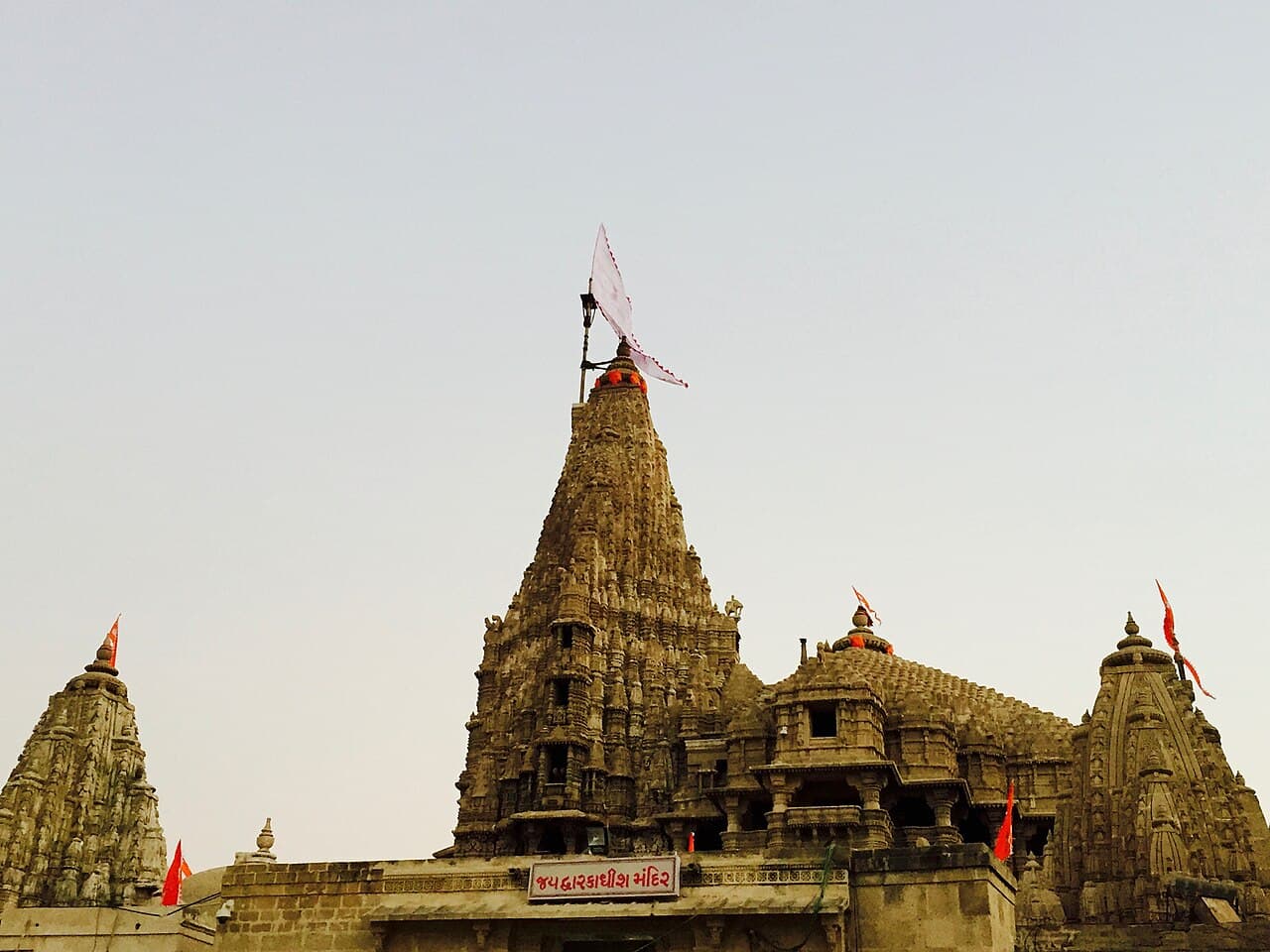
Krishna's fabled sea-kingdom of Dwarka — the western seat of the Char Dham, rising in five storeys above the Gomti.
- Deity
- Vishnu (Krishna)
- Location
- Dwarka, Gujarat
- Category
- Char Dham · Vishnu Desam
- Established
- Present five-storey temple 15th–16th century; site of great antiquity (traditionally founded by Vajranabha)
- Setting
- Where the Gomti creek meets the Arabian Sea, on the Saurashtra coast
- Best Time to Visit
- October to March, and at Janmashtami
- Western seat of the Char Dham; also a Sapta Puri and a Divya Desam
- Krishna is worshipped here as Dwarkadhish, the 'King of Dwarka'
- Known as the Jagat Mandir, the 'Temple of the World'
- Five storeys on 72 pillars; spire rises ~78 m (256 ft) by the common measure
- Traditionally founded by Vajranabha, Krishna's great-grandson
- Great sun-and-moon flag changed by hand several times a day
- Home to the Dwarka Sharada Peeth, Adi Shankaracharya's western matha
- Present temple dates to the 15th–16th century; the site is far older
Significance
Dwarka is one of the rare shrines to hold three of Hinduism's great designations at once: it is the western abode of the Char Dham that Adi Shankaracharya wove into a single all-India pilgrimage (with Badrinath, Puri and Rameswaram), one of the Sapta Puri or seven cities said to grant liberation, and a Divya Desam sung by the Tamil Alvar saints.
Here Krishna is worshipped not as the cowherd of Vrindavan but as Dwarkadhish, the 'King of Dwarka' — the sovereign and statesman of the Mahabharata. Atop the spire flies an enormous flag bearing the sun and the moon, changed by hand several times each day; to sponsor and process a new flag is itself an act of devotion for which pilgrims wait years. To stand before Dwarkadhish, at the meeting of river and sea on the country's western rim, is for many the fulfilment of a lifelong vow.
History
Dwarka stands at the western edge of the Saurashtra peninsula, where the Gomti creek meets the Arabian Sea, and takes its fame from Krishna: tradition holds that, leaving Mathura, he raised his golden capital here, reclaiming the very land from the ocean. The temple — known as the Jagat Mandir, the 'Temple of the World' — is believed to rise over the site of Krishna's own residence, the Hari-griha.
Legend credits the first shrine to Vajranabha, Krishna's great-grandson, and the place has been revered for well over two thousand years; marine archaeology off the coast has indeed brought up jetties, stone anchors and the traces of an ancient submerged port. The present five-storey temple, however, largely dates to the 15th–16th century, rebuilt and enlarged after earlier structures were lost, over a sanctified core of far greater age.
Dwarka's spiritual standing was sealed by Adi Shankaracharya, who founded here the Sharada Peeth, the western of his four cardinal monasteries. The bhakti poet-saint Mira Bai is remembered in legend as having merged into the image of Krishna at this very shrine — one of many stories that bind the town to the deepest currents of Vaishnava devotion.
Architecture
Built in the Māru-Gurjara (Chalukya) style, the Jagat Mandir rises in five storeys of intricately carved limestone and sandstone, its tall shikhara borne — by tradition — on seventy-two pillars and climbing, by the most-cited measure, to around 78 metres (256 feet). From its summit streams the great Dhwaja, a flag of some fifty-two yards of cloth marked with the sun and moon, replaced several times a day by a priest who scales the tower.
The temple has two principal gateways: the Swarga Dwara, the 'Gate to Heaven', through which pilgrims enter and descend fifty-six steps to the Gomti ghats to bathe, and the Moksha Dwara, the 'Gate to Liberation', opening toward the town. Nearby, the Sudama Setu footbridge crosses the Gomti creek toward the sea. Every surface — pillars, brackets and spire — carries the dense figural carving characteristic of western Indian temple building.
Festivals
Timings
Open for darshan roughly 6:30 AM–1:00 PM and 5:00 PM–9:30 PM (closed in the early afternoon); the day runs through the Mangala, Shringar, Sandhya and Shayan aartis, and the flag atop the spire is changed several times daily. Confirm current timings with the temple.
Dwarka lies on Gujarat's far western coast and is well linked by rail and road. The town's own railway station, about 3 km from the temple, sits on the Ahmedabad–Okha line, with the port of Okha a short way beyond; the nearest airports are at Porbandar (around 100 km) and Jamnagar (around 137 km), with Rajkot the larger airport farther inland. Buses and taxis run along NH-51. The shrine stands in the heart of the old town, an easy walk from the Gomti ghats and the sea, and is often visited together with the island shrine of Bet Dwarka and the Nageshwar Jyotirlinga close by.
Timings are indicative — please confirm with the temple trust before travelling.
Videos
Nearby Temples
Frequently Asked Questions
Where is Dwarkadhish Temple located?+
Dwarkadhish Temple is in Dwarka, Gujarat, India.
Which deity is worshipped at Dwarkadhish Temple?+
Dwarkadhish Temple is dedicated to Vishnu (Krishna).
Which tradition does Dwarkadhish belong to?+
Dwarkadhish is one of the Char Dham temples dedicated to Vishnu.
What are the timings of Dwarkadhish Temple?+
Open for darshan roughly 6:30 AM–1:00 PM and 5:00 PM–9:30 PM (closed in the early afternoon); the day runs through the Mangala, Shringar, Sandhya and Shayan aartis, and the flag atop the spire is changed several times daily. Confirm current timings with the temple.
What is the best time to visit Dwarkadhish Temple?+
October to March, and at Janmashtami
When was Dwarkadhish Temple established?+
Dwarkadhish Temple — Present five-storey temple 15th–16th century; site of great antiquity (traditionally founded by Vajranabha).
Sources & further reading
Photo: TeshTesh · CC BY-SA 4.0