
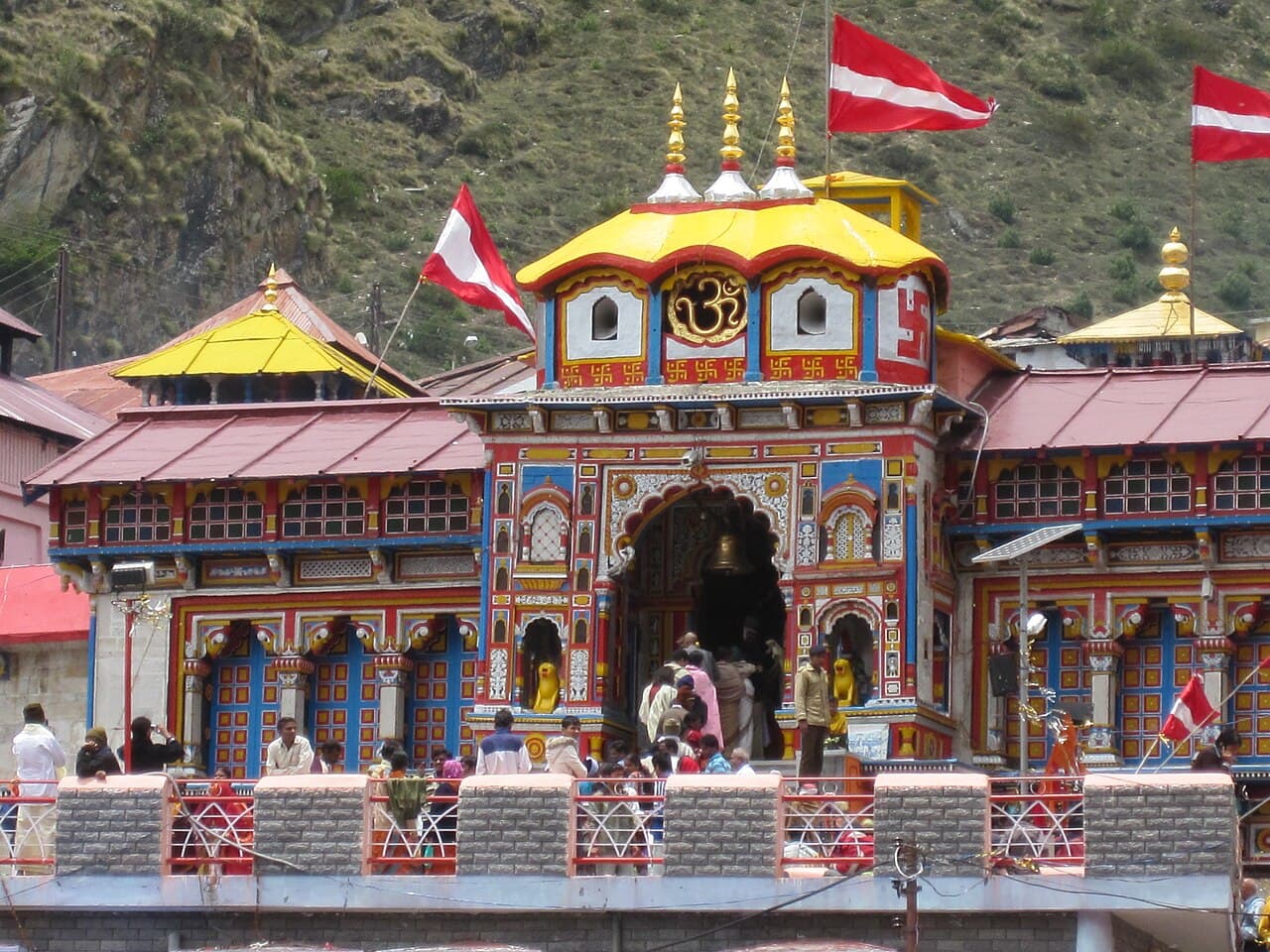
Vishnu as Badrinarayan in the high Himalaya — the northern seat of the Char Dham, on the Alaknanda between the Nar and Narayan peaks.
- Deity
- Vishnu (Badrinarayan)
- Location
- Chamoli, Uttarakhand
- Category
- Char Dham · Vishnu Desam
- Established
- Ancient Badrika Ashrama; revived by Adi Shankaracharya (8th–9th c.); present temple rebuilt after the 1803 earthquake
- Setting
- Garhwal Himalaya, on the Alaknanda between the Nar & Narayan peaks
- Best Time to Visit
- May–June and September–October
- Northern seat of the Char Dham, and one of Uttarakhand's Chota Char Dham
- One of the 108 Divya Desams sacred to Vaishnavism
- Deity is a ~1-foot self-manifested black Shaligram image of Vishnu in meditation
- Revived by Adi Shankaracharya in the 8th–9th century
- Stands about 3,133 m (10,280 ft) up, on the Alaknanda's left bank
- Tapt Kund hot springs (~55°C) lie just below the temple
- Open only about six months a year; the deity is moved to Joshimath for winter
Significance
Badrinath is the northern abode of the Char Dham, the four shrines that Adi Shankaracharya wove into a single all-India pilgrimage — Badrinath in the north, Puri in the east, Dwarka in the west and Rameswaram in the south. It is also one of Uttarakhand's Chota Char Dham (with Kedarnath, Gangotri and Yamunotri) and one of the 108 Divya Desams, the abodes of Vishnu sung by the Tamil Alvar saints — one of the few shrines held sacred across both the northern and southern Vaishnava traditions.
The deity is Vishnu as Badrinarayan, worshipped in a roughly one-foot black Shaligram image seated in meditation rather than the more common reclining or standing forms. It is counted among the eight svayam vyakta kshetras, shrines whose image is believed to be self-manifested rather than carved. Watched over in legend by the sage-twins Nar and Narayan — after whom the guardian peaks are named — Badrinath draws pilgrims who believe that darshan here, at the very edge of the habitable Himalaya, cleanses the sins of many lifetimes and turns the soul toward liberation.
History
Badrinath stands on the left bank of the Alaknanda in the Garhwal Himalaya, in a valley framed by the Nar and Narayan ranges beneath the snow-pyramid of Neelkanth. Its name comes from an old legend: Vishnu is said to have sat here through ages of meditation, unmindful of the cold, while the goddess Lakshmi sheltered him as a badri (jujube) tree — giving the place its ancient name, Badrika Ashrama, and the lord his name, Badrinath. The shrine is named in the Vishnu and Skanda Puranas, and pilgrims have made their way to this Badrika Ashrama for well over two thousand years.
The temple's revival is traditionally credited to Adi Shankaracharya, the philosopher-saint who in the 8th–9th century re-established Badrinath as a great seat of pilgrimage. Legend holds that he recovered the black-stone image of Badrinarayan from the Alaknanda, near the Tapt Kund springs, and first enshrined it in a cave nearby.
In the 16th century a King of Garhwal moved the image into the present temple. Perched on an active Himalayan fault, the shrine has been rebuilt more than once — most significantly after the great Garhwal earthquake of 1803, when it was extensively restored under the patronage of the King of Jaipur, with work continuing through the 19th century. Today it is managed, together with Kedarnath, by a state temple committee.
Architecture
The temple rises in three parts — the garbha griha (sanctum), the darshan mandapa where the rituals are performed, and the sabha mandapa where pilgrims gather. Its conical stone sanctum, about fifteen metres tall, is capped by a small gilded cupola, while the broad, brightly painted façade — reached by a stairway to a tall arched gateway, the Singh Dwara — gives the shrine its vivid, unmistakable look against the grey peaks.
Just below the temple, on the bank of the Alaknanda, steam rises from the Tapt Kund, a cluster of hot sulphur springs that stay near 55°C the year round; pilgrims traditionally bathe there before entering for darshan. The setting — a small stone town clinging to a river gorge between towering ridges — is as much a part of the pilgrimage as the shrine itself.
Festivals
Timings
Open only during the roughly six-month season — the shrine opens on Akshaya Tritiya (around April–May) and closes near Vijayadashami/Bhai Dooj (October–November). Daily darshan is about 4:30 AM–1:00 PM and 4:00–9:00 PM, opening with the Maha Abhishek at dawn and closing with the evening aarti and Geet Govinda. Confirm seasonal timings with the temple committee.
Badrinath lies at the road-head of the Garhwal Himalaya and is reached by a long mountain drive. The nearest airport is Jolly Grant at Dehradun (about 315 km), and the closest railheads are Rishikesh and Haridwar (roughly 290–300 km); from either, the road climbs along the Alaknanda through Devprayag, Rudraprayag, Karnaprayag and Joshimath before the final stretch to the temple. Shared jeeps and buses run through the season. Because the route crosses steep, landslide-prone terrain, travellers usually break the journey overnight and avoid the peak monsoon weeks of July and August.
Timings are indicative — please confirm with the temple trust before travelling.
Videos
Nearby Temples

Frequently Asked Questions
Where is Badrinath Temple located?+
Badrinath Temple is in Chamoli, Uttarakhand, India.
Which deity is worshipped at Badrinath Temple?+
Badrinath Temple is dedicated to Vishnu (Badrinarayan).
Which tradition does Badrinath belong to?+
Badrinath is one of the Char Dham temples dedicated to Vishnu.
What are the timings of Badrinath Temple?+
Open only during the roughly six-month season — the shrine opens on Akshaya Tritiya (around April–May) and closes near Vijayadashami/Bhai Dooj (October–November). Daily darshan is about 4:30 AM–1:00 PM and 4:00–9:00 PM, opening with the Maha Abhishek at dawn and closing with the evening aarti and Geet Govinda. Confirm seasonal timings with the temple committee.
What is the best time to visit Badrinath Temple?+
May–June and September–October
When was Badrinath Temple established?+
Badrinath Temple — Ancient Badrika Ashrama; revived by Adi Shankaracharya (8th–9th c.); present temple rebuilt after the 1803 earthquake.
Sources & further reading
Photo: Anubha khare · CC BY-SA 4.0