
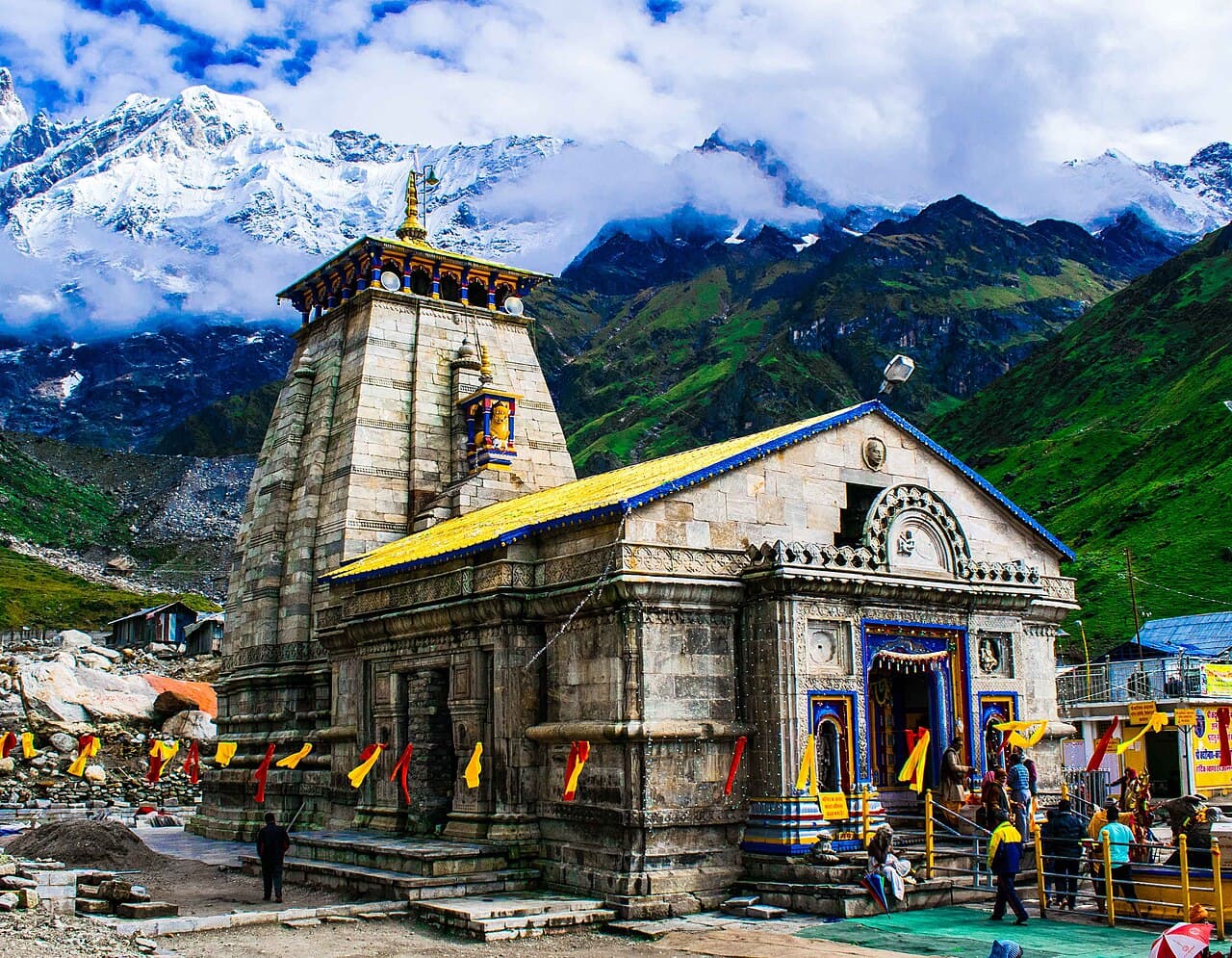
One of Shiva's most revered abodes — the highest of the twelve Jyotirlingas, at 3,583 m in the Garhwal Himalaya, open only half the year.
- Deity
- Shiva
- Location
- Kedarnath, Uttarakhand
- Category
- Jyotirlinga
- Established
- Revived 8th c. by Adi Shankara; ancient stone temple
- Setting
- Garhwal Himalaya, ~3,583 m, near the head of the Mandakini
- Best Time to Visit
- May–June and September–October
- Highest of the twelve Jyotirlingas at ~3,583 m
- Worshipped as a natural conical rock, not a carved lingam
- Chief among the Panch Kedar; a seat of the Chota Char Dham
- Founded by the Pandavas in legend; revived by Adi Shankaracharya
- Survived the June 2013 floods; the Bhim Shila boulder is venerated
- Open only ~six months a year; deity wintered at Ukhimath
- Reached by a ~16 km trek from Gaurikund
Significance
Kedarnath is the chief of the Panch Kedar, the five Himalayan shrines of Shiva, and one of the four seats of the Uttarakhand Chota Char Dham, so that a single journey through the Garhwal hills gathers it with Badrinath, Gangotri and Yamunotri. To stand before the rough dark rock in the cold thin air, after the long climb, is counted among the most powerful darshans in all of Shaivism.
Because snow closes the high valley for half the year, the temple keeps a seasonal rhythm found at few great shrines: opened around Akshaya Tritiya in spring and closed near Kartik Purnima in autumn, when the deity is carried down to Ukhimath to be worshipped through the winter. The opening and closing days, with their processions, are themselves great occasions.
History
Kedarnath stands near the head of the Mandakini valley in the Garhwal Himalaya, at about 3,583 metres the highest of the twelve Jyotirlingas and, for many, the most arduous and moving to reach. The grey-stone temple sits alone on a broad meadow beneath snow peaks, fed by the glaciers that give birth to the Mandakini, a tributary of the Ganga.
Tradition holds that the Pandavas raised the first shrine here, seeking Shiva to absolve the bloodshed of the Kurukshetra war; Shiva, unwilling to face them, took the form of a bull and dived into the earth, his hump surfacing at Kedarnath — worshipped ever since as a rough, conical rock rather than a carved lingam. Its revival into the great pan-Indian network of Shaiva shrines is credited to Adi Shankaracharya in the 8th century, whose samadhi is remembered just behind the temple.
Built of massive interlocking stone slabs set without mortar, the temple has stood through a thousand winters — and, most famously, through the flood of June 2013, when a torrent of water and debris destroyed the town around it but split around a great boulder that lodged behind the sanctum, leaving the shrine itself standing. That rock is now venerated as the Bhim Shila.
Architecture
The temple is a robust, high-plinthed structure of grey ashlar stone, built low and immensely strong to survive snow, avalanche and flood, and unusually oriented north to south. A small mandapa fronts the sanctum, which shelters the conical swayambhu rock; outside stands a large image of Nandi, the bull.
There is little ornament — the power of the place is in its bare stone, its endurance and its setting among the peaks, not in carving. Behind it rises the Adi Shankaracharya samadhi, rebuilt after the 2013 disaster, and the flood only deepened the shrine's aura of divine protection.
Festivals
Timings
Open ~6:00 AM – 7:00 PM in season (late Apr/May to Oct/Nov); closed through winter, when the deity is worshipped at Ukhimath.
Kedarnath is among the hardest of the Jyotirlingas to reach. The nearest airport is Jolly Grant at Dehradun and the nearest railhead Rishikesh, from which the road climbs some two hundred kilometres up the Garhwal valleys to Gaurikund; from there the temple is a further sixteen to seventeen kilometres on foot, by pony, by palanquin, or — for those who can — by helicopter from Phata or Guptkashi. The trek, hard as it is, is for most pilgrims part of the offering, and the shrine is open only from about late April or May to October or November.
Timings are indicative — please confirm with the temple trust before travelling.
Videos
Nearby Temples

Frequently Asked Questions
Where is Kedarnath Temple located?+
Kedarnath Temple is in Kedarnath, Uttarakhand, India.
Which deity is worshipped at Kedarnath Temple?+
Kedarnath Temple is dedicated to Shiva.
Which tradition does Kedarnath belong to?+
Kedarnath is one of the Jyotirlinga temples dedicated to Shiva.
What are the timings of Kedarnath Temple?+
Open ~6:00 AM – 7:00 PM in season (late Apr/May to Oct/Nov); closed through winter, when the deity is worshipped at Ukhimath.
What is the best time to visit Kedarnath Temple?+
May–June and September–October
When was Kedarnath Temple established?+
Kedarnath Temple — Revived 8th c. by Adi Shankara; ancient stone temple.
Sources & further reading
Photo: Shivam Kumar 766 · CC BY-SA 4.0