
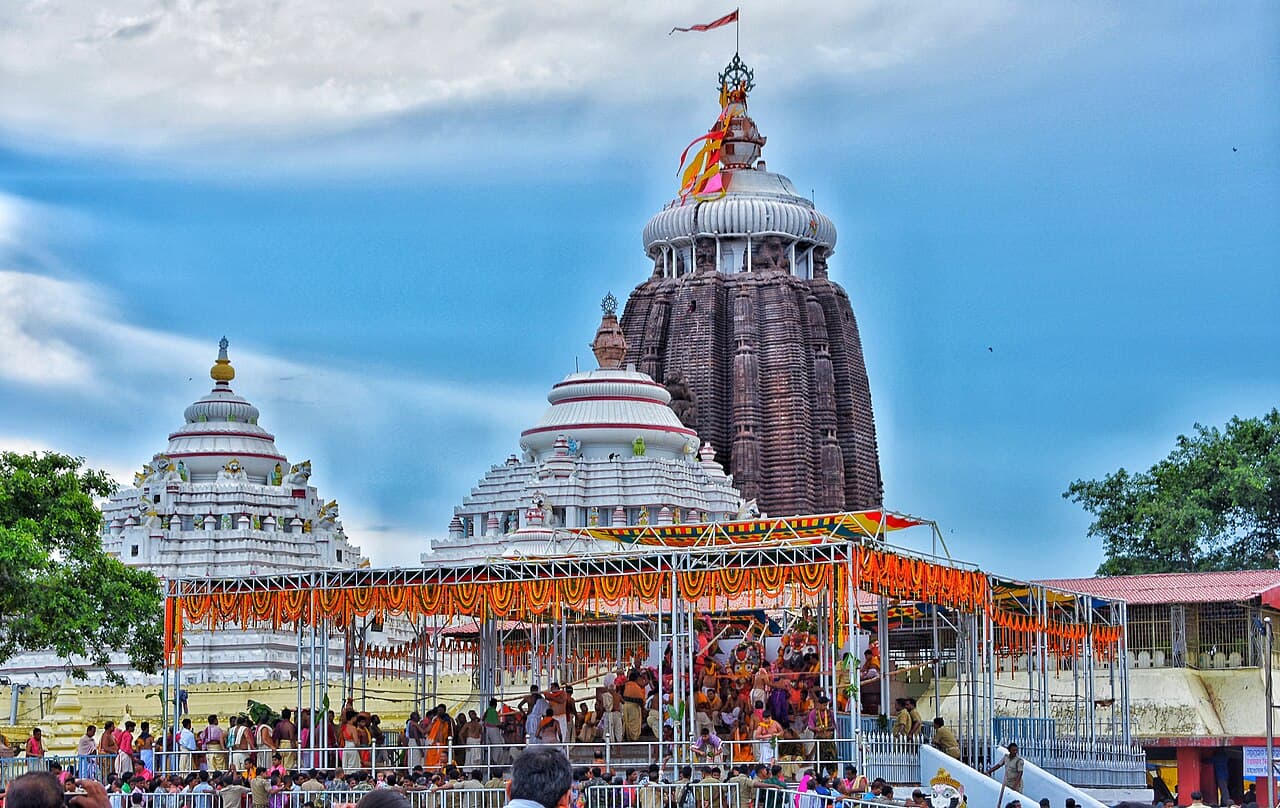
Lord Jagannath of Puri — the eastern seat of the Char Dham, famed for the world's grandest Rath Yatra.
- Deity
- Vishnu (Jagannath)
- Location
- Puri, Odisha
- Category
- Char Dham · Vishnu Desam
- Established
- Present temple 12th–13th century (Eastern Ganga dynasty; begun by Anantavarman Chodaganga Deva)
- Setting
- On the Nilachala hill near the Bay of Bengal, Puri
- Best Time to Visit
- October to February; and for the Rath Yatra in June–July
- Eastern seat of the Char Dham and one of the Sapta Puri
- Deities Jagannath, Balabhadra and Subhadra are carved from neem wood, not stone
- Images are periodically renewed in the Nabakalebara ceremony (every 12 or 19 years)
- Present temple built in the 12th century by Anantavarman Chodaganga Deva
- Kalinga-style tower rises ~65 m (214 ft), crowned by the ashtadhatu Nilachakra
- Its Mahaprasad is cooked in one of the world's largest temple kitchens
- The annual Rath Yatra draws the three deities through Puri on giant chariots
- By custom the flag is changed by hand daily and is said to fly against the wind
Significance
Puri is the eastern abode of the Char Dham, the four shrines that Adi Shankaracharya wove into a single all-India pilgrimage — Badrinath in the north, Dwarka in the west, Rameswaram in the south and Jagannath Puri in the east. It is also counted among the Sapta Puri, the seven cities held to grant liberation, so that for many Hindus a journey here is the culmination of a lifetime of devotion.
At the heart of Puri's spiritual life is the Mahaprasad, the food first offered to Jagannath and then shared among all pilgrims without distinction of caste or standing. Cooked in the temple's vast kitchen — often called one of the largest in the world — in stacked earthen pots over wood fires, it is distributed at the Ananda Bazaar and revered as supremely sacred. In that openness the temple voices a powerful ideal: before Jagannath, the 'Lord of the Universe', all devotees stand equal.
History
The Jagannath Temple crowns the Nilachala, the 'Blue Hill', in the coastal town of Puri, a little way from the Bay of Bengal. Unlike most Hindu shrines, its sanctum holds not stone icons but a triad carved from neem wood — Lord Jagannath, a form of Vishnu-Krishna, with his elder brother Balabhadra and their sister Subhadra, worshipped alongside the Sudarshana Chakra on a jewelled platform called the Ratnavedi.
The present temple was raised in the 12th century by Anantavarman Chodaganga Deva of the Eastern Ganga dynasty and, by most accounts, completed under his successor Anangabhima Deva in the 13th century. Puri had long been a great centre of Vaishnava devotion, and Adi Shankaracharya is traditionally said to have established one of his four cardinal monasteries, the Govardhana Matha, here.
The wooden images set Jagannath apart in another way. Because the sacred daru (neem wood) slowly decays, the deities are ritually renewed in the Nabakalebara — the 'new body' ceremony — when fresh images are carved from specially chosen trees and the old ones reverently buried. Recurring every twelve or nineteen years, it draws some of the largest crowds the town ever sees.
Architecture
The temple is a masterwork of the Kalinga style of Odishan architecture. Its curvilinear tower, the deul or vimana, rises about 65 metres (214 feet) over the sanctum and is crowned by the Nilachakra, an eight-spoked wheel cast from ashtadhatu, the traditional alloy of eight metals; above it the Patita Pavana flag is changed by hand each day by a priest who scales the sheer tower, a ritual said to be unbroken for centuries.
Two concentric walls enclose the complex, entered through four gates facing the cardinal directions — the Singhadwara or Lion Gate (the main eastern entrance), the Hathidwara, Vyaghradwara and Ashwadwara. Before the Lion Gate stands the sixteen-sided Aruna Stambha, a monolithic pillar brought from the Sun Temple at Konark. Along the main axis the sanctum is preceded by three great halls — the Jagamohana (assembly hall), the Nata Mandir (hall of dance) and the Bhoga Mandapa (hall of offerings). Devotees also cherish the beliefs that the temple flag flutters against the wind and that the great tower casts no shadow at noon — mysteries held in faith rather than settled by science.
Festivals
Timings
Open daily from about 5:00 AM, after the Mangala Aarti, until around 10:00 PM, with darshan in phases through the day and a customary afternoon pause; the deities' routine moves through the dhupa (meal) offerings to the evening Sandhya Aarti. Confirm the current schedule with the temple administration.
Puri sits on the Odisha coast and is easily reached. The nearest airport is Biju Patnaik International at Bhubaneswar, about 60 km away, from where taxis and buses run to the town; Puri's own railway station, roughly 3 km from the temple, is a well-connected terminus. The shrine stands at the heart of the old town on the Bada Danda (Grand Road), within walking distance of the sea. By long-standing custom, entry to the temple is permitted only to those of the Hindu — and, by tradition, Jain, Sikh and Buddhist — faiths; other visitors often view it from rooftops nearby, such as the Raghunandan Library.
Timings are indicative — please confirm with the temple trust before travelling.
Videos
Nearby Temples

Frequently Asked Questions
Where is Jagannath Puri Temple located?+
Jagannath Puri Temple is in Puri, Odisha, India.
Which deity is worshipped at Jagannath Puri Temple?+
Jagannath Puri Temple is dedicated to Vishnu (Jagannath).
Which tradition does Jagannath Puri belong to?+
Jagannath Puri is one of the Char Dham temples dedicated to Vishnu.
What are the timings of Jagannath Puri Temple?+
Open daily from about 5:00 AM, after the Mangala Aarti, until around 10:00 PM, with darshan in phases through the day and a customary afternoon pause; the deities' routine moves through the dhupa (meal) offerings to the evening Sandhya Aarti. Confirm the current schedule with the temple administration.
What is the best time to visit Jagannath Puri Temple?+
October to February; and for the Rath Yatra in June–July
When was Jagannath Puri Temple established?+
Jagannath Puri Temple — Present temple 12th–13th century (Eastern Ganga dynasty; begun by Anantavarman Chodaganga Deva).
Sources & further reading
Photo: Prachites · CC BY-SA 3.0