Krishna kept as a king in a merchant's mansion — the Pushtimarg haveli above Mathura's Vishram Ghat, where the doors open eight times a day and not once between.
- Deity
- Vishnu (Krishna as Dwarkadhish)
- Location
- Mathura, Uttar Pradesh
- Category
- Vishnu Desam
- Established
- Begun 1814 by Seth Gokul Das Parikh, treasurer of the Gwalior state, and completed by his heir Seth Lakshmi Chandra; seva under the Pushtimarg's third gaddi at Kankroli since 1930
- Setting
- Rajadhiraj Bazaar in old Mathura, a short walk from Vishram Ghat on the Yamuna
- Best Time to Visit
- October to March; the Hindola days of Shravan (July–August) and Janmashtami
- Begun in 1814 by Seth Gokul Das Parikh, treasurer of the Gwalior state
- Approved and part-funded by Daulatrao Scindia of Gwalior; finished by Seth Lakshmi Chandra
- Served since 1930 in Vallabhacharya's Pushtimarg, under the third gaddi at Kankroli
- Eight darshans a day: Mangala, Shringar, Gwal, Rajbhog, Utthapan, Bhog, Sandhya and Shayan
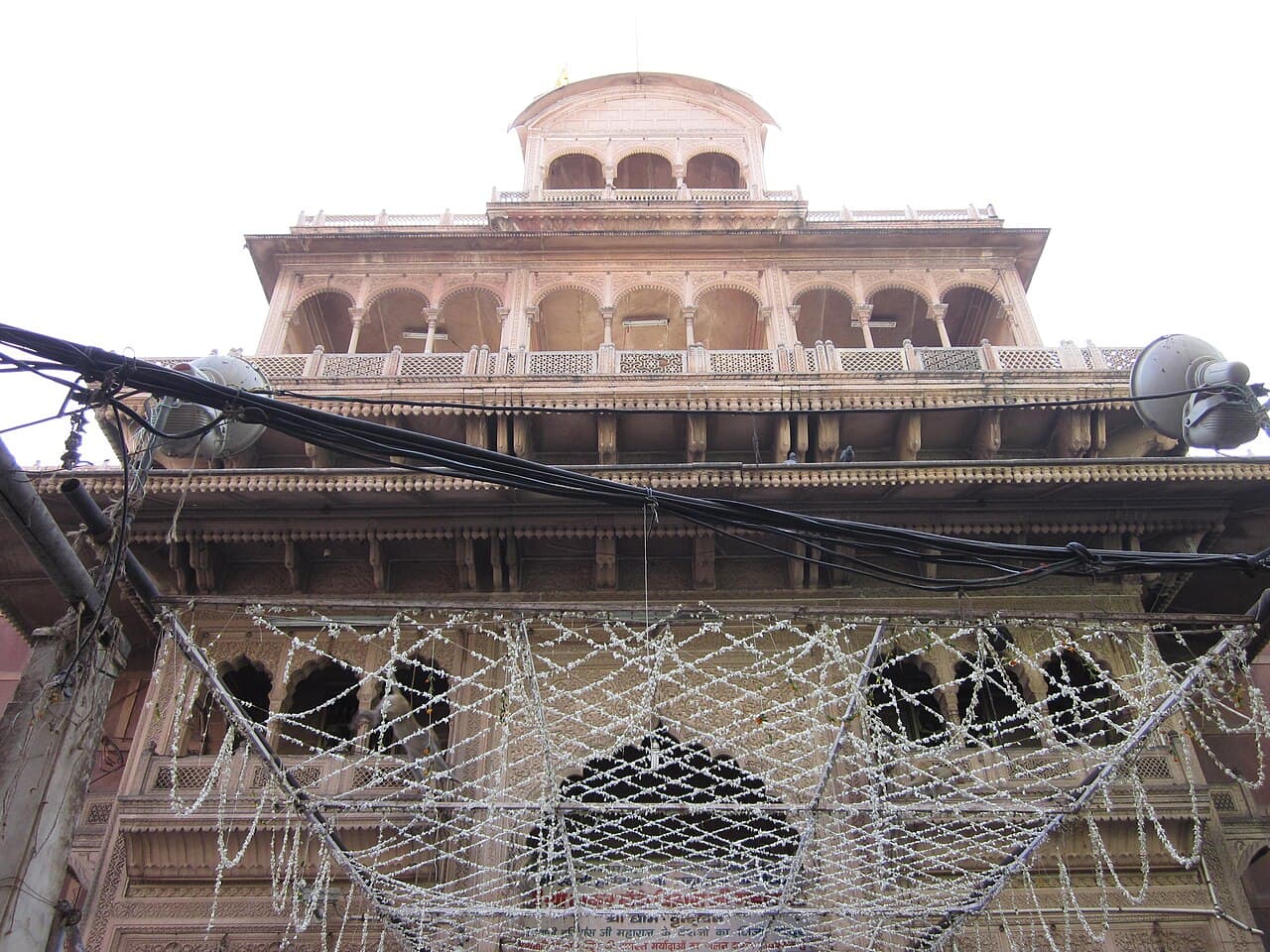
- A haveli, not a spired temple — a carved Rajasthani gateway set in a bazaar wall
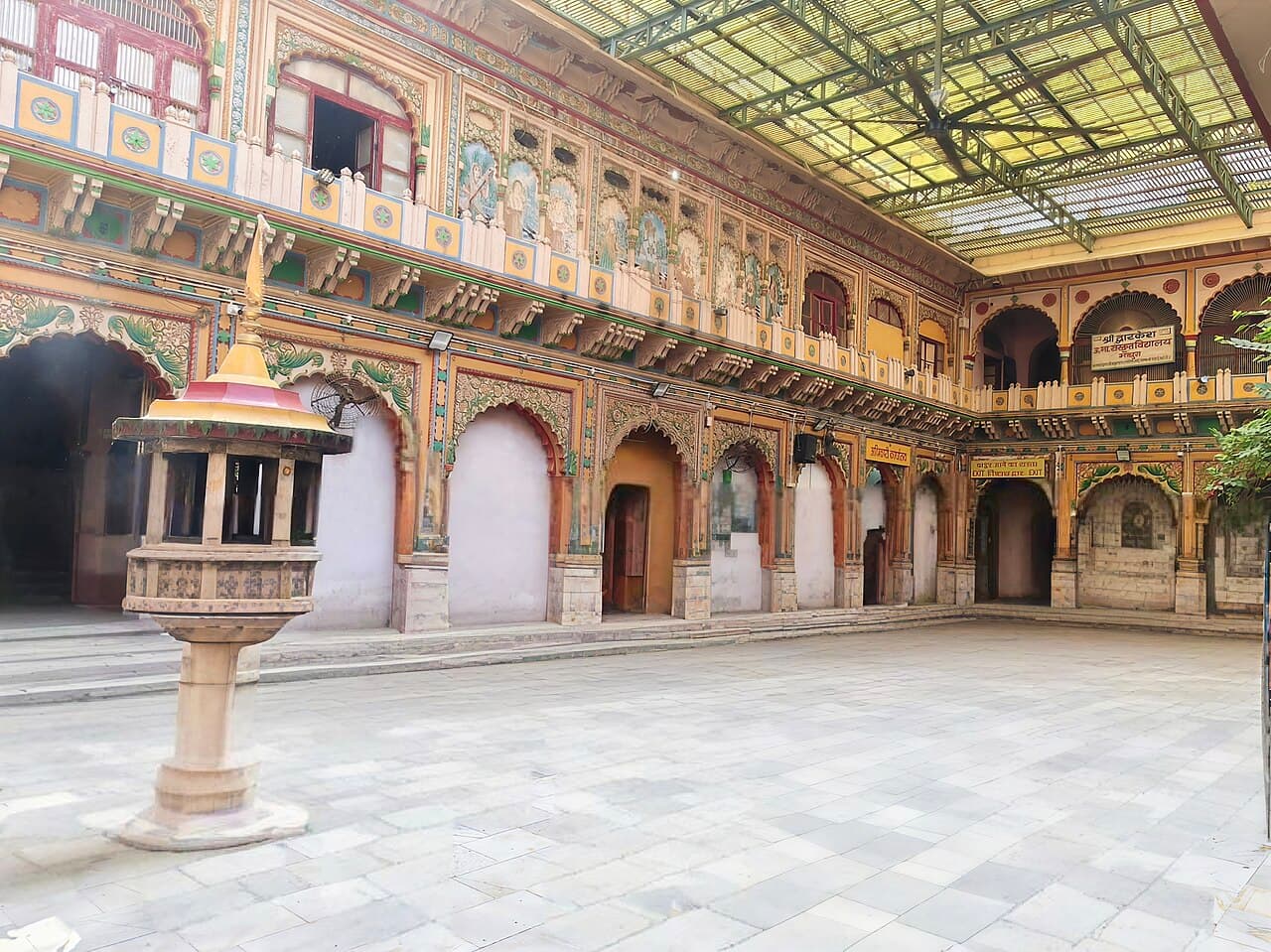
- Painted courtyard: five rows of carved pillars and galleries of Krishna's life
- Hindola Utsav — thirteen days of gold and silver swings through Shravan
- Steps from Vishram Ghat, where Mathura's five-kos parikrama begins and ends
Significance
Vallabhacharya (1478–1530) taught that the Lord is won not by knowledge or austerity but by pushti — grace — and that the devotee's whole work is seva, service offered as a household offers it to one it loves. Pushtimarg shrines are therefore havelis, mansions rather than temples, and the Lord within is master of the house: woken, dressed, fed, fanned, sung to and put to bed. Vitthalnathji, his son, divided that service among seven houses; the third — Balkrishnalalji's, at Kankroli — holds Dwarkadhish as its own swaroop, and Mathura's haveli belongs to it.
The day is therefore a sequence of eight darshans, and the doors part only for them. Mangala wakes the Lord at dawn; Shringar dresses and ornaments him; Gwal sends him out with the cows; Rajbhog, the midday offering, closes the house until afternoon. Utthapan rouses him from rest, Bhog brings the evening food, the Sandhya aarti follows, and Shayan puts him to sleep.
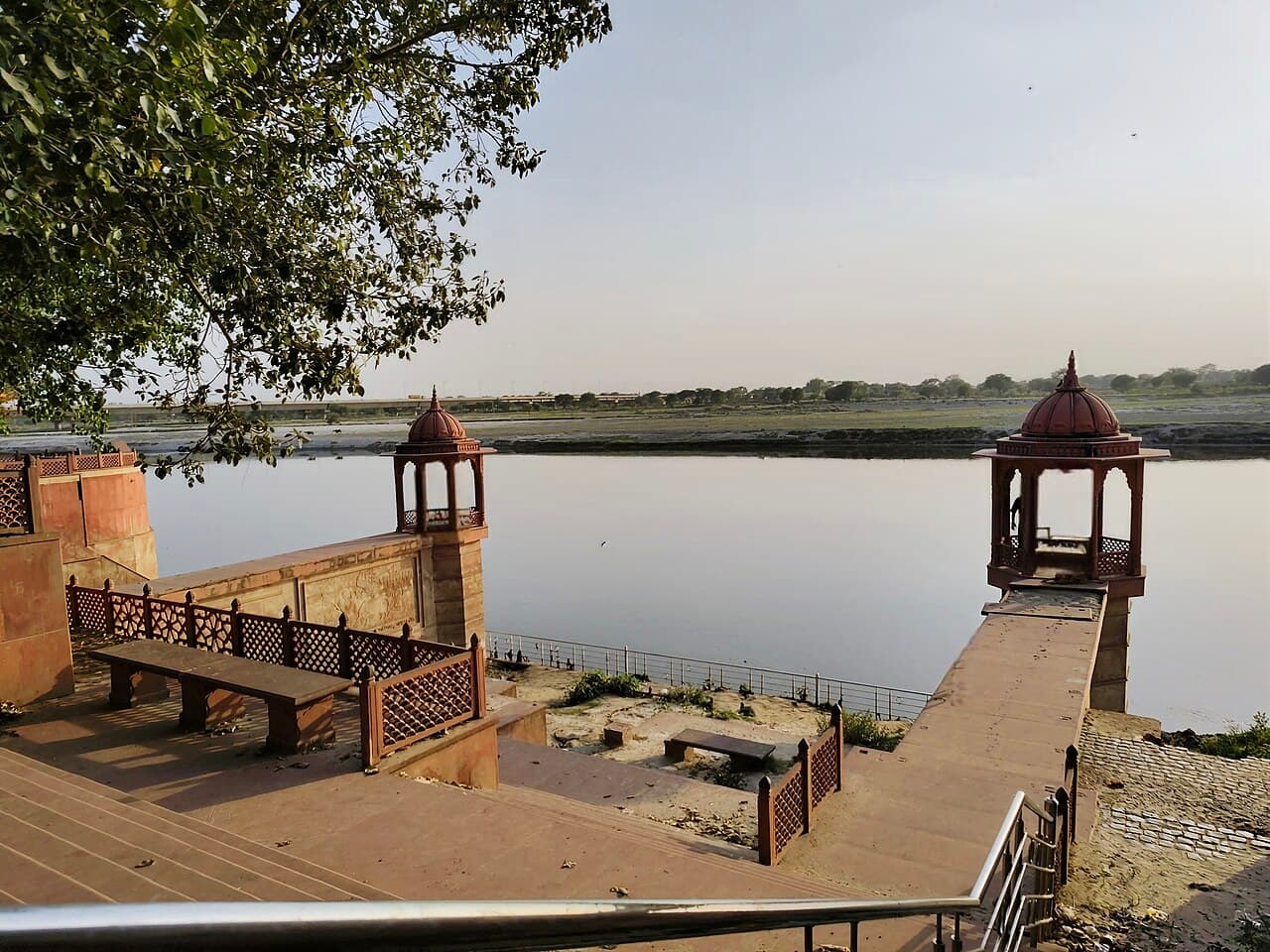
Out of the gate the bazaar runs down to Vishram Ghat, most revered of Mathura's twenty-five ghats, where Krishna is said to have rested after killing Kansa and freeing his parents — vishram is simply 'rest'. The fifteen-kilometre Mathura parikrama, five kos in all, is by custom begun and closed here with a bath in the Yamuna, and at dusk the lamps go down the stone steps for the Yamuna aarti.
History
The temple stands in the Rajadhiraj Bazaar of old Mathura, between Vishram Ghat and Asikunda Ghat on the Yamuna — a young shrine in a very old city. Its Krishna is not the flute-player of the Braj woods but the sovereign: Dwarkadhish, lord of Dwarka, the son Mathura remembers leaving for the western sea. He stands in black marble with a white marble Radharani beside him: a wholly separate shrine from the Jagat Mandir on the Arabian Sea, and named for it.
Seth Gokul Das Parikh, treasurer of the Gwalior state under Shrimant Daulatrao Scindia, began the building in 1814 with his Maharaja's approval and a donation towards it; he died before it was finished, and his heir Seth Lakshmi Chandra completed it. Gokul Das was a Vaishnava of the Pushtimarg and a devotee of the sampradaya's third gaddi, whose own Dwarkadhish is enshrined at Kankroli in Mewar — which is how a Gwalior treasurer's temple in Mathura came to carry a Saurashtra name.
In 1930 the seva of the shrine was made over to Acharya Giridharlalji of Kankroli, and has followed Pushtimarg usage exactly ever since. The gateway still announces it: a peeth of the Shuddhadvaita path of Jagadguru Shri Vallabhacharya, the deity styled Shri Rajadhiraj Thakur Shri Dwarkadhishji Maharaj — king of kings.
Architecture
From the lane the haveli shows only a tall carved gateway of Rajasthani work — cusped arches, deep foliate borders, jharokhas above — set flush in a wall of shops, with nothing of a spire about it.
Within, it is a rich merchant's courtyard house turned to worship, and that courtyard is its fame: a wide flagged court open to the sky, arcaded on all sides in two storeys. Five rows of carved pillars divide it into three lanes — one for women, one for men, the centre kept clear — and above them the galleries, brackets and ceilings are painted in the bright palette of Rajasthan with the life of Krishna, from the birth to the leelas of Braj. Through Shravan the swings hang in this same court for the thirteen days of the Hindola Utsav, when Dwarkadhish and Radharani leave the sanctum for jhoolas of gold and silver; and on Janmashtami, while the whole city keeps vigil for the midnight birth, the Lord here is bathed in water, milk and curd and laid in a cradle.
Festivals
Timings
The doors open only for the eight darshans of the Pushtimarg seva-krama — broadly 6:30–10:30 AM, and (on the evening schedule revised from Ram Navami 2026) about 4:00–7:30 PM in summer, with winter evenings starting nearer 3:30 PM. Indicative times: Mangala 6:30 AM, Shringar 7:40 AM, Gwal 8:25 AM and Rajbhog 10:00 AM; Utthapan 4:00 PM, Bhog 4:45 PM, Sandhya aarti 5:20 PM and Shayan 6:30 PM. Times move with the season and the festival calendar — confirm with the temple.
Mathura lies about a hundred and sixty kilometres south-east of Delhi on the Yamuna Expressway. Mathura Junction, on the trunk lines to Mumbai and Chennai, is three to four kilometres away; e-rickshaws reach the old city and the last lanes are walked. Agra's Kheria airport is nearest at about forty-six kilometres and Delhi's Indira Gandhi International about a hundred and thirty-six; the new Noida International Airport at Jewar lies between them on the Expressway.
Timings are indicative — please confirm with the temple trust before travelling.
Nearby Temples

Frequently Asked Questions
Where is Shri Dwarkadhish, Mathura Temple located?+
Shri Dwarkadhish, Mathura Temple is in Mathura, Uttar Pradesh, India.
Which deity is worshipped at Shri Dwarkadhish, Mathura Temple?+
Shri Dwarkadhish, Mathura Temple is dedicated to Vishnu (Krishna as Dwarkadhish).
Which tradition does Shri Dwarkadhish, Mathura belong to?+
Shri Dwarkadhish, Mathura is one of the Vishnu Desam temples dedicated to Vishnu.
What are the timings of Shri Dwarkadhish, Mathura Temple?+
The doors open only for the eight darshans of the Pushtimarg seva-krama — broadly 6:30–10:30 AM, and (on the evening schedule revised from Ram Navami 2026) about 4:00–7:30 PM in summer, with winter evenings starting nearer 3:30 PM. Indicative times: Mangala 6:30 AM, Shringar 7:40 AM, Gwal 8:25 AM and Rajbhog 10:00 AM; Utthapan 4:00 PM, Bhog 4:45 PM, Sandhya aarti 5:20 PM and Shayan 6:30 PM. Times move with the season and the festival calendar — confirm with the temple.
What is the best time to visit Shri Dwarkadhish, Mathura Temple?+
October to March; the Hindola days of Shravan (July–August) and Janmashtami
When was Shri Dwarkadhish, Mathura Temple established?+
Shri Dwarkadhish, Mathura Temple — Begun 1814 by Seth Gokul Das Parikh, treasurer of the Gwalior state, and completed by his heir Seth Lakshmi Chandra; seva under the Pushtimarg's third gaddi at Kankroli since 1930.
Sources & further reading
Photo: Aliva Sahoo · CC BY-SA 3.0