
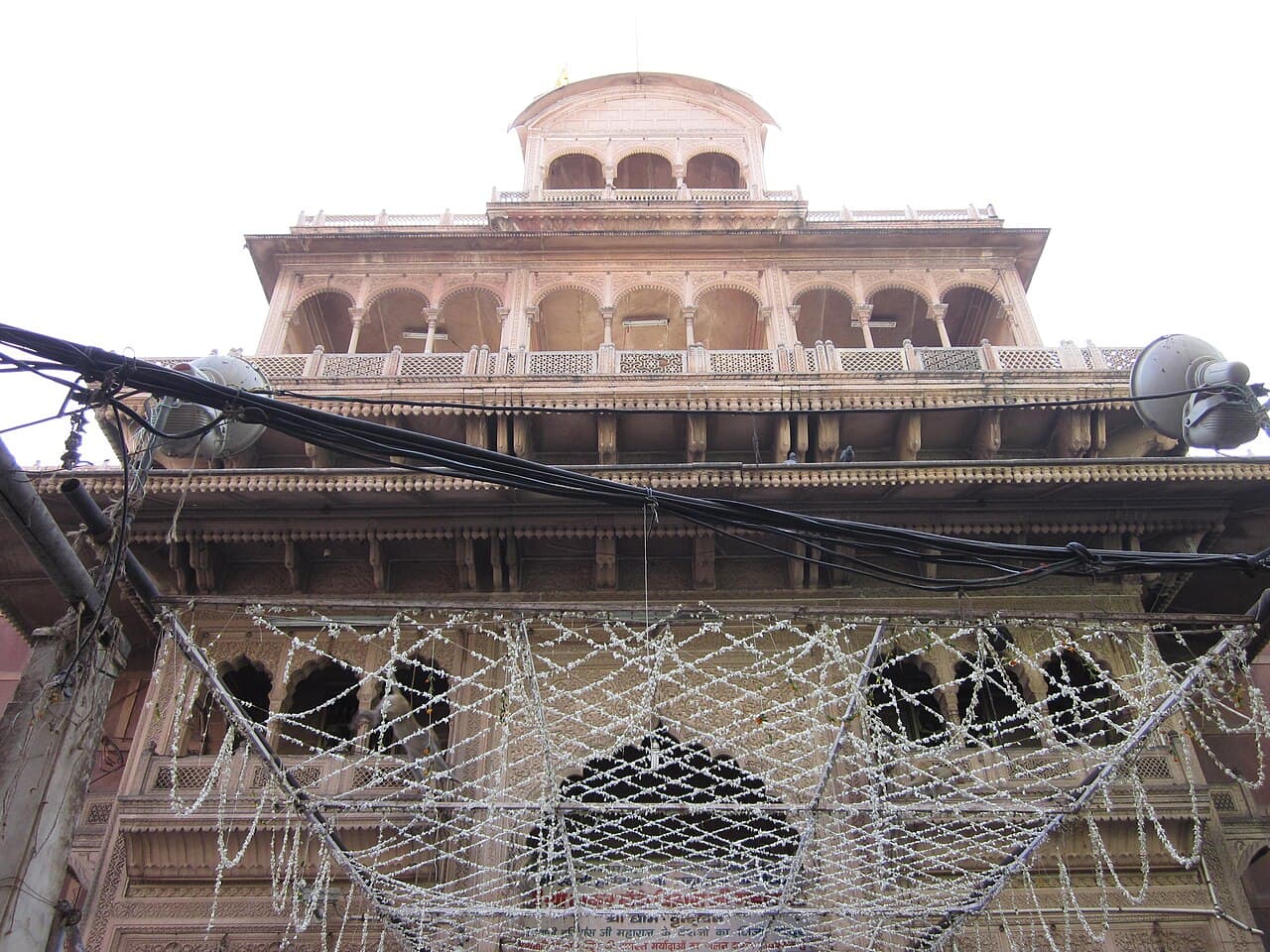
Krishna as Banke Bihari, revealed to Swami Haridas in the grove of Nidhivan — where the curtain closes every few minutes, no bell is ever rung, and the Mangala aarti comes once a year.
- Deity
- Krishna (Banke Bihari)
- Location
- Vrindavan, Mathura, Uttar Pradesh
- Category
- Vishnu Desam
- Established
- Deity revealed to Swami Haridas in Nidhivan and worshipped there; present temple raised by the Goswamis in the 1860s (the temple's own record 1862; UP tourism and district records 1864)
- Setting
- In the lanes of Vrindavan, near the Radha Vallabh temple and a short walk from Nidhivan
- Best Time to Visit
- October to March, and the Phool Bangla season (spring to Shravan) for the flower bungalows; 30,000–40,000 come on an ordinary day and up to five lakh on the great festivals
- Krishna as Banke Bihari — banke, bent in three places (tribhanga); bihari, the enjoyer
- Revealed to Swami Haridas as he sang in Nidhivan, where his samadhi still stands
- Jhanki darshan — the curtain is drawn across the deity every few minutes
- No bells hang in the temple and no conch is sounded; the deity is served as a child
- Mangala aarti on one day of the year only — Krishna Janmashtami
- Charan darshan on Akshaya Tritiya alone, with sarvang darshan the same evening
- Phool Bangla from Kamada Ekadashi to Hariyali Amavasya — a bungalow of flowers in the jagmohan
- On Sharad Purnima the flute is placed in his hands and at his lips
Significance
Darshan here is never continuous. A curtain is drawn across the deity every few minutes and opened again — in the temple's own words the darshan is never continuous but is broken by the curtain drawn on him regularly — and the district record calls it jhanki darshan, a tableau seen under a purdah. Devotees explain it by the pull of those eyes: hold his gaze unbroken, they say, and he would rise and follow you home. The sight comes in glimpses, the crowd's cry rising each time the cloth parts.
He is served as a small child, and the house rules follow from it. There is no Mangala aarti, because Swami Haridas would not have him woken at dawn when he has played through the night; the temple's calendar records exactly one exception in the year, Krishna Janmashtami. No bells hang anywhere in the temple and no conch is sounded, lest the sleeping child be startled. Three services carry the day: Shringar, Rajbhog and Shayan.
The year turns on rare sights. On Akshaya Tritiya alone he gives charan darshan in the morning and sarvang darshan in the evening, cooled with sandalwood, a ball of chandan set at his feet and carried home in fragments as prasad. From Kamada Ekadashi to Hariyali Amavasya he sits in the jagmohan under the Phool Bangla, a bungalow woven of flowers against the heat. On Sharad Purnima the flute is placed in his hands and at his lips — every other day it rests beside the throne — and darshan is held open until the moonlight reaches his feet. Hariyali Teej brings the jhoola; Bihar Panchami marks his day of appearance.
History
Swami Haridas was born, the temple's own record says, on Radha Ashtami in Vikram Samvat 1535 — 1478 CE — at Haridaspur near Aligarh. He came to Vrindavan and made his sadhana in Nidhivan, a dense grove at the edge of the town, singing dhrupad to a god he could not see. He founded the Haridasi sampradaya, and popular tradition — which some scholars dispute — makes him the teacher of Tansen.
There, as he sang in the kunj, the divine couple appeared before his disciples in a blaze of light, smiling and at play. Haridas asked that they take a form his followers could bear, and the two merged into a single dark image. He called it Kunj Bihari; his disciples renamed it Banke Bihari — banke, bent in three places, for the tribhanga stance, and bihari, the enjoyer. Service passed to his younger brother Jagannath and has stayed in that family since.
The image was worshipped in Nidhivan for some three centuries. In the 1860s the goswamis raised the present temple in the lanes of Vrindavan and carried him there — the temple's own history gives 1862, the state and district tourism records 1864. It remains, as the board above its gate declares, the private shrine of Swami Haridas's descendants. His samadhi is still in Nidhivan, and every Guru Purnima the temple offers him a Phool Bangla there.
Architecture
The building is nineteenth-century Rajasthani work, wedged into a narrow lane and best seen from directly below: a carved sandstone front climbing in tiers of arcaded galleries and pierced jali balustrades to a domed pavilion, with jharokha windows along the way. Behind the gates the crowd gathers in the jagmohan, the hall before the sanctum, where the deity is brought out for the Phool Bangla and for Sharad Purnima.
The image itself is small and dark, standing in the three-fold bend that gives it its name and dressed afresh through the day. No bell hangs above the crowd; the goswami families who serve it live behind the temple.
Festivals
Timings
Summer (about 5 March – 10 November): opens 7:45 AM with Shringar aarti at 7:55, bhog 11:00–11:30 AM, aarti and closing at 12:00 noon; reopens 5:30 PM, bhog 8:30–9:00 PM, aarti and closing 9:30 PM. Winter hours run roughly 8:45 AM – 1:00 PM and 4:30 PM – 8:30 PM. There is no Mangala aarti on any day except Janmashtami. Confirm current timings with the temple.
Vrindavan lies about fourteen kilometres from Mathura Junction, the temple's nearest railhead, with Agra's Kheria airport some seventy kilometres away and Delhi's IGI about a hundred and fifty. Road access is by NH-44 or the Yamuna Expressway; the Chhatikara stop on NH-44 is nearest to Vrindavan, with e-rickshaws for the last stretch. No vehicle reaches the temple — park in the town and walk the lanes. Phones, leather items and umbrellas are not allowed inside, and there is no VIP darshan.
Timings are indicative — please confirm with the temple trust before travelling.
Nearby Temples

Frequently Asked Questions
Where is Shri Banke Bihari Mandir, Vrindavan Temple located?+
Shri Banke Bihari Mandir, Vrindavan Temple is in Vrindavan, Mathura, Uttar Pradesh, India.
Which deity is worshipped at Shri Banke Bihari Mandir, Vrindavan Temple?+
Shri Banke Bihari Mandir, Vrindavan Temple is dedicated to Krishna (Banke Bihari).
Which tradition does Shri Banke Bihari Mandir, Vrindavan belong to?+
Shri Banke Bihari Mandir, Vrindavan is one of the Vishnu Desam temples dedicated to Vishnu.
What are the timings of Shri Banke Bihari Mandir, Vrindavan Temple?+
Summer (about 5 March – 10 November): opens 7:45 AM with Shringar aarti at 7:55, bhog 11:00–11:30 AM, aarti and closing at 12:00 noon; reopens 5:30 PM, bhog 8:30–9:00 PM, aarti and closing 9:30 PM. Winter hours run roughly 8:45 AM – 1:00 PM and 4:30 PM – 8:30 PM. There is no Mangala aarti on any day except Janmashtami. Confirm current timings with the temple.
What is the best time to visit Shri Banke Bihari Mandir, Vrindavan Temple?+
October to March, and the Phool Bangla season (spring to Shravan) for the flower bungalows; 30,000–40,000 come on an ordinary day and up to five lakh on the great festivals
When was Shri Banke Bihari Mandir, Vrindavan Temple established?+
Shri Banke Bihari Mandir, Vrindavan Temple — Deity revealed to Swami Haridas in Nidhivan and worshipped there; present temple raised by the Goswamis in the 1860s (the temple's own record 1862; UP tourism and district records 1864).
Sources & further reading
Photo: Guptaele · CC BY-SA 4.0