
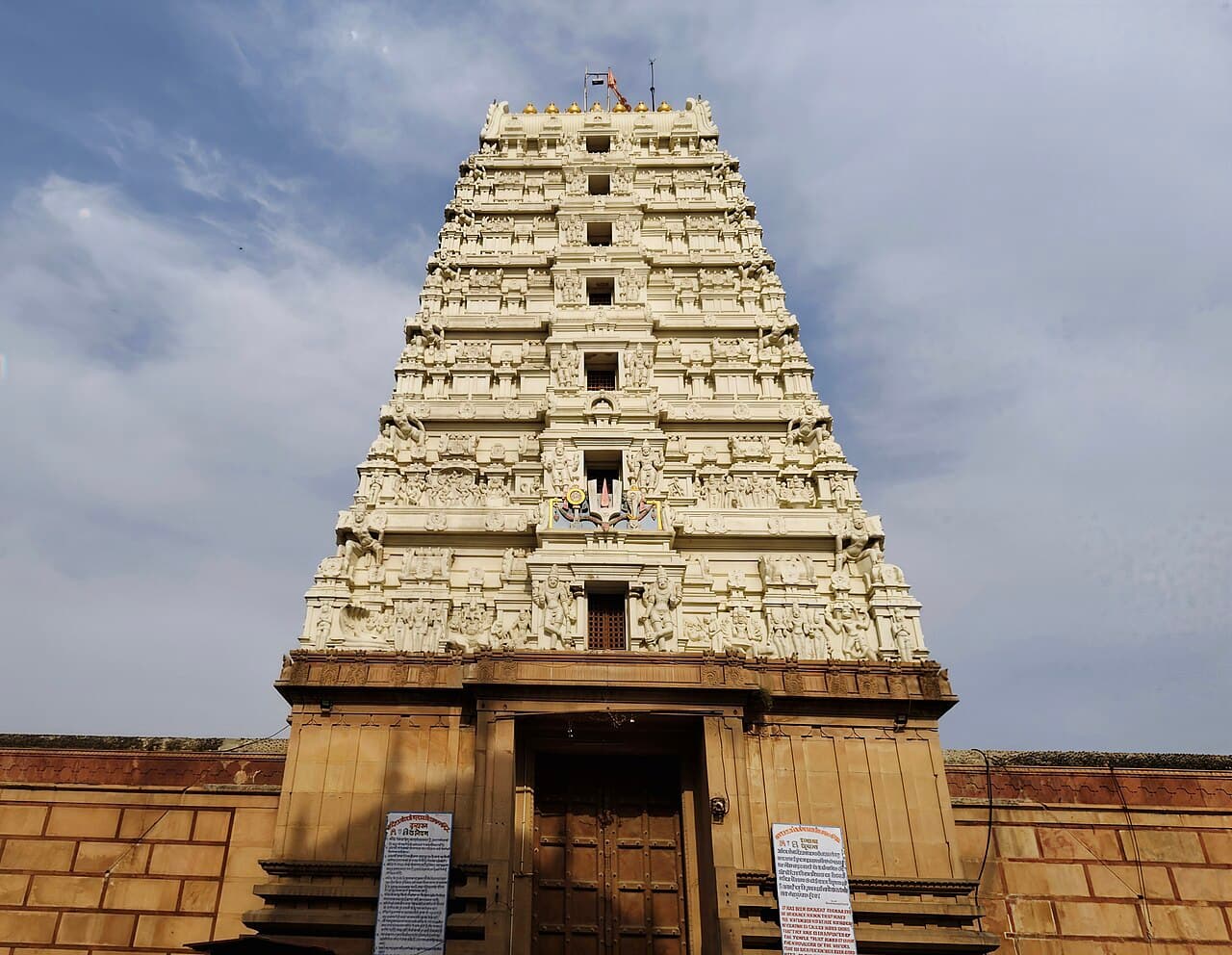
A seven-storey Dravidian gopuram and a fifty-foot gilded flagstaff in the middle of Braj — Ranganatha of the South brought north in 1851 to keep Andal's wish to live at Krishna's feet in Vrindavan.
- Deity
- Vishnu (Sri Goda-Rangamannar / Ranganatha)
- Location
- Vrindavan, Mathura, Uttar Pradesh
- Category
- Vishnu Desam
- Established
- Built 1845–1851 at a cost of ₹45 lakh, by Seth Radha Krishna Das and Seth Govind Das of Mathura under Sri Rangadeshik Swami; held since by the Sri Rangji Temple Trust
- Setting
- On the Mathura–Vrindavan road, Vrindavan, Mathura district
- Best Time to Visit
- October to March; the Brahmotsav 'Rath ka Mela' (March–April) and Dhanurmas (16 December – 14 January)
- Sri Goda-Rangamannar — Ranganatha standing as Andal's bridegroom, walking stick in hand
- The largest South-Indian-style temple in North India (Utsav portal, Ministry of Tourism)
- Built 1845–1851 for ₹45 lakh by Seth Radha Krishna Das and Seth Govind Das of Mathura
- Sri Rangadeshik Swami took Srirangam's leave first; craftsmen came north from there
- Five concentric enclosures; a seven-storey western gopuram and a five-storey eastern one
- A 50-ft gold-plated dhwaja-stambha stands past the clock tower
- Brahmotsav — ten days of Chaitra, all Braj's 'Rath ka Mela'; kept 17–26 March in 2025
- Sri Vaishnava (Ramanuja) worship in Braj — the Tiruppavai chanted daily through Dhanurmas
Significance
At Srirangam, first of the 108 Divya Desams, Ranganatha lies full length asleep upon Adishesha. Here he stands: the mool-vigraha is Rangamannar the bridegroom, a walking stick in his hand as a South Indian groom carries at his wedding, Goda at his right and Garuda at his left — the marriage that closes Andal's story, set up at last in the land she sang of. The lineage is Srirangam's; the form in the sanctum is its own.
What came north with the stone was a whole calendar. Through Dhanurmas, from 16 December to 14 January, the thirty pasurams of the Tiruppavai are recited before dawn as in the Vishnu temples of the Tamil south. Vaikunth Ekadasi opens the Vaikunth Dwar, unbarred once a year and no more. Goda's own ten-day utsav falls in the monsoon, and each morning the water for the deity's bath is drawn from the temple tank, honoured here as a form of the Yamuna.
Greatest of all is the Brahmotsav, ten days of Chaitra in March or April, close on the heels of Holi, which all Braj calls the Rath ka Mela, the fair of the chariot. Morning and evening the utsava-vigrahas go out on a different vahana: lion, sun, Garuda, Sesha, elephant, the golden palanquin. On the great day the wooden rath is brought out, the one day it moves, and thousands take the ropes and draw it to the garden; before the ten days end the Lord plays Holi from a palanquin of mirrors.
History
Vrindavan holds thousands of temples and only one of them looks like this. On the Mathura road, behind a stone gate carved in the Jaipur manner, a seven-storeyed gopuram rises over five walled enclosures — the largest South-Indian-style temple in North India, to all Braj simply Rangji. The deity is Sri Goda-Rangamannar: Ranganatha with Goda beside him, the eighth-century Tamil saint the South calls Andal.
Andal was the foster-daughter of Periyalvar of Srivilliputtur, and the thirty verses of her Tiruppavai are a girl's vow to reach Krishna in the pastures of Braj. Tradition gives her three wishes, one of them to live out her life at Krishna's feet in Vrindavan; it is that wish this temple was raised to keep. Two brothers of Mathura, Seth Radha Krishna Das and Seth Govind Das, came to their acharya with the means to build it — Sri Rangadeshik Swami (1809–1873), who had carried Ramanuja's Sri Vaishnava lineage north and founded the Goverdhan Peeth.
He went first to Srirangam and asked the leave of the divine couple there before a stone was laid; craftsmen were engaged in that town and brought the length of India. Work began in 1845 and ended in 1851, at a cost of forty-five lakh rupees. The shrine is held by the Sri Rangji Temple Trust, whose managing trustee is still the Goverdhan Peeth's head, Swami Sri Goverdhan Rangacharya, fifth in the founder's line.
Architecture
Five concentric rectangular enclosures stand one inside the next with the sanctum at the centre — Srirangam's scheme, reduced and rebuilt by northern hands. Both chief entrances are stone gates cut in the Jaipur style, and that meeting is the character of the building: Rajput gateways opening on Dravidian towers. Behind the western gate rises a gopuram of seven storeys, the eastern has five, and between them lie the Pushkarni, the temple's tank, and a formal garden to which the weekly sawari goes out.
Past the clock tower and another gate stands the dhwaja-stambha, fifty feet of flagstaff under gold plate. Around the inner circuit, clockwise, are the sannidhis of Sudarshana, Narasimha, Venkateswara, Venugopal, the Alvars, Ramanuja and the founder himself. Outside the western gate waits the wooden rath that moves once a year and no oftener.
Festivals
Timings
Mangala aarti and Vishwaroop darshan at 5:00–5:30 AM, Jalaanayan from the Pushkarni at 6:30, Divya Aradhan 6:30–7:30 AM and bhog 8:00–9:00. The sanctum is open for darshan roughly 11:00 AM–4:00 PM from April to August and 12:00 noon–3:00 PM from September to March, with evening aarti 6:00–6:30 PM and evening bhog 7:00–7:30; in the September–March half a night aradhan and bhog follow before darshan closes at 9:00 PM. Timings shift during the utsavas — confirm with the temple trust.
Rangji stands in Vrindavan, about eleven kilometres by road from Mathura. Mathura Junction is the railhead: Vrindavan's own metre-gauge station closed in 2023 and its track has since been lifted, so the last stretch is by road, and autos and e-rickshaws run it all day. The district gives Agra's Kheria airport at forty-six kilometres and Delhi's Indira Gandhi International at a hundred and thirty-six, with the Yamuna Expressway the usual road down from Delhi.
Timings are indicative — please confirm with the temple trust before travelling.
Nearby Temples

Frequently Asked Questions
Where is Shri Rangji (Ranganatha), Vrindavan Temple located?+
Shri Rangji (Ranganatha), Vrindavan Temple is in Vrindavan, Mathura, Uttar Pradesh, India.
Which deity is worshipped at Shri Rangji (Ranganatha), Vrindavan Temple?+
Shri Rangji (Ranganatha), Vrindavan Temple is dedicated to Vishnu (Sri Goda-Rangamannar / Ranganatha).
Which tradition does Shri Rangji (Ranganatha), Vrindavan belong to?+
Shri Rangji (Ranganatha), Vrindavan is one of the Vishnu Desam temples dedicated to Vishnu.
What are the timings of Shri Rangji (Ranganatha), Vrindavan Temple?+
Mangala aarti and Vishwaroop darshan at 5:00–5:30 AM, Jalaanayan from the Pushkarni at 6:30, Divya Aradhan 6:30–7:30 AM and bhog 8:00–9:00. The sanctum is open for darshan roughly 11:00 AM–4:00 PM from April to August and 12:00 noon–3:00 PM from September to March, with evening aarti 6:00–6:30 PM and evening bhog 7:00–7:30; in the September–March half a night aradhan and bhog follow before darshan closes at 9:00 PM. Timings shift during the utsavas — confirm with the temple trust.
What is the best time to visit Shri Rangji (Ranganatha), Vrindavan Temple?+
October to March; the Brahmotsav 'Rath ka Mela' (March–April) and Dhanurmas (16 December – 14 January)
When was Shri Rangji (Ranganatha), Vrindavan Temple established?+
Shri Rangji (Ranganatha), Vrindavan Temple — Built 1845–1851 at a cost of ₹45 lakh, by Seth Radha Krishna Das and Seth Govind Das of Mathura under Sri Rangadeshik Swami; held since by the Sri Rangji Temple Trust.
Sources & further reading
Photo: Aliva Sahoo · CC BY-SA 3.0