
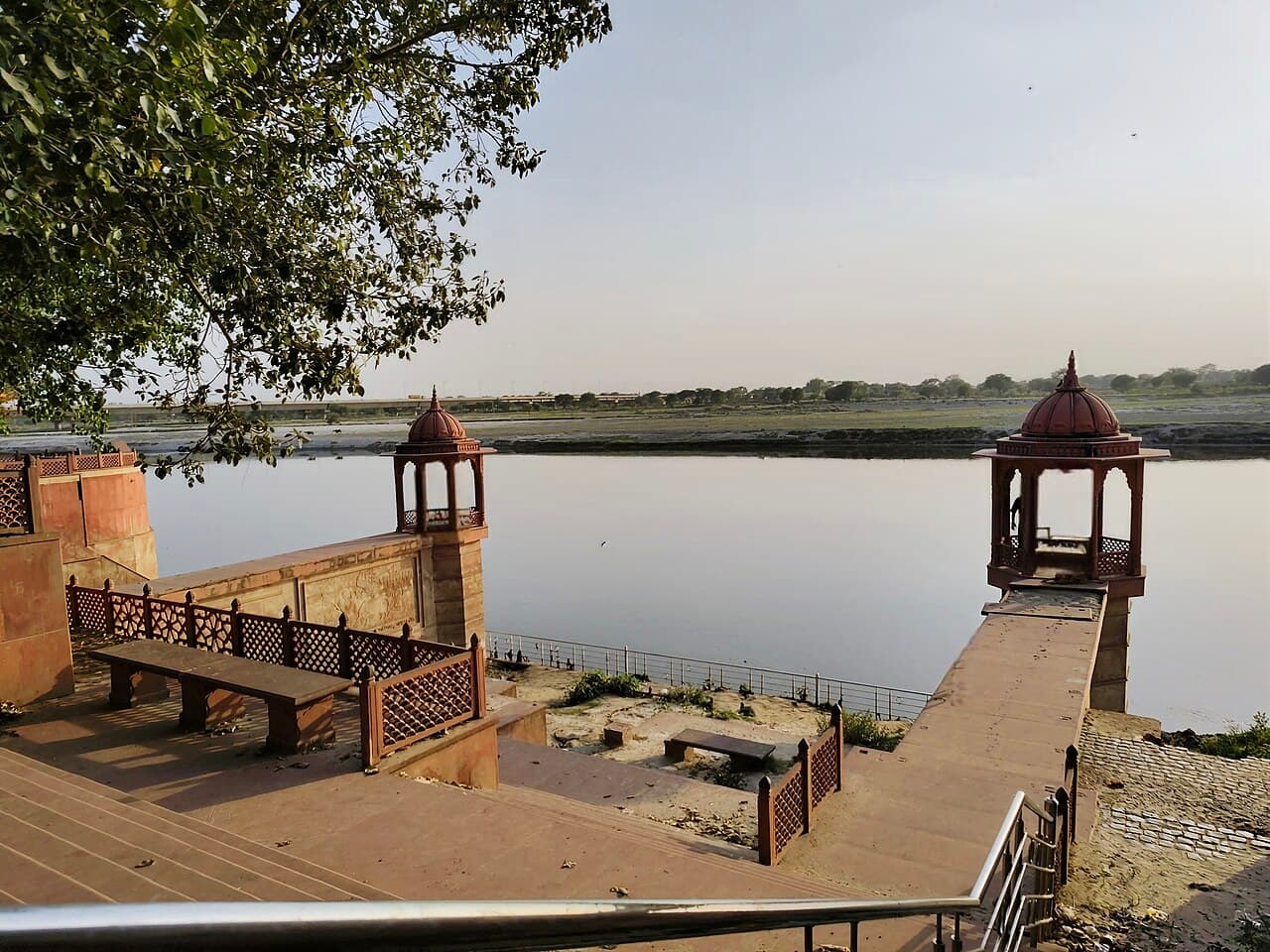
The haveli of Gokulnath Ji in the lanes of Gokul — principal shrine of the town Krishna was carried to the night he was born, seat of the fourth house of Vallabhacharya's Pushtimarg, hearth of the infancy leelas.
- Deity
- Krishna as Gokulnath, with Radha and Chandravali
- Location
- Gokul, Mathura, Uttar Pradesh
- Category
- Vishnu Desam
- Established
- Gokul made the Pushtimarg's centre by Vitthalnath (Gusainji), son of Vallabhacharya, in the later 16th century; the Gokulnath svarup bestowed on his fourth son Gokulnath (1551–1641), whose fourth house keeps the haveli still
- Setting
- In the lanes of Gokul on the left bank of the Yamuna, about 15 km south-east of Mathura
- Best Time to Visit
- October to March; Nandotsav, the day after Janmashtami (August–September), is Gokul's greatest day
- Gokul's principal shrine and the gaddi of the fourth house (chaturth peeth) of the Pushtimarg
- A small four-armed metal svarup — flute in two hands, conch in the fourth, Radha and Chandravali at his sides
- Vitthalnath (Gusainji), Vallabhacharya's son, settled here and made Gokul the sampradaya's centre
- Firmans in Akbar's name left his Gokul lands tax-free and let his cows roam state ground
- Gokul was once home to Navanitpriya and all seven Pushtimarg svarups
- Nandotsav — Bhadrapada Krishna Navami, the day after Janmashtami — is the town's greatest festival
- Raman Reti: the sacred sands, with a deer sanctuary and the Karshni Ashram's Raman Bihariji temple
- Chaurasi Khamba at Mahavan: Nand Bhavan on eighty-four pillars, one for each lakh of the world's species
Significance
Pilgrims come to Gokul for the infancy, and the town fixes each episode to a patch of ground. At Brahmand Ghat on the Yamuna, Yashoda scolded the child for eating clay and looked into his open mouth to find the whole brahmanda inside it. At Ukhal Bandhan she bound him to the grinding mortar he then dragged into the twin arjuna trees. The Gokulnath haveli anchors that remembering — principal shrine of the town, gaddi of the fourth peeth.
Gokul's greatest day is not Janmashtami but Nandotsav, the festival of Nanda, kept on the ninth of the waning moon of Bhadrapada — the day after Janmashtami. It honours the cowherd chief who, hearing a son had come, called all Vraja to rejoice: drummers, brahmanas bathing the child, Yashoda showering flowers. Gokul repeats it with panchamrita abhisheka and aarti, with gifts scattered among the crowd and pots of curd slung high to be broken — for Krishna reached this house only the morning after his birth, and the town keeps its rejoicing a day behind Mathura's.
Close by lie the sands of Raman Reti, where, the district administration records, Krishna played — raman — with Balarama and the cowherd boys, and met Radha before they left for Vrindavan. It is a sandy compound with a deer sanctuary; the adjoining Karshni Ashram holds the old Raman Bihariji temple of the eighteenth-century saint Gyandasji. Pilgrims still lie down and roll in the sand.
History
Gokul stands across the Yamuna, south-east of Mathura. In the Puranas gokula names no place at all but a cattle herd, a cowherd's camp; and it was to such a camp that Vasudeva carried the newborn across the river on the night of the birth in Kamsa's prison. Here Nanda, the cowherd chief, and his wife Yashoda raised him as their own alongside Balarama; and here, the Bhagavata says, he performed most of his childhood leela.
Before the sixteenth century Gokul and Mahavan were one. The vartas of the Pushtimarg tell that when Vallabhacharya reached Braj both had been lost to memory, until Yamuna herself appeared and showed him the site of Gokul beside a shami tree. His son Vitthalnath — Gusainji — settled here and made the town the sampradaya's centre, holding firmans in Akbar's name that left his Gokul lands tax-free and let his cows roam state ground. Gokul was once home to Navanitpriya and to all seven svarups of the Pushtimarg.
The svarup called Gokulnath was served in the family of Vallabhacharya's wife before Vitthalnath bestowed him on his fourth son, Gokulnath (1551–1641), founder of the fourth house and the acharya credited with the sampradaya's Braj Bhasha varta literature. When Braj's deities went into exile under Aurangzeb he was taken to Jaipur and returned later; his descendants keep the haveli still.
Architecture
Gokulnath Ji is housed as a Pushtimarg deity always is — not under a spire but in a haveli, a mansion where the Lord is a child of the household, woken, bathed, dressed, fed and put to sleep, and shown in the day's fixed jhankis, not continuously. The image is small and of metal, four-armed: two hands play the flute, the third is raised — read as the arm that carried Govardhan — and the fourth holds a conch, with Radha and Chandravali at either side.
Four kilometres off at Mahavan, the old settlement Braj calls Bade Gokul, stands Nand Bhavan, the house of Nanda, known to everyone as Chaurasi Khamba for the eighty-four pillars that carry it. Tradition counts eighty-four lakh species of life in this world, and each pillar is said to stand for a hundred thousand of them. Krishna and Balarama were named in this hall, where the cowherds lived until Krishna was three years and four months old.
Festivals
Timings
Gokulnath Ji is served as a Pushtimarg haveli: the deity is shown in the day's fixed jhankis and the doors close between them, so darshan comes in sessions rather than continuously. Gokul's shrines broadly keep about 5:00–5:30 AM to noon and 4:00 to 8:30–9:00 PM; Raman Reti follows the same pattern and charges no entry. No official timetable is published — confirm the day's jhankis locally, and expect them to shift for Janmashtami and Nandotsav.
Gokul lies fifteen kilometres south-east of Mathura on the far bank of the Yamuna. Mathura Junction and Mathura Cantt are the railheads, with buses, taxis and e-rickshaws for the last stretch; the district administration puts Agra's Kheria airport 46 km from Mathura and Delhi's IGI 136; the Yamuna Expressway and NH-19 serve the city. Gokul, Mahavan and Raman Reti make one half-day loop.
Timings are indicative — please confirm with the temple trust before travelling.
Nearby Temples

Frequently Asked Questions
Where is Shri Gokulnath Ji, Gokul Temple located?+
Shri Gokulnath Ji, Gokul Temple is in Gokul, Mathura, Uttar Pradesh, India.
Which deity is worshipped at Shri Gokulnath Ji, Gokul Temple?+
Shri Gokulnath Ji, Gokul Temple is dedicated to Krishna as Gokulnath, with Radha and Chandravali.
Which tradition does Shri Gokulnath Ji, Gokul belong to?+
Shri Gokulnath Ji, Gokul is one of the Vishnu Desam temples dedicated to Vishnu.
What are the timings of Shri Gokulnath Ji, Gokul Temple?+
Gokulnath Ji is served as a Pushtimarg haveli: the deity is shown in the day's fixed jhankis and the doors close between them, so darshan comes in sessions rather than continuously. Gokul's shrines broadly keep about 5:00–5:30 AM to noon and 4:00 to 8:30–9:00 PM; Raman Reti follows the same pattern and charges no entry. No official timetable is published — confirm the day's jhankis locally, and expect them to shift for Janmashtami and Nandotsav.
What is the best time to visit Shri Gokulnath Ji, Gokul Temple?+
October to March; Nandotsav, the day after Janmashtami (August–September), is Gokul's greatest day
When was Shri Gokulnath Ji, Gokul Temple established?+
Shri Gokulnath Ji, Gokul Temple — Gokul made the Pushtimarg's centre by Vitthalnath (Gusainji), son of Vallabhacharya, in the later 16th century; the Gokulnath svarup bestowed on his fourth son Gokulnath (1551–1641), whose fourth house keeps the haveli still.
Sources & further reading
Photo: Aliva Sahoo · CC BY-SA 3.0