
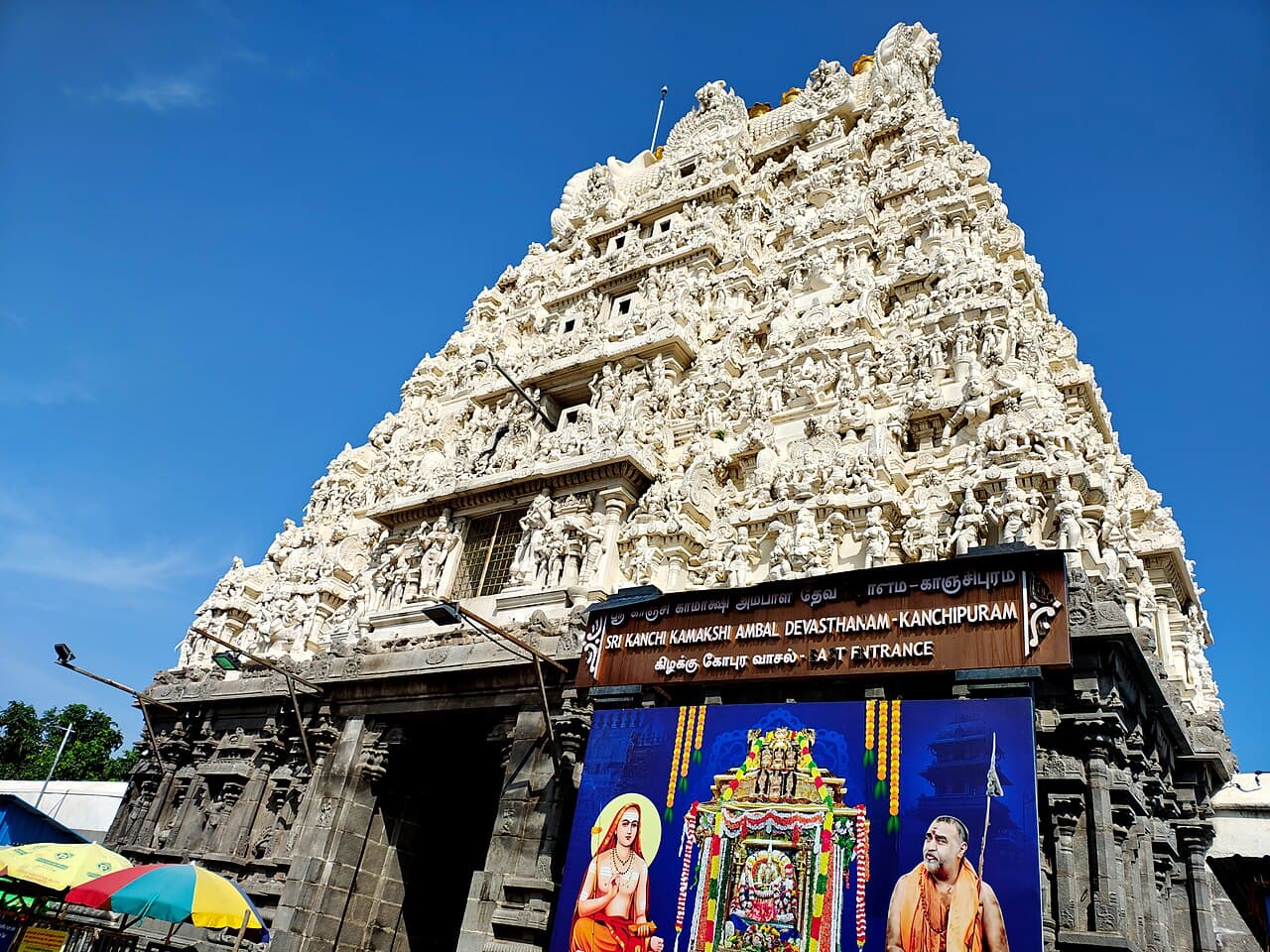
The one Devi temple in a city of a thousand temples — where all the Shakti of Kanchipuram is held to gather, Kamakshi seated in lotus before the Sri Chakra.
- Deity
- Devi Kamakshi (Kamakshi Amman)
- Location
- Kanchipuram, Tamil Nadu
- Category
- Shakti Peethas
- Established
- Pallava foundation (c. 5th–8th century CE); rebuilt and expanded under the Cholas and Vijayanagara rulers
- Setting
- In the heart of old Kanchipuram (Shiva Kanchi), Tamil Nadu
- Best Time to Visit
- October to March; Navaratri; and the Masi Brahmotsavam with its Ther (February–March)
- The only Devi temple in Kanchipuram — the principal seat of the Goddess in the city
- Tradition: no other Kanchi temple keeps a separate Amman shrine; all Shakti is gathered here
- Kamakshi sits in Padmasana with pasha, ankusha, a sugarcane bow and flower arrows
- Tradition holds Adi Shankara set the Sri Chakra before her and calmed her fierce form
- Seat of the Kanchi Kamakoti Peetham, the temple's hereditary trustee
- The sanctum stands in the Gayatri Mandapam — 4 walls (Vedas), 24 pillars (Gayatri syllables)
- Named as Kamakshi of Kanchi in the Ashtadasa Shakti Peetha stotra; also counted among the 51
- Kanchipuram is one of the seven moksha-puris and 'the city of a thousand temples'
Significance
What sets Kamakshi apart is something missing elsewhere: in a city crowded with temples, hers is the only temple of the Devi. The great Shiva temples of Kanchi — Ekambareswarar and the rest — keep no separate Amman sannidhi, as Tamil temples almost always do, because tradition holds that the whole Shakti of Kanchipuram is gathered here, in her alone. To seek the Goddess in this city is to be sent to Kamakshi.
She is counted among the foremost seats of the Goddess: the Ashtadasa Shakti Peetha stotra ascribed to Adi Shankara names her in its opening breath — Kamakshi of Kanchi — and the Devasthanam itself reckons the city among the fifty-one peethas, where Sati's navel is said to have fallen, whence the name Nabhi Peetham.
Tradition holds that Adi Shankara, finding the Devi here in her fierce aspect, set the Sri Chakra before her and drew her into her serene form; that yantra, kept under fresh lotus flowers, is worshipped in the sanctum beside her, and the Kamakoti Peetham he is said to have founded here still bears her name. She sits in Padmasana, holding noose and goad in her upper hands and, in the lower, the bow of sugarcane and arrows of flowers — the weapons of Tripurasundari, who conquers by sweetness. Navaratri fills the temple for nine nights, and the Masi Brahmotsavam of February–March draws the great Ther through the four streets.
History
Kanchipuram stands among the seven moksha-puris, the cities whose dust is said to grant liberation, and has long been called the city of a thousand temples. Its western half is Shiva Kanchi and its eastern half Vishnu Kanchi, and between them, in the heart of the old town, is the shrine of Kamakshi — the Devi from whom the whole city takes its spiritual centre. Her name is read as ka-ma-akshi, she in whose eyes are Saraswati and Lakshmi, one glance from her carrying both learning and abundance.
The temple's beginnings are old and not exactly datable. Its foundation is generally placed with the Pallavas, between the fifth and eighth centuries, when Kanchi was their capital; the Cholas and later the Vijayanagara rulers rebuilt and enlarged it, and the five-acre complex standing today is largely their work.
The eighteenth century left a wound the temple still remembers. In the disorder of the Carnatic Wars the solid-gold processional image was carried away for safety — smuggled out, tradition says, wrapped as a sick child in a palanquin — and came to rest at Thanjavur, where it is worshipped still as Bangaru Kamakshi, the Golden Kamakshi. The Kanchi Kamakoti Peetham, which moved south with it, returned; the Peetham is still the temple's hereditary trustee.
Architecture
The temple is Dravidian in manner, low rather than lofty, spread over five acres behind plain walls pierced by gopurams. Its glory is the gold: the vimana over the sanctum and the towers above the inner shrines are sheathed in gold plate, mirrored in the pushkarini, the tank on which the float festival is rowed.
The goddess sits at the centre of the Gayatri Mandapam, a hall whose four walls are said to stand for the four Vedas and its twenty-four pillars for the twenty-four syllables of the Gayatri mantra; unusually for a Tamil shrine, she faces south-east. Within the same enclosure is Kalvar, Adi Varaha Perumal, one of the hundred and eight Divya Desams — a Vishnu shrine of the first rank inside a temple of the Devi. Around the prakarams stand Bangaru Kamakshi, Saraswati, Annapurna, Kala Bhairava and a shrine to Adi Shankara himself.
Festivals
Timings
Open daily from about 5:30 AM, when the Gau and Gaja pooja and the Viswarupa darshan begin the day; there is a midday closure commonly around 12:30 PM to 4:00 PM, and the Arthajama and Palliarai poojas follow at about 7:30 PM and 8:30 PM. Abhishekams are at roughly 7:30 AM, 11:00 AM and 4:00 PM, and hours run later on Fridays and full-moon days. Confirm current timings locally.
Kanchipuram lies about 75 kilometres from Chennai and the temple sits in the heart of the old town, roughly a kilometre from the bus stand and a short auto ride from Kanchipuram railway station. Chennai International Airport at Meenambakkam is the nearest, about two hours by road; trains reach the town from Chennai Central and Arakkonam, with suburban services up from Chengalpattu. Ekambareswarar, Kailasanathar and Varadaraja Perumal all stand within a few kilometres.
Timings are indicative — please confirm with the temple trust before travelling.
Nearby Temples


Frequently Asked Questions
Where is Kamakshi Amman, Kanchipuram Temple located?+
Kamakshi Amman, Kanchipuram Temple is in Kanchipuram, Tamil Nadu, India.
Which deity is worshipped at Kamakshi Amman, Kanchipuram Temple?+
Kamakshi Amman, Kanchipuram Temple is dedicated to Devi Kamakshi (Kamakshi Amman).
Which tradition does Kamakshi Amman, Kanchipuram belong to?+
Kamakshi Amman, Kanchipuram is one of the Shakti Peethas temples dedicated to Devi (Shakti).
What are the timings of Kamakshi Amman, Kanchipuram Temple?+
Open daily from about 5:30 AM, when the Gau and Gaja pooja and the Viswarupa darshan begin the day; there is a midday closure commonly around 12:30 PM to 4:00 PM, and the Arthajama and Palliarai poojas follow at about 7:30 PM and 8:30 PM. Abhishekams are at roughly 7:30 AM, 11:00 AM and 4:00 PM, and hours run later on Fridays and full-moon days. Confirm current timings locally.
What is the best time to visit Kamakshi Amman, Kanchipuram Temple?+
October to March; Navaratri; and the Masi Brahmotsavam with its Ther (February–March)
When was Kamakshi Amman, Kanchipuram Temple established?+
Kamakshi Amman, Kanchipuram Temple — Pallava foundation (c. 5th–8th century CE); rebuilt and expanded under the Cholas and Vijayanagara rulers.
Sources & further reading
Photo: Shivashanky · CC BY-SA 4.0