

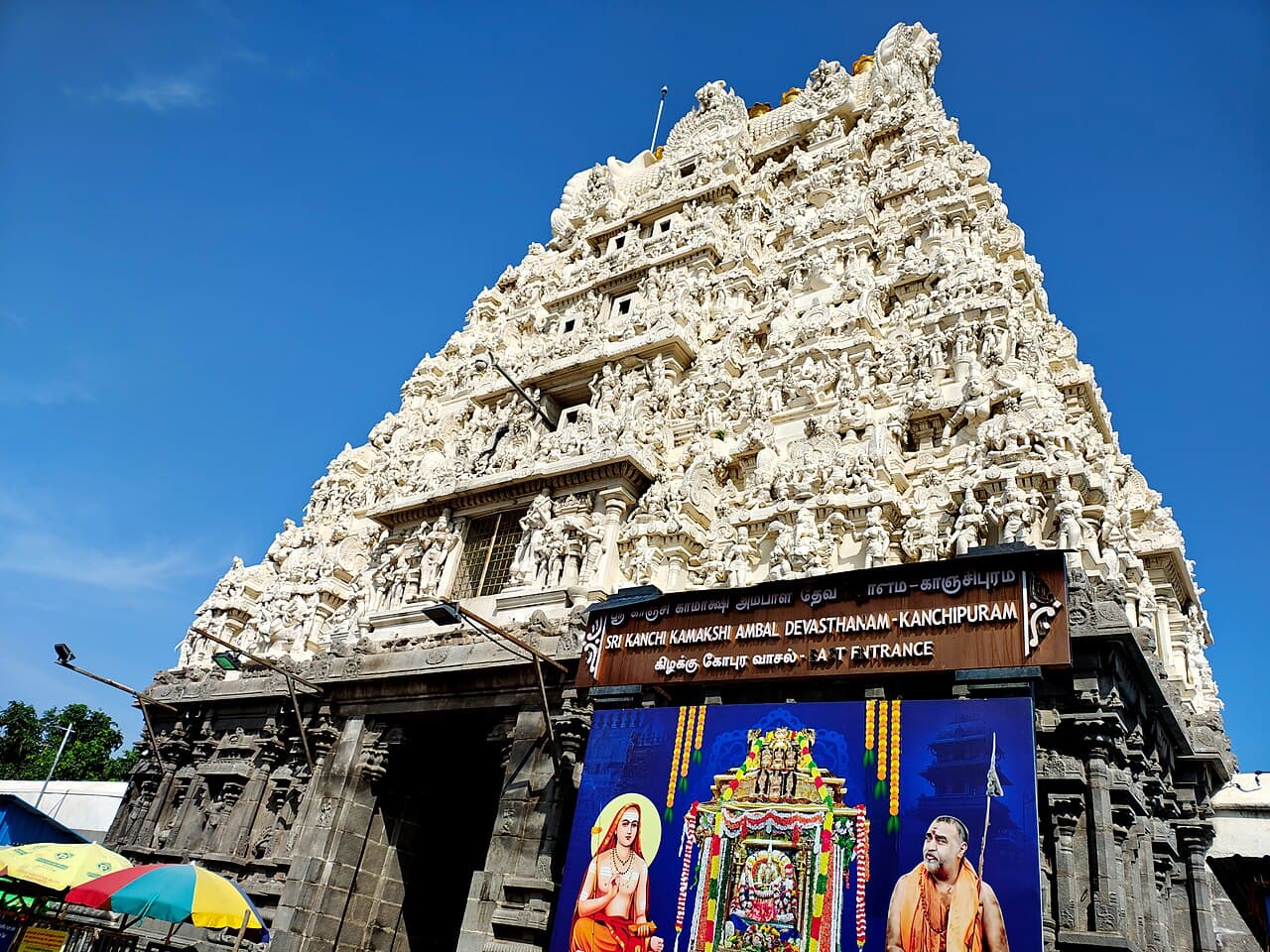
The great gopuram over Mylapore — where Parvati worshipped Mahadev in the form of a peahen and gave Chennai's oldest quarter its name, and where the sixty-three Nayanmars go out each Panguni.
- Deity
- Shiva as Kapaleeswarar (with Karpagambal)
- Location
- Chennai, Tamil Nadu
- Category
- Shiva Mahadev
- Established
- Ancient shrine — Thirumayilai is sung in the 7th-century Tevaram; the present structure is Vijayanagara in manner, rebuilt between the 16th and 18th centuries, with the east gopuram in its present form from the early 20th century (commonly dated 1906)
- Setting
- In the heart of Mylapore, ringed by the four mada streets, beside the Kapaleeswarar tank
- Best Time to Visit
- November to February; and the Panguni Brahmotsavam with the Arubathimoovar procession (March–April)
- Shiva as Kapaleeswarar with Karpagambal — the great temple of Mylapore, Chennai
- Parvati worshipped him in the form of a peahen — mayil, from which Mayilai and Mylapore
- Karpagambal — the Mother who is the karpagam, the wish-yielding tree of the gods
- Thirumayilai is among the 276 Paadal Petra Sthalams sung in the Tevaram
- Sambandar's Poompavai padhigam, sung here, names the temple's festivals one by one
- Arubathimoovar: the 63 Nayanmars go through the mada streets on Panguni's eighth day
- The east gopuram — seven tiers, about 120 ft (37 m) — is the landmark of Mylapore
- The sung shrine stood by the sea; scholars debate whether the temple moved inland
Significance
The sthala purana is the town's own name. Mahadev was expounding the truth to Parvati on Kailasa when her glance went aside to a dancing peacock, and for that he bade her take the peahen's form and worship him below; she did penance on this shore before his lingam under a punnai tree until he received her again. Mayil is Tamil for peacock: from her penance came Mayilai, and from Mayilai, Mylapore. The peahen is carved there still, at worship before the lingam under the punnai; the Mother here is Karpagambal, she who is the karpagam, the wish-yielding tree of the gods.
Sambandar sang Poompavai back to life here: before the pot that held the ashes of Sivanesar's daughter, dead of snakebite, he sang the padhigam that names the festivals of Mylai one by one and asked how she could let them pass. Mylapore gave the canon one of the sixty-three too — Vayilar Nayanar, said to have built Mahadev a whole temple within his mind; his shrine and Margazhi guru puja are kept here.
The year turns on Panguni. The Brahmotsavam of that month, mid-March to mid-April, runs ten days from the kodiyettam to the Thirukalyanam at the full moon; the ther goes out on the seventh day, and on the eighth the Arubathimoovar, when the bronzes of all sixty-three Nayanmars are carried in palanquins through the mada streets. It is the largest day of Mylapore's year and one of Chennai's: the streets fill wall to wall, hawkers and giant wheels take the roads leading in, the city police divert traffic across the quarter, and a procession that sets out after three is still going past six.
History
Mylapore is older than Madras — a port and temple town before Fort St George rose up the coast — and Kapaleeswarar stands at the middle of it, the tank on one side, four mada streets squared about its walls. Tamil Nadu's Hindu Religious and Charitable Endowments department, which administers the temple, knows it by its older name, Thirumayilai.
Its place in the Tamil Shaiva canon is settled: Thirumayilai is one of the 276 Paadal Petra Sthalams sung in the Tevaram, and Thirugnana Sambandar's Poompavai padhigam is sung on it. What is debated is the ground — Sambandar, and Arunagirinathar after him, describe a shrine standing by the sea, and this temple stands more than a kilometre inland, facing west.
Most scholars read that as relocation: the older temple on the shore where the San Thome cathedral now is, pulled down after Mylapore passed to the Portuguese in 1566. Its inscriptions turn up near the beach and in the cathedral wall, among them a broken twelfth-century Chola record naming the Nataraja of the Kapaleeswara temple. Others hold that the temple never moved and was only rebuilt. The present structure is not in dispute: Vijayanagara in manner, its shrines and small west gopuram built by Mylapore's Nattu Mudaliars, with a plaque within dating the rebuilding to about three hundred years ago.
Architecture
The temple faces west — unusual, and itself part of the argument about the older site — while the great gopuram stands over the eastern gate: seven tiers and about a hundred and twenty feet, some thirty-seven metres, of stucco figures in high colour, raised in its present form early in the twentieth century and commonly dated to 1906. It is the landmark of the quarter, seen above the roofs from across the tank. The smaller western gopuram looks out over that tank, the theppakulam, with its sixteen-pillared mandapam standing in the water.
Within the walls Kapaleeswarar's lingam, held to be swayambhu, stands in the sanctum and Karpagambal in her own shrine beside him, while the sixty-three Nayanmars stand in bronze along the prakara. The courtyard keeps the punnai, the sthala vriksham, and the temple's water is the Kapali theertham.
Festivals
Timings
Open daily, commonly from about 5:30 AM to 12:00 noon and 4:00 PM to 9:30 PM, with six pujas through the day — from Ushathkalam at about 6:00 AM to Ardha Jamam at about 9:00 PM. Confirm current timings with the temple.
The temple stands on Kutchery Road in the heart of Mylapore, ringed by its four mada streets, about a kilometre and a half inland from Santhome and the Marina. Thirumayilai station on the Chennai MRTS is under a kilometre off; Chennai Central is some six kilometres north and the international airport about seventeen by road. Parthasarathy at Triplicane is barely three kilometres up the coast.
Timings are indicative — please confirm with the temple trust before travelling.
Nearby Temples


Frequently Asked Questions
Where is Kapaleeshwarar, Mylapore Temple located?+
Kapaleeshwarar, Mylapore Temple is in Chennai, Tamil Nadu, India.
Which deity is worshipped at Kapaleeshwarar, Mylapore Temple?+
Kapaleeshwarar, Mylapore Temple is dedicated to Shiva as Kapaleeswarar (with Karpagambal).
Which tradition does Kapaleeshwarar, Mylapore belong to?+
Kapaleeshwarar, Mylapore is one of the Shiva Mahadev temples dedicated to Shiva (Mahadev).
What are the timings of Kapaleeshwarar, Mylapore Temple?+
Open daily, commonly from about 5:30 AM to 12:00 noon and 4:00 PM to 9:30 PM, with six pujas through the day — from Ushathkalam at about 6:00 AM to Ardha Jamam at about 9:00 PM. Confirm current timings with the temple.
What is the best time to visit Kapaleeshwarar, Mylapore Temple?+
November to February; and the Panguni Brahmotsavam with the Arubathimoovar procession (March–April)
When was Kapaleeshwarar, Mylapore Temple established?+
Kapaleeshwarar, Mylapore Temple — Ancient shrine — Thirumayilai is sung in the 7th-century Tevaram; the present structure is Vijayanagara in manner, rebuilt between the 16th and 18th centuries, with the east gopuram in its present form from the early 20th century (commonly dated 1906).
Sources & further reading
Photo: G V Balasubramanian · CC BY-SA 2.0