

Vishnu as Varadaraja on the elephant-hill of Hastagiri — the shrine Sri Vaishnavas call simply Perumal Koil, whose fig-wood deity rises from its tank once in forty years.
- Deity
- Vishnu (Varadaraja Perumal)
- Location
- Kanchipuram, Tamil Nadu
- Category
- Vishnu Desam
- Established
- Ancient foundation; Chola renovation in 1053 and expansion under Kulottunga I and Vikrama Chola; a further wall and gopura in the 14th century; Vijayanagara additions, the temple car dated 1517
- Setting
- On the rock of Hastagiri in Little Kanchipuram (Vishnu Kanchi), Tamil Nadu
- Best Time to Visit
- October to March; the Vaikasi Brahmotsavam and its Garuda Sevai (May–June); Vaikunta Ekadasi in Margazhi (December–January)
- A Divya Desam — Thirukkachi, Attigiri; no city holds more of the 108 than Kanchipuram
- Sung by three Alvars — Thirumangai (4 pasurams), Bhoothathalvar (2), Peyalvar (1)
- Called simply 'Perumal Koil' — as Srirangam is 'Koil' and Tirumala 'Malai'
- Athi Varadar: the atti (fig) wood deity raised from the Anantha Saras tank once in forty years
- Forty-eight days of darshan — twenty-four reclining, then twenty-four standing
- Ramanuja's Kanchi years; Kanchi's Perarulalan is said to have named him Ethirajar
- The hundred-pillared hall's stone chains — every link cut from a single block
- ~23.5 acres (9.5 ha) and some 350 inscriptions — the largest temple in Kanchipuram
Significance
Among the hundred and eight Divya Desams — the abodes of Vishnu hymned by the Alvars — this one is Thirukkachi, Attigiri, and no city in India holds more of them than Kanchipuram. Three Alvars sang it: Thirumangai in four verses, Bhoothathalvar in two, Peyalvar in one; and Thirumangai names the god by his tree, Attiyuran. Sri Vaishnavas give three shrines one word apiece: Srirangam is Koil, the Temple; Tirumala is Malai, the Hill; and this is Perumal Koil.
Ramanuja belonged here before he belonged to Srirangam. Parted from his teacher, he became a devotee of Varadaraja and found here Kanchipurna — Thirukkachi Nambi — who came daily with flowers to fan the deity and was held to converse with him as he fanned. Six of Ramanuja's questions are said to have been answered by Varadaraja through Nambi; and when he asked to be taken as Kanchipurna's disciple he was refused and sent instead, on the Lord's own instruction, to Srirangam. It was Kanchi's Perarulalan who gave him the name he keeps still: Ethirajar, king of the ascetics.
The deity first worshipped here was not granite but atti wood. Hidden from invaders in the sixteenth century and replaced by the stone Devaraja Perumal, it was found again in 1709 when the tank was drained. From that came the rarest observance in the south: Athi Varadar rests in a chamber beneath the water of the Anantha Saras and is raised once in forty years — most recently within living memory, when pilgrims came in their millions — to be worshipped forty-eight days in the Vasantha Mandapam, twenty-four reclining and twenty-four standing, before returning to the water. In other years the great days are the Vaikasi Brahmotsavam, whose Garuda Sevai on the third morning doubles every crowd and whose chariot rolls on the seventh, and Vaikunta Ekadasi in Margazhi, when the Sorgavasal opens.
History
In Vishnu Kanchi, the eastern half of Kanchipuram, the ground lifts into a low rock called Hastagiri, the elephant hill, where Vishnu stands as Varadaraja, the king who gives — known equally as Perarulalan, the great bestower of grace. Indra, released from a curse, is said to have taken elephant form and borne the god here; and Brahma, performing an ashvamedha on the bank of the Vegavati, saw Vishnu come out of that fire within an atti, a fig tree — whence the temple's older names, Attiyur and Attigiri.
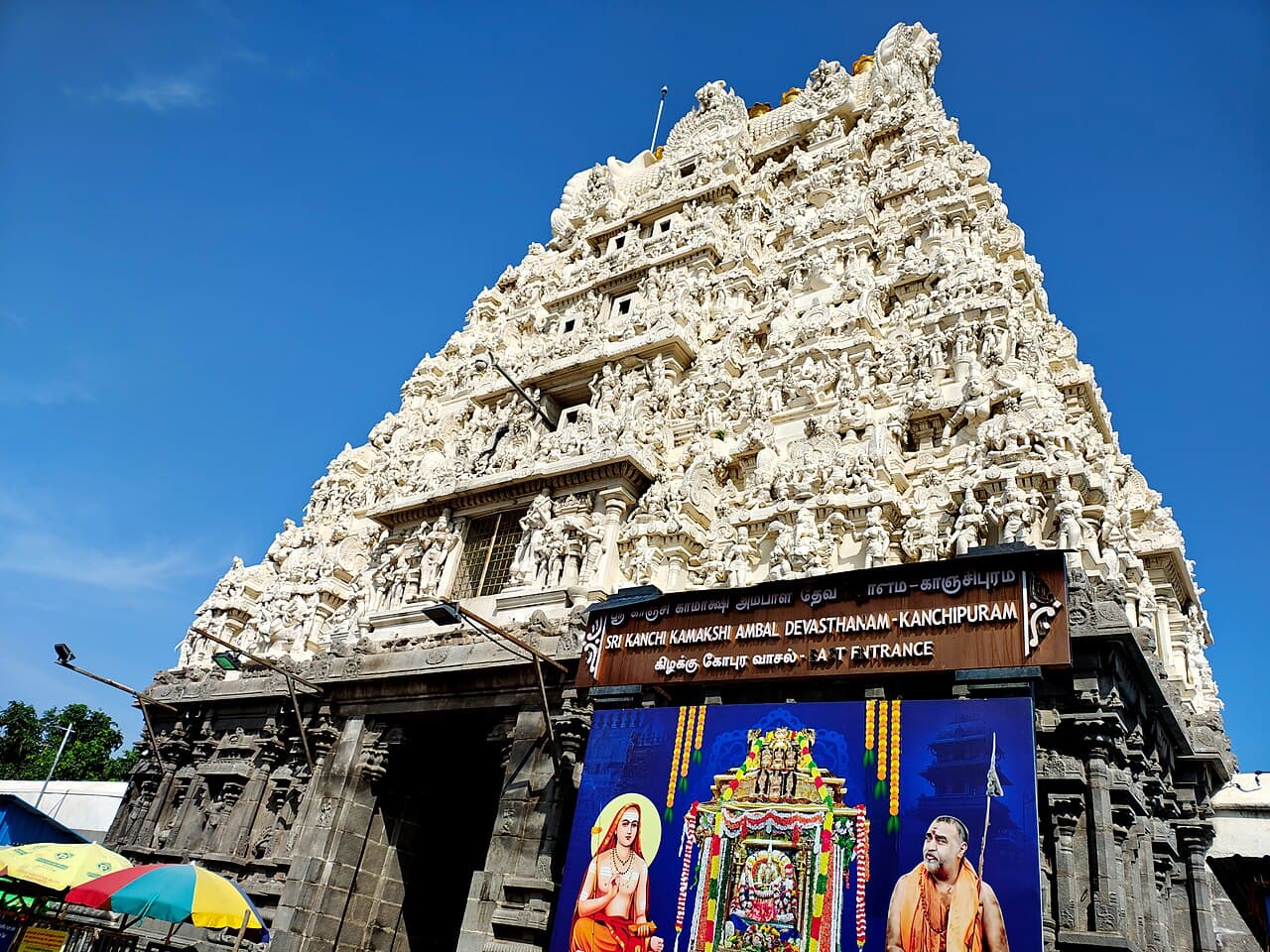
The stone keeps its own archive: some three hundred and fifty inscriptions in Chola, Pandya, Hoysala and Vijayanagara hands. The Cholas renovated the temple in 1053 and it grew under Kulottunga I and Vikrama Chola; the Vijayanagara kings raised the eastern tower, and the temple car is held to be Krishnadevaraya's gift of 1517.
With invasion expected in 1688 the images were carried off to Udayarpalayam and came home in 1710; the return is kept as a festival still. Robert Clive came to see the Garuda Sevai and left a necklace, worn each year on its day and called the Clive Maharkandi. Tamil Nadu's Hindu Religious and Charitable Endowments Department administers it, with the Thathachariars as hereditary trustees.
Architecture
At 23.5 acres (9.5 hectares) this is the largest temple in Kanchipuram — thirty-two shrines, nineteen vimanas and three hundred and eighty-nine pillared halls. The sanctum stands not at ground level but up on the Hastagiri rock, reached by a flight of steps, where Varadaraja is three metres of granite facing west; Perundevi Thayar keeps her shrine below, and custom sends the pilgrim to her first.
Its most famous stone is the hundred-pillared hall, Vijayanagara work, its pillars cut with yalis, war-horses and mounted riders; at its corners hang chains of stone, each carved from a single block, link freed from link without a join. Over the steps to the sanctum are two lizards, one gold-plated and one silver, which pilgrims reach up to touch.
Festivals
Timings
Open daily from about 6:00 AM to noon and again from about 4:00 PM to 9:00 PM; the sanctum is reached by a flight of steps up the Hastagiri rock. Hours shift through the Vaikasi Brahmotsavam and Margazhi — confirm with the temple before travelling.
The temple stands in Little Kanchipuram, the Vishnu Kanchi quarter east of the old town, about five kilometres from the Kanchipuram bus stand along the Chengalpattu road. Kanchipuram lies roughly 75 kilometres from Chennai, some two hours by road; Chennai International Airport is the nearest, with trains from Chennai Central and Arakkonam.
Timings are indicative — please confirm with the temple trust before travelling.
Nearby Temples


Frequently Asked Questions
Where is Varadaraja Perumal, Kanchipuram Temple located?+
Varadaraja Perumal, Kanchipuram Temple is in Kanchipuram, Tamil Nadu, India.
Which deity is worshipped at Varadaraja Perumal, Kanchipuram Temple?+
Varadaraja Perumal, Kanchipuram Temple is dedicated to Vishnu (Varadaraja Perumal).
Which tradition does Varadaraja Perumal, Kanchipuram belong to?+
Varadaraja Perumal, Kanchipuram is one of the Vishnu Desam temples dedicated to Vishnu.
What are the timings of Varadaraja Perumal, Kanchipuram Temple?+
Open daily from about 6:00 AM to noon and again from about 4:00 PM to 9:00 PM; the sanctum is reached by a flight of steps up the Hastagiri rock. Hours shift through the Vaikasi Brahmotsavam and Margazhi — confirm with the temple before travelling.
What is the best time to visit Varadaraja Perumal, Kanchipuram Temple?+
October to March; the Vaikasi Brahmotsavam and its Garuda Sevai (May–June); Vaikunta Ekadasi in Margazhi (December–January)
When was Varadaraja Perumal, Kanchipuram Temple established?+
Varadaraja Perumal, Kanchipuram Temple — Ancient foundation; Chola renovation in 1053 and expansion under Kulottunga I and Vikrama Chola; a further wall and gopura in the 14th century; Vijayanagara additions, the temple car dated 1517.
Sources & further reading
Photo: IM3847 · CC BY-SA 4.0