

Vishnu as Vitthal, standing arms-akimbo on Pundalik's brick beside the Chandrabhaga — the heart of Maharashtra's Warkari faith, where every Ashadhi the walking pilgrimage of a whole people comes home.
- Deity
- Vishnu (Vitthal / Panduranga)
- Location
- Pandharpur, Maharashtra
- Category
- Vishnu Desam
- Established
- Shrine attested by an inscription of 1189 CE; temple rebuilt c. 1273–77; present structure largely 17th century and later; under the Shri Vitthal Rukmini Mandir Samiti since the Pandharpur Temples Act, 1973
- Setting
- On the crescent bend of the Chandrabhaga (Bhima), Pandharpur, Solapur district
- Best Time to Visit
- November to February; Ashadhi Ekadashi (June–July) and Kartiki Ekadashi (Oct–Nov) bring the greatest crowds and the longest queues
- Vitthal (Vithoba, Panduranga) — Krishna as Vishnu, arms akimbo on a brick
- Pundalik's brick: the Lord agreed to wait while a son served his parents
- Rukmini — Rakhumai — keeps her own shrine within the same walls
- Heart of the Warkari sampradaya of Sant Dnyaneshwar, Sant Namdev, Sant Eknath, Sant Tukaram and Sant Chokhamela
- Ashadhi Wari: palkhis walk ~250 km from Alandi and Dehu; in 2026 they arrived 24 July
- Kartiki Ekadashi is the second great wari; Chaitri and Maghi follow
- Namdev Payari — first of the twelve steps; Sant Chokhamela's samadhi lies below them
- Padasparsh darshan — pilgrims may touch the feet of the image itself
Significance
Pandharpur is the heart of the Warkari sampradaya, the bhakti tradition that has carried Maharashtra's faith for some seven centuries. Its sants sang to Vitthal in abhangas — Sant Dnyaneshwar, whose Dnyaneshwari opened the Gita to Marathi; Sant Namdev; Sant Eknath; Sant Tukaram; Sant Chokhamela and Sant Janabai — and made a religion in which caste and learning counted for nothing beside love. A warkari wears tulsi beads, keeps a plain vegetarian rule, and above all walks.
Twice a year that walking becomes a flood. For the Ashadhi wari Sant Dnyaneshwar's padukas are borne in a palkhi from Alandi and Sant Tukaram's from Dehu, some two hundred and fifty kilometres, the dindis singing all the way and gathering at Wakhari before entering the town together. In 2026 Tukaram's palkhi left Dehu on 7 July and Dnyaneshwar's Alandi on 8 July; both reached Pandharpur on 24 July, and lakhs of warkaris kept Ashadhi — Devshayani — Ekadashi on 25 July, the Chief Minister offering the state's mahapuja before dawn. Kartiki Ekadashi in November is the second great wari; Chaitri and Maghi follow.
The pilgrimage keeps its own order: a dip in the Chandrabhaga, the nagar pradakshina round the town, then the queue. At the eastern Mahadwar the first of the twelve steps is the Namdev Payari, where Sant Namdev is said to lie so that every devotee's foot may touch him first; Sant Chokhamela's samadhi rests below the steps. Ordinary days allow padasparsh darshan, the pilgrim touching the feet of the image itself — rare in any great temple; through the yatras the doors stay open day and night and the moving line allows only mukh darshan, a sight of the face.
History
Pandharpur lies in western Solapur district on the crescent bend of the Bhima, which the town calls Chandrabhaga, the moon's portion. Here Vishnu is worshipped as Vitthal — Vithoba, Panduranga — held to be Krishna himself, and shown as no other great image in India: a dark young figure standing straight upon a brick, hands resting on his hips, waiting.
He waits because of Pundalik — a son who came late to serving his aged parents and then gave himself to it so wholly that when Krishna came to his door he could spare no attention for God. He threw out a brick for the Lord to stand on and asked him to wait; and the Lord, delighted by a devotion that put parents first, has been standing on it ever since.
The stone remembers the shrine from the Yadava age. An inscription of 1189 records a small shrine to Vitthal here; one of 1237 notes a temple gateway, a Hoysala grant of a village for the god's food-offering, and the earliest epigraphic mention of Pundalik; inscriptions of 1273–77 record a temple raised over the older shrine. What stands today is largely of the seventeenth century and after. Under the Pandharpur Temples Act of 1973 the shrine passed to the Shri Vitthal Rukmini Mandir Samiti, and in 2014 it became the first temple in India to appoint women and people of every caste as priests.
Architecture
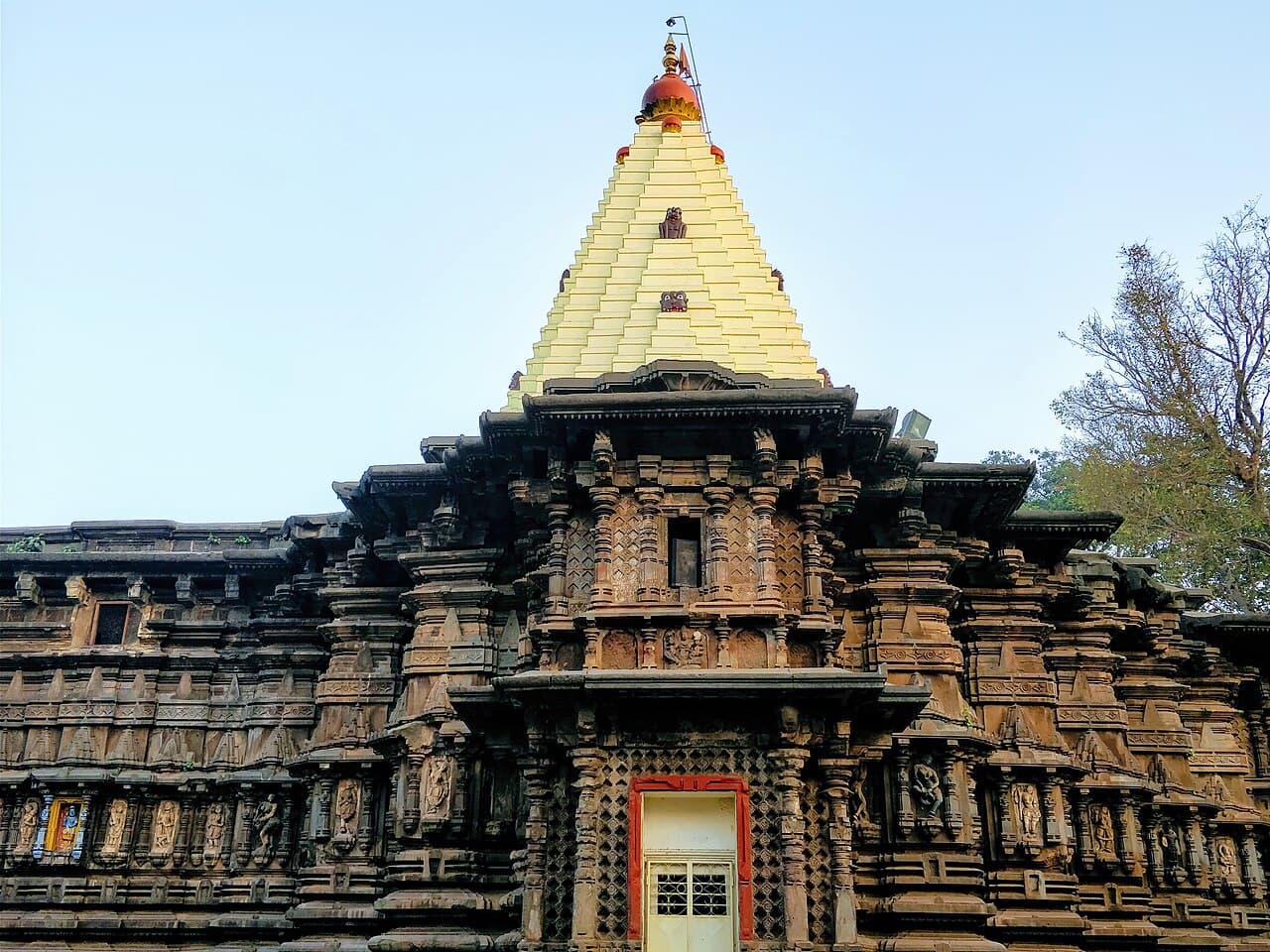
The temple is a Deccan building of the later kind, its domes and lobed arches raised over a much older core, spread through the old town behind eight gates. From the eastern Mahadwar, the chief entrance, the pilgrim climbs the twelve steps and passes hall after hall — the Mukti Mandapa, the Sabha Mandapa with its Garuda and Hanuman, the sixteen-pillared Solakhambi, the four-pillared Chaukhambi — before reaching the sanctum.
The image stands a little over a metre tall, its headpiece likened by devotees to a shivalinga, a conch in the left hand and Bhrigu's footmark on the breast. Rukmini — Rakhumai to her people — keeps a shrine of her own within the same walls, with lesser shrines around to Amba, Rameshvara, Radha, Satyabhama and Narasimha.
Festivals
Timings
The Namdev Payari door opens about 4:00 AM for Kakad aarti and the nitya pooja; darshan runs roughly 6:00–11:00 AM, 11:15 AM–4:30 PM and 5:00–11:15 PM, pausing for the Mahanaivedya (10:45–11:00 AM) and the Poshakh (4:30–5:00 PM), with Dhoop aarti at 6:45 PM and Shej aarti from midnight to 1:00 AM. Through the Ashadhi and Kartiki yatras the temple stays open round the clock. Confirm current timings with the Mandir Samiti.
Pandharpur is about seventy-two kilometres by road from Solapur and some two hundred and ten from Pune, the usual airport. Its own station lies on the Kurduwadi–Miraj line of the Central Railway; Kurduwadi is fifty kilometres off and Solapur, at seventy-four, is the nearest major railhead. State buses run constantly, and through the wari season extra trains and buses are laid on.
Timings are indicative — please confirm with the temple trust before travelling.
Videos
Nearby Temples
Frequently Asked Questions
Where is Vitthal Rukmini, Pandharpur Temple located?+
Vitthal Rukmini, Pandharpur Temple is in Pandharpur, Maharashtra, India.
Which deity is worshipped at Vitthal Rukmini, Pandharpur Temple?+
Vitthal Rukmini, Pandharpur Temple is dedicated to Vishnu (Vitthal / Panduranga).
Which tradition does Vitthal Rukmini, Pandharpur belong to?+
Vitthal Rukmini, Pandharpur is one of the Vishnu Desam temples dedicated to Vishnu.
What are the timings of Vitthal Rukmini, Pandharpur Temple?+
The Namdev Payari door opens about 4:00 AM for Kakad aarti and the nitya pooja; darshan runs roughly 6:00–11:00 AM, 11:15 AM–4:30 PM and 5:00–11:15 PM, pausing for the Mahanaivedya (10:45–11:00 AM) and the Poshakh (4:30–5:00 PM), with Dhoop aarti at 6:45 PM and Shej aarti from midnight to 1:00 AM. Through the Ashadhi and Kartiki yatras the temple stays open round the clock. Confirm current timings with the Mandir Samiti.
What is the best time to visit Vitthal Rukmini, Pandharpur Temple?+
November to February; Ashadhi Ekadashi (June–July) and Kartiki Ekadashi (Oct–Nov) bring the greatest crowds and the longest queues
When was Vitthal Rukmini, Pandharpur Temple established?+
Vitthal Rukmini, Pandharpur Temple — Shrine attested by an inscription of 1189 CE; temple rebuilt c. 1273–77; present structure largely 17th century and later; under the Shri Vitthal Rukmini Mandir Samiti since the Pandharpur Temples Act, 1973.
Sources & further reading
Photo: Rahul godase · CC BY-SA 4.0