
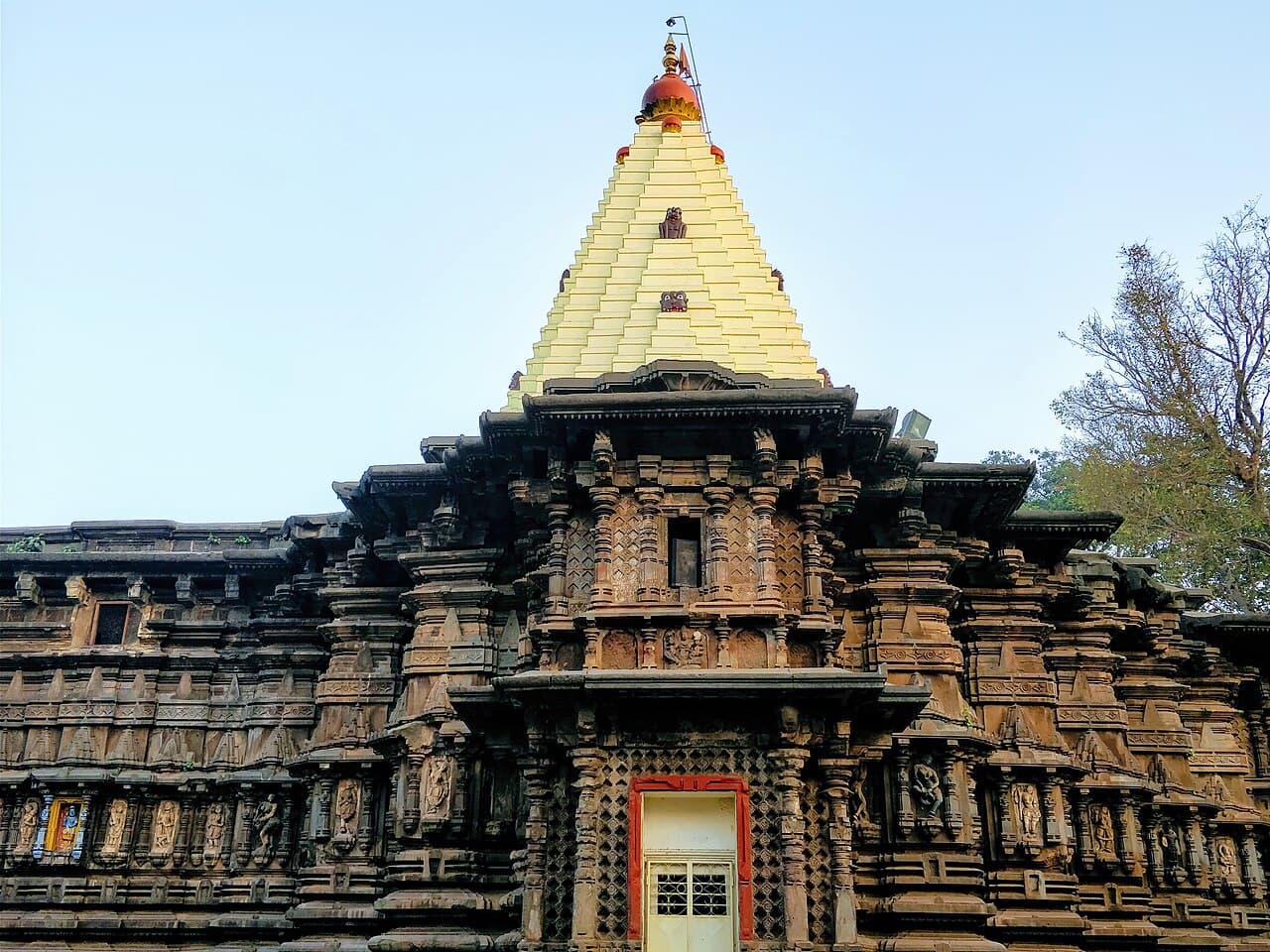
Ambabai of Kolhapur — the living Devi of Karvir, whom the setting sun itself comes to worship at the Kiranotsav.
- Deity
- Devi Mahalakshmi (Ambabai)
- Location
- Kolhapur, Maharashtra
- Category
- Shakti Peethas
- Established
- Traditionally founded by the Chalukya king Karandeva (c. 634 CE); expanded by later dynasties
- Setting
- In the old city of Kolhapur (Karvir), southern Maharashtra
- Best Time to Visit
- October to February; Navaratri; and the Kiranotsav (early February and mid-November)
- Worshipped across Maharashtra as Ambabai, the Mother goddess of Karvir
- A great Devi seat — counted among the 'Sade Teen' (three-and-a-half) peethas
- Some pan-India lists place it among the 51 Shakti Peethas (Sati's eyes)
- Black-stone image ~3 ft tall, crowned by a five-headed cobra, lion at her side
- Kiranotsav: the setting sun's rays fall on the deity for 3 days, twice a year
- Traditionally founded by the Chalukya king Karandeva (c. 634 CE)
- Built in the Hemadpanti (mortar-less basalt) style
Significance
To her devotees Ambabai is Adi Shakti herself, the primordial power, and Kolhapur is joined in pilgrimage with Tuljapur, Mahur and Saptashrungi as the great goddess-seats of Maharashtra.
The image is a striking one: a black-stone figure about three feet tall, richly jewelled, crowned by the hood of a five-headed cobra, with a stone lion — her mount — behind her, and in her four hands a citron, a mace, a shield and a vessel. Most remarkable is the Kiranotsav, the 'festival of sun-rays', when for three days twice a year the light of the setting sun enters the western door and falls full upon the goddess — reaching her feet on the first day, her breast on the second and her face on the third, an alignment the temple's builders set into its very stones.
The temple keeps a full ceremonial calendar — the Navaratri festival above all, the Rathotsav when the goddess is drawn in procession, and the Kiranotsav twice a year — and on Fridays and full-moon days the crowds are thickest. Together with Tuljapur's Bhavani, Mahur's Renuka and the goddess of Saptashrungi, Kolhapur's Ambabai completes the 'Sade Teen' Shakti Peethas that anchor the Devi worship of Maharashtra, a circuit many families make at least once in a generation.
History
In the heart of old Kolhapur stands the temple of Mahalakshmi, worshipped across Maharashtra as Ambabai, the Mother. The town is known in tradition as Karvir and the goddess as Karvir Nivasini, 'she who dwells in Karvir'; local legend tells that she slew the demon Kolhasura here, and from him the city takes its name.
The shrine is old. Its founding is traditionally ascribed to the Chalukya king Karandeva in the 7th century, around 634 CE, and the centuries since have layered on additions by the Shilahara, Yadava and Maratha dynasties who ruled the Deccan. Through all of it Ambabai has remained one of the most beloved and continuously worshipped goddesses of western India.
Kolhapur's place among the Shakti Peethas is told differently by different traditions: some pan-Indian lists count it among the fifty-one, tied to the falling of Sati's eyes, while Maharashtra reveres it distinctively as one of the 'Sade Teen' — the three-and-a-half seats of the Goddess — where she is felt to reside in her fullness as Mahalakshmi rather than as a single relic. Either way, it is held among the most powerful Devi shrines in the land.
Architecture
The temple is built in the Hemadpanti manner of the Deccan — black basalt laid, in the old way, without mortar, the blocks locked together by their own cut — carrying finely carved pillars, several halls and clustered shikharas raised over the centuries.
Its west-facing openings are placed with a precision that lets the low sun of early February and mid-November reach the sanctum for the Kiranotsav, a piece of temple-astronomy shared by only a handful of Indian shrines. The compound holds subsidiary shrines to many deities, along with a Garuda-mandapa and stone deepmalas, and the whole is cared for by the Paschim Maharashtra Devasthan Samiti.
Festivals
Timings
Open daily from about 5:00 AM to 10:00 PM, through the round of Kakad, midday and evening aartis to the Shej aarti at night; hours extend during Navaratri. Confirm current timings locally.
Kolhapur lies in southern Maharashtra, well linked by air, rail and road. Its own airport is about nine kilometres from the temple, with Pune and Mumbai as larger gateways; the Kolhapur railway terminus is around three kilometres away, and the city sits on the national highway roughly 230 km south of Pune. The temple is in the old city centre, an easy walk from the central bus stand.
Timings are indicative — please confirm with the temple trust before travelling.
Videos
Nearby Temples


Frequently Asked Questions
Where is Mahalakshmi, Kolhapur Temple located?+
Mahalakshmi, Kolhapur Temple is in Kolhapur, Maharashtra, India.
Which deity is worshipped at Mahalakshmi, Kolhapur Temple?+
Mahalakshmi, Kolhapur Temple is dedicated to Devi Mahalakshmi (Ambabai).
Which tradition does Mahalakshmi, Kolhapur belong to?+
Mahalakshmi, Kolhapur is one of the Shakti Peethas temples dedicated to Devi (Shakti).
What are the timings of Mahalakshmi, Kolhapur Temple?+
Open daily from about 5:00 AM to 10:00 PM, through the round of Kakad, midday and evening aartis to the Shej aarti at night; hours extend during Navaratri. Confirm current timings locally.
What is the best time to visit Mahalakshmi, Kolhapur Temple?+
October to February; Navaratri; and the Kiranotsav (early February and mid-November)
When was Mahalakshmi, Kolhapur Temple established?+
Mahalakshmi, Kolhapur Temple — Traditionally founded by the Chalukya king Karandeva (c. 634 CE); expanded by later dynasties.
Photo: Lovelitjadhav · CC BY-SA 4.0