

Shiva as Lingaraja and Tribhuvaneshwara at Bhubaneswar — the lord whose name the city carries, whose fifty-five-metre deula is the crown of Kalinga building over the mango-tree land of Ekamra Kshetra.
- Deity
- Shiva as Lingaraja (Tribhuvaneshwara)
- Location
- Bhubaneswar, Odisha
- Category
- Shiva Mahadev
- Established
- Present temple of the 11th century, ascribed to Jajati Keshari of the Somavamshi line, with the natamandira and bhoga-mandapa added later; worship of the linga held older still. Protected by the Archaeological Survey of India and cared for with a temple trust board
- Setting
- In Bhubaneswar's Old Town — the Ekamra Kshetra — just south of the Bindusagar tank
- Best Time to Visit
- October to March; Maha Shivaratri (Feb–Mar) and the Rukuna Rath Yatra on Ashokashtami (Mar–Apr) are the great days
- Shiva as Lingaraja and Tribhuvaneshwara — the Lord of the Three Worlds the city is named for
- A swayambhu linga, unshaped, honoured as Hari-Hara — Shiva and Vishnu in one stone
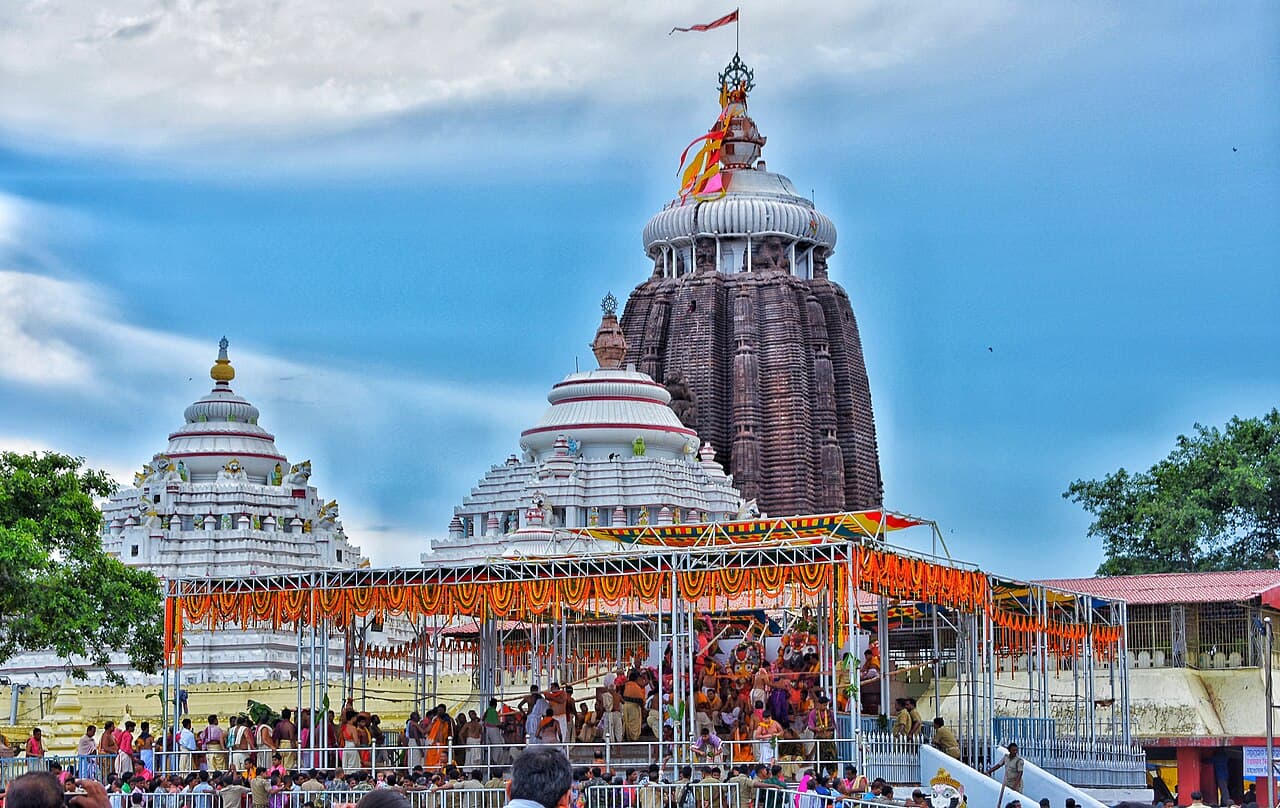
- The vimana rises 180 ft (about 55 m), the crown of the Kalinga school
- Four halls on one east-facing axis: bhoga-mandapa, natamandira, jagamohana, vimana
- 150 subsidiary shrines in the compound by the state's count; 108 by older reckonings
- Ekamra Kshetra — the mango-tree ground of the 13th-century Ekamra Purana
- Rukuna Rath Yatra on Ashokashtami — the chariot drawn home without ever being turned
- Protected by the Archaeological Survey of India; entry is for those of the Hindu faith, with a viewing platform outside the wall
Significance
Lingaraja is the king of the linga, and what is worshipped here is swayambhu — a great unshaped stone, some eight feet across in its seat. It is honoured as a Hari-Hara linga: the state's own account calls the shrine a syncretisation of Shaivism and Vaishnavism, dedicated not to one deity but to Shiva and Vishnu together. Few of the great Shiva homes hold both so openly in one stone.
North of the temple lies the Bindusagar, thirteen hundred feet by seven hundred — the drop-ocean into which, tradition holds, a bindu of every sacred water of the country was gathered. It is the hub of the temple's festivities, and Ekamra Van on its western bank keeps the trees the gods are loved by.
His own chariot festival is the Rukuna Rath Yatra, kept on Ashokashtami, the eighth of the bright fortnight of Chaitra. Chandrashekhara goes out as Lingaraja's representative, riding with Rukmini and Basudeva to the Rameswar temple — Mausi Maa, the aunt's house — and returns after four days; and the name holds the wonder of it: a rukuna chariot is one drawn home without ever being turned about. Maha Shivaratri is the great night, when the fast is broken only at the sight of the Mahadipa, the huge lamp carried to the summit of the deula and lit above the dark city. Chandan Yatra keeps the weeks after, twenty-two days of decorated chapa boats on the Bindusagar.
The compound is closed to those not of the Hindu faith; a raised platform outside the wall gives the whole of it to be seen and photographed.
History
The city is named for him. Bhubaneswar takes its name, the state says plainly, from Tribhubaneswar — the Lord of the Three Worlds — and that Lord is Shiva. The old town about the temple is Ekamra Kshetra, the ground adorned with mango trees, and the thirteenth-century Ekamra Purana remembers the deity beneath a single mango there, the one amra the kshetra is named for.
The temple standing today was raised in the eleventh century, ascribed to Jajati Keshari of the Somavamshi line, though the linga is held worshipped long before — by one account as early as the seventh. Nor did the whole rise at once: the tower and the assembly hall came first, the halls of dance and of offering in the centuries after.
Odisha still quotes the historian James Fergusson's judgement of it — one of the finest examples of purely Hindu temple in India — and calls it the culmination of temple architecture in the cradle city of the Kalinga school. The Archaeological Survey of India protects the monument, its schedule naming Lord Lingraj Temple together with the minor shrines of the compound — Parbati, Sabitri Devi, Chandeswar, Sakreswar, Ladukeswar, Gopaluni and the rest — and a trust board shares the care.
Architecture
Sandstone and laterite, and the Kalinga school at full height. Four halls stand on one east-facing axis and climb as they approach the god: the bhoga-mandapa, hall of offering, roofed as a pyramid and crowned with an inverted bell; the natamandira, hall of dance, its walls carved with couples and women; the jagamohana, the assembly hall, its perforated windows worked in lion motifs; and the vimana, the sanctum tower, one hundred and eighty feet — some fifty-five metres — of curving rekha deula carved from summit to base.
The main gate faces east, smaller gates north and south; the shrine's porch gate is of sandalwood. Around the courtyard stand the subsidiary shrines the compound is famous for — a hundred and fifty by the state's count, a hundred and eight by older reckonings — each a small deula of its own, so the enclosure reads as a city of towers gathered about the great one.
Festivals
Timings
Incredible India (Ministry of Tourism) gives 7:00 AM – 7:00 PM daily; other listings give longer hours and the Mangala Alati is earlier still — confirm before travelling.
Biju Patnaik International Airport and Bhubaneswar railway station both serve the city, and the temple stands in the Old Town, reached by city bus, auto rickshaw or cab. Puri lies about sixty kilometres south by road, the Ganjam hill of Tara Tarini some hundred and seventy-five.
Timings are indicative — please confirm with the temple trust before travelling.
Nearby Temples
Frequently Asked Questions
Where is Lingaraja, Bhubaneswar Temple located?+
Lingaraja, Bhubaneswar Temple is in Bhubaneswar, Odisha, India.
Which deity is worshipped at Lingaraja, Bhubaneswar Temple?+
Lingaraja, Bhubaneswar Temple is dedicated to Shiva as Lingaraja (Tribhuvaneshwara).
Which tradition does Lingaraja, Bhubaneswar belong to?+
Lingaraja, Bhubaneswar is one of the Shiva Mahadev temples dedicated to Shiva (Mahadev).
What are the timings of Lingaraja, Bhubaneswar Temple?+
Incredible India (Ministry of Tourism) gives 7:00 AM – 7:00 PM daily; other listings give longer hours and the Mangala Alati is earlier still — confirm before travelling.
What is the best time to visit Lingaraja, Bhubaneswar Temple?+
October to March; Maha Shivaratri (Feb–Mar) and the Rukuna Rath Yatra on Ashokashtami (Mar–Apr) are the great days
When was Lingaraja, Bhubaneswar Temple established?+
Lingaraja, Bhubaneswar Temple — Present temple of the 11th century, ascribed to Jajati Keshari of the Somavamshi line, with the natamandira and bhoga-mandapa added later; worship of the linga held older still. Protected by the Archaeological Survey of India and cared for with a temple trust board.
Sources & further reading
- Lingaraj Temple — Odisha Tourism, Government of Odisha
- Bhubaneswar — Odisha Tourism, Government of Odisha
- Lingaraj Temple — Incredible India, Ministry of Tourism, Government of India
- Centrally Protected Monuments / Sites — Odisha (Bhubaneswar Circle), Archaeological Survey of India
- Know Your Bhubaneswar — Bhubaneswar Smart City Limited
Photo: Bernard Gagnon · CC BY-SA 3.0