
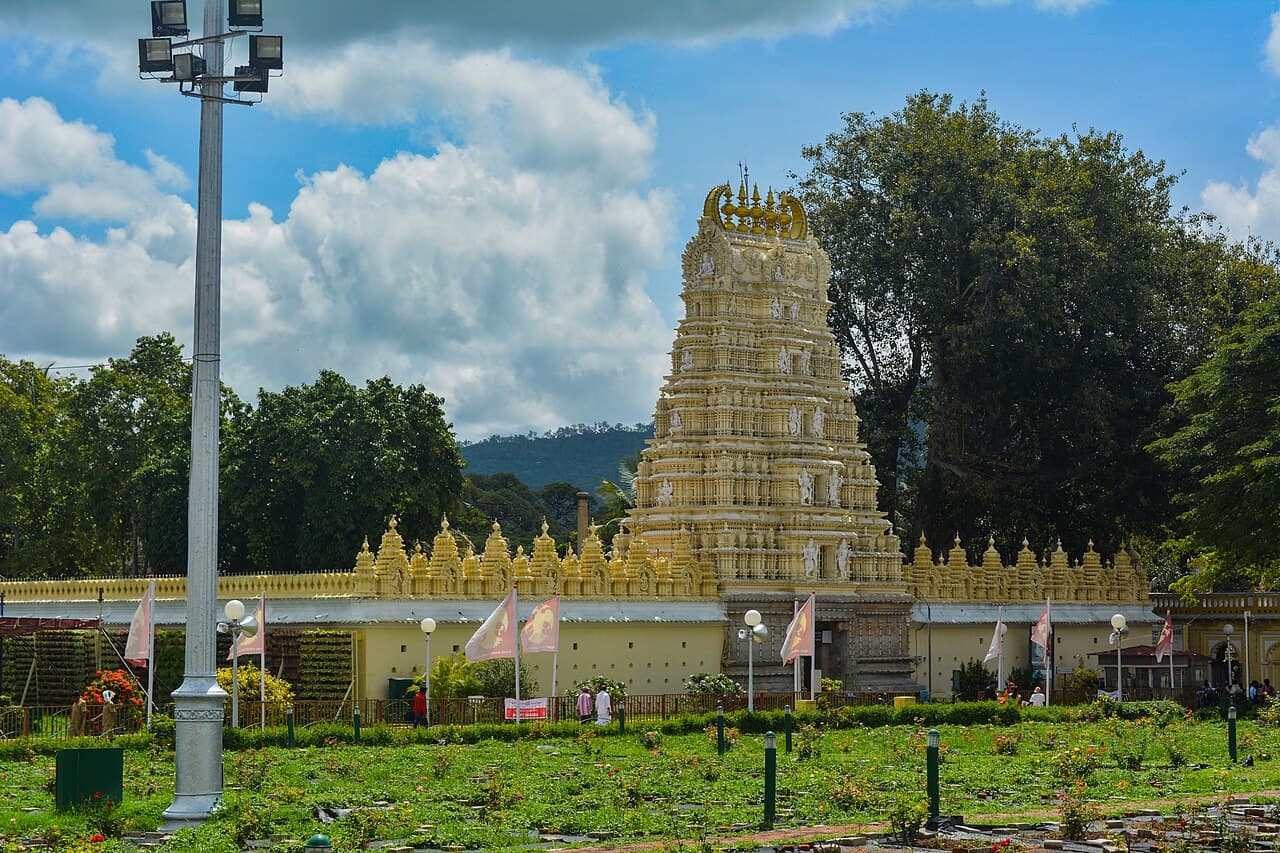
Mahishasuramardini on the hill that gave Mysuru its name — kuladevi of the Wodeyars, presiding Mother of the city below, and the Devi whose Dasara Karnataka keeps as its Nada Habba.
- Deity
- Devi Chamundeshwari (Mahishasuramardini)
- Location
- Chamundi Hill, Mysuru, Karnataka
- Category
- Shakti Peethas
- Established
- A shrine of great antiquity — the Development Authority gives it over a thousand years of background; the district administration reads a Hoysala grant of 1128 to the Mahabaleshwara temple on the hill, and the present gopura is credited to Krishnaraja Wodeyar III in 1827
- Setting
- On the summit of Chamundi Hill (Mahabaladri), about 3,489 feet above sea level, thirteen kilometres from Mysuru
- Best Time to Visit
- October to March; the Navaratri of Mysuru Dasara (Ashvayuja) and the Fridays of Ashadha
- Mahishasuramardini — kuladevi of the Wodeyars and presiding deity of Mysuru
- The Endowments Department's record remembers the city as Mahishurapura — Mahishuru, then Mysuru
- Named in the Ashtadasha stotram as Chamundi of Krauncha Pattana; tradition holds Sati's hair fell here
- Seven-storey Dravida gopura with seven golden kalashas; the Devi in the sanctum is eight-armed
- Krishnaraja Wodeyar III repaired the shrine in 1827 and raised the gopura; Simha-vahana given in 1843
- 1,008 stone steps by Karnataka Tourism's count, cut in Dodda Devaraja Wodeyar's reign (1659–1673)
- The monolithic Nandi midway — 16 feet tall at the front, 25 long, one of the largest in the country
- Mysuru Dasara, Karnataka's Nada Habba, opens here and closes with the Jamboo Savari on Vijayadashami
- Mahabaleshwara and Narayanaswamy share the hill; Jwalamukhi Tripura Sundari stands below at Uttanahalli
- Free dasoha is served on the hill three times a day
Significance
Karnataka Tourism puts it in the words Mysuru itself uses — the city exists because of Chamundeshwari. The Authority and the district administration alike call her the tutelary deity of the Mysuru Maharajas and the presiding deity of the city; the Endowments Department's register names her kuladevate and nadadevate in one breath, and in everyday Kannada she is the Nada Devate, the Mother of the land.
Beyond Mysuru she is counted higher still. The Ashtadasha stotram of the eighteen Maha Shakti Peethas names her in its opening verses — Chamundi at Krauncha Pattana — and that Puranic Krauncha Puri is identified with this hill, where, tradition holds, the hair of Sati came to rest. The state's own pages do not press the claim; the reckoning is old, and steadily kept.
Her greatest days are the Navaratri Karnataka keeps as Mysuru Dasara, which the state tourism department titles Nada Habba, the festival of the land. The Authority lists the Dasara utsavas from the first day of the bright fortnight of Ashvayuja to the tenth, and the celebration opens here, with puja at the Devi's door, before the palace below is lit. It closes on Vijayadashami with the Jamboo Savari, the Devi riding down in the golden howdah on a caparisoned elephant at the head of the procession to Bannimantap. The temple's own year holds more — the Ammanavara Vardhanti, her birthday, on the seventh of the dark fortnight of Ashadha, and the Fridays of that month, when the hill fills before dawn.
History
Chamundi Hill stands over Mysuru like a crown, some 3,489 feet above the sea and thirteen kilometres from the city. Its first name was Mahabaladri, for Mahadev, worshipped here as Mahabaleshwara in what the Sri Chamundeshwari Kshetra Development Authority — the Government of Karnataka body that keeps the shrine — calls the oldest temple on the hill; the Mysuru district administration reads an inscription of the Hoysala king Vishnuvardhana giving to it in 1128. The Authority sets the hill older still: the Skanda Purana names a sacred ground called Trimuta Kshetra ringed by eight hills, of which this is the western.
The hill's later name, and the city's, come from the Mother. The Devi Mahatmya tells of the form she took to overcome the asura Mahisha, and Karnataka holds that it ended on this summit; the Endowments Department's own record of the temple remembers Mysuru as Mahishurapura, from which came Mahishuru, and from that Mysuru. Her own name is older — Chamundi, for Chanda and Munda whom she overcame — and from her the hill is Chamundi Betta.
The Authority is plain about how the temple grew: a shrine of great antiquity with over a thousand years of background, small at first, which the centuries made great. What raised it was the throne — when the Wodeyars came to power in 1399 the Devi became their home deity — and the Authority's Kannada page names the Hoysalas of the twelfth century, the Vijayanagara rulers of the seventeenth and the Mysuru kings together as the hands that built this hill.
Architecture
The temple is quadrangular and Dravida: main doorway, entrance, Navaranga hall, Antharala mantapa, sanctum and prakara, a vimana over the sanctum, and at the gate the seven-storey gopura whose shikhara carries seven golden kalashas. Krishnaraja Wodeyar III repaired the shrine in 1827 and, by the Authority's account, raised that tower; the district administration adds its gold finials, the statues he set up of himself and his three queens, and the Simha-vahana he gave in 1843, drawn still on the great days. Older accounts give the tower instead to Vijayanagara in the seventeenth century — both readings stand in the record.
Festivals
Timings
Open daily. The Development Authority and the Karnataka Endowments Department give darshan from 7:30 AM to 2:00 PM, 3:30 to 6:00 PM and 7:30 to 9:00 PM, with abhisheka 6:00–7:30 AM and 6:00–7:30 PM and 5:00–6:30 AM on Fridays; the district administration gives the afternoon session from 3:00 PM, and some of the Authority's own pages still show an older 5:30 AM–1:30 PM and 3:30–5:30 PM day. Free dasoha is served morning, noon and night. Hours lengthen through Ashadha and Navaratri — confirm with the Authority.
A motorable road climbs the thirteen kilometres from Mysuru, and a second from the Nanjangud side; KSRTC buses leave the city bus stand about every twenty minutes. The district administration puts the airport 14.6 kilometres off, the railway station 13.2 and the suburban bus stand 11.6. Those who climb take the thousand and eight steps Karnataka Tourism counts, cut in the reign of Dodda Devaraja Wodeyar, passing midway the colossal Nandi credited to that same Maharaja. Kukke Subramanya lies about 185 kilometres north-west.
Timings are indicative — please confirm with the temple trust before travelling.
Nearby Temples

Frequently Asked Questions
Where is Sri Chamundeshwari, Mysuru Temple located?+
Sri Chamundeshwari, Mysuru Temple is in Chamundi Hill, Mysuru, Karnataka, India.
Which deity is worshipped at Sri Chamundeshwari, Mysuru Temple?+
Sri Chamundeshwari, Mysuru Temple is dedicated to Devi Chamundeshwari (Mahishasuramardini).
Which tradition does Sri Chamundeshwari, Mysuru belong to?+
Sri Chamundeshwari, Mysuru is one of the Shakti Peethas temples dedicated to Devi (Shakti).
What are the timings of Sri Chamundeshwari, Mysuru Temple?+
Open daily. The Development Authority and the Karnataka Endowments Department give darshan from 7:30 AM to 2:00 PM, 3:30 to 6:00 PM and 7:30 to 9:00 PM, with abhisheka 6:00–7:30 AM and 6:00–7:30 PM and 5:00–6:30 AM on Fridays; the district administration gives the afternoon session from 3:00 PM, and some of the Authority's own pages still show an older 5:30 AM–1:30 PM and 3:30–5:30 PM day. Free dasoha is served morning, noon and night. Hours lengthen through Ashadha and Navaratri — confirm with the Authority.
What is the best time to visit Sri Chamundeshwari, Mysuru Temple?+
October to March; the Navaratri of Mysuru Dasara (Ashvayuja) and the Fridays of Ashadha
When was Sri Chamundeshwari, Mysuru Temple established?+
Sri Chamundeshwari, Mysuru Temple — A shrine of great antiquity — the Development Authority gives it over a thousand years of background; the district administration reads a Hoysala grant of 1128 to the Mahabaleshwara temple on the hill, and the present gopura is credited to Krishnaraja Wodeyar III in 1827.
Sources & further reading
- Sri Chamundeshwari Kshetra Development Authority, Government of Karnataka (official)
- Sri Chamundeshwari Temple, Chamundi Hill — Hindu Religious Institutions & Charitable Endowments Department, Government of Karnataka
- Chamundi Hill — District Mysuru, Government of Karnataka
- Chamundeshwari Temple — Karnataka Tourism, Government of Karnataka
- Mysuru Dasara Festival, Nada Habba — Karnataka Tourism, Government of Karnataka
Photo: Arun Mohan · CC BY-SA 4.0