

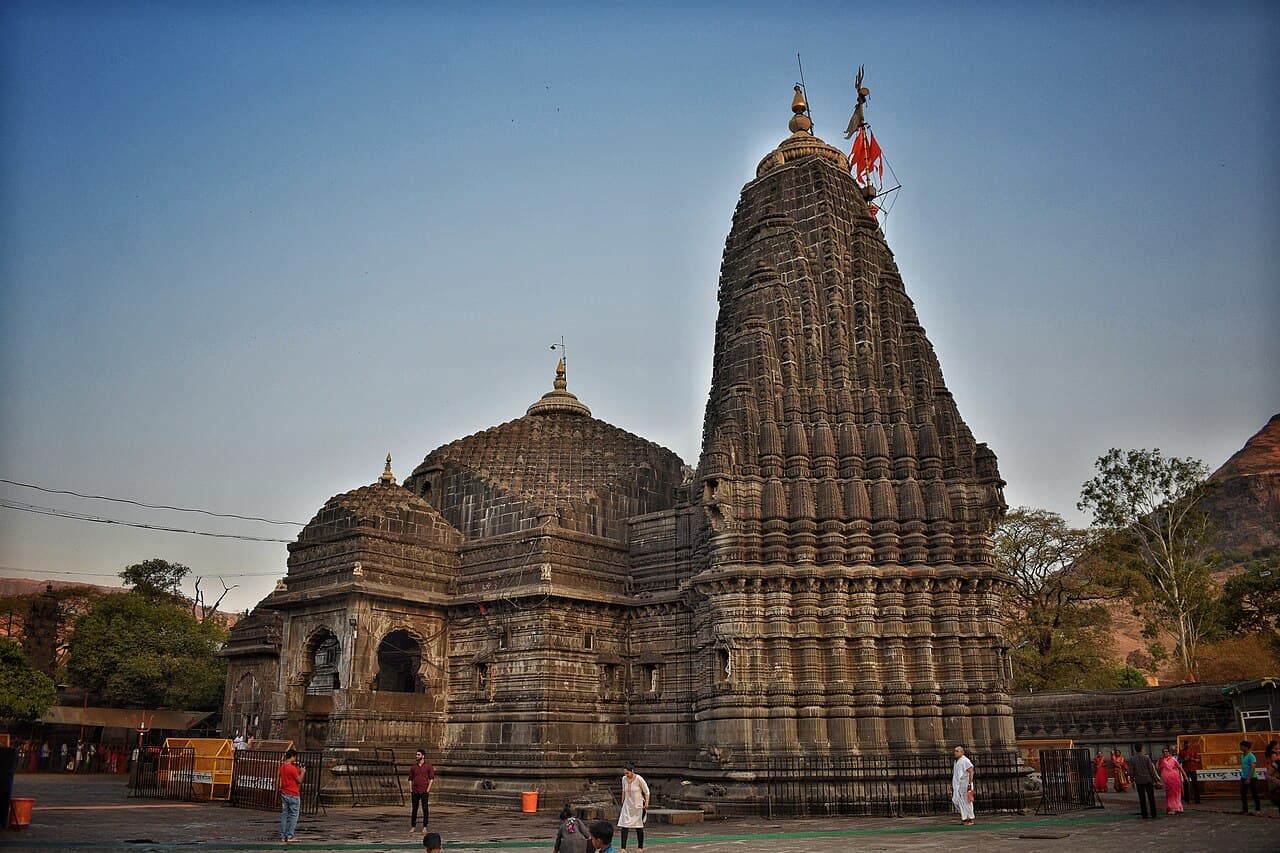
The black Rama of Panchavati — Rama, Sita and Lakshmana in dark stone on the Godavari at Nashik, on ground the Ramayana remembers as the forest of the exile years.
- Deity
- Rama, worshipped as Kala Rama, with Sita and Lakshmana
- Location
- Panchavati, Nashik, Maharashtra
- Category
- Vishnu Desam
- Established
- Present black-stone temple c. 1780–1792 (Sardar Rangrao Odhekar); the district record gives 1782 and twelve years
- Setting
- In Panchavati, on the left bank of the Godavari at Nashik
- Best Time to Visit
- October to March; Chaitra for Rama Navami and the rath yatra
- Kala Rama — Rama, Sita and Lakshmana in black stone, each about two feet tall
- In Panchavati, held to be the ground of Rama's forest exile, on the Godavari
- Present temple raised by Sardar Rangrao Odhekar; the Sansthan dates the work 1780–1792
- Black stone from the Ramshej hills, each block tested in boiling milk before it was set
- A 17-ft wall encloses a court 245 × 105 ft, with gates facing the four directions
- Spire about 70 ft with a gold-plated copper peak; 96 pillars within the enclosure
- Hanuman stands at the threshold, turned towards Rama
- Site of Dr. B. R. Ambedkar's 1930 temple-entry satyagraha
- The Chaitra rath yatra, on the Ekadashi after Rama Navami, is the year's chief procession
Significance
Nashik carries the Ramayana in its streets, and Kalaram is the heart of that memory. A few steps away is the Sita Gufa, the cave where Sita is said to have stayed during the exile, and a little downstream lies Tapovan, the forest of austerities, once part of Dandakaranya. Ramkund, where Rama is believed to have bathed, is a short walk down to the river, and every twelve years the Simhastha Kumbh brings the sadhus to the Godavari at Nashik.
The temple also holds a place in the social history of modern India: in 1930 Dr. B. R. Ambedkar led a satyagraha here for the right of Dalits to enter and worship. Maharashtra's tourism department records that movement as a milestone in the struggle against caste-based discrimination, and it is remembered as such.
The year turns on Chaitra. Shri Ram Navratra is kept through the bright fortnight and Rama Navami is the great day; on the Ekadashi that follows, the Lord goes out in his rath in a grand procession through the city — the Sansthan's chief observance of the year. On the tenth of Ashvin, at Dussehra, he is borne out again in a silver palanquin. Between the festivals the day itself is full: Kakad aarti before dawn, the Mangal aarti and Mahanyas puja of the morning, bhajan through the afternoon, Shej aarti at evening and kirtan until the doors close.
History
Panchavati lies on the left bank of the Godavari at Nashik, and its name is a tally of trees — panch, five, and vati, banyan — whose old and lofty descendants still stand close beside the temple. This is the forest of the Ramayana's middle years: the district record sets the shrine on the very spot where Rama is believed to have lived through the vanavasa, and tradition places the parnakuti of Rama, Sita and Lakshmana in this reach of the old Dandakaranya.
The Lord here is Kala Rama, the black Rama — kala for the dark stone from which he is carved. Three standing images fill the sanctum, each about two feet tall: Rama at the centre, Sita and Lakshmana at his sides, upright as befits the wanderers of the forest. Maharashtra's tourism department preserves the tradition that Sardar Rangrao Odhekar, a nobleman of the Maratha court, saw in a vision a black murti of Rama lying in the Godavari, sought it, and found it where he had dreamt.
An older wooden shrine stood here before him. Odhekar, in consultation with Sawai Madhavrao Peshwa, raised the present temple in black stone; the Sansthan dates the work from 1780, the main temple finished in 1792 and the sabhamandapa and enclosure by 1799, while the district record gives 1782 and twelve years' building with two thousand employed daily. The masons brought their blocks from the Ramshej hills and tested each one in boiling milk before setting it.
Architecture
Kalaram is built wholly of black stone in the Hemadpanthi manner, and its gravity is its beauty. A dressed-stone wall seventeen feet high encloses a court some 245 feet long and 105 broad, entered by four gates that face the four directions; within it the spire rises about seventy feet, its copper peak gold-plated so that it takes the sun by day and the lamps by night.
The main structure stands at the centre of that enclosure on ninety-six pillars, its eastern entrance set under an arched portal, and a separate sabhamandapa some seventy-five feet long, open on every side, faces the sanctum. At the threshold a murti of Hanuman is turned towards his Lord — the first darshan the pilgrim receives, and the posture in which the whole precinct seems to wait.
Festivals
Timings
Darshan generally from about 5:30 AM to 10:00 PM. The Sansthan's daily round: Kakad aarti 5:30–6:30 AM, sanai vadan and bhupali 7:00–8:00 AM, Mangal aarti 8:00–10:00 AM, Mahanyas puja and Maha aarti 10:30 AM–1:00 PM, bhajan 3:00–5:00 PM, Shej aarti 7:00–8:00 PM and kirtan 8:00–10:00 PM. Confirm current timings with the Sansthan.
Kalaram stands in Panchavati, about three kilometres from Nashik's Central Bus Stand, with city buses and auto-rickshaws running to it from every quarter. Nashik Road is the nearest railhead, roughly ten kilometres away, and Nashik's Ozar airport about twenty-four; by road the city is some 170 kilometres from Mumbai and 210 from Pune. Trimbakeshwar lies about twenty-eight to thirty kilometres west and the Saptashringi gad about sixty kilometres north, so the three are commonly taken on one journey.
Timings are indicative — please confirm with the temple trust before travelling.
Nearby Temples

Frequently Asked Questions
Where is Shri Kalaram Mandir, Panchavati Temple located?+
Shri Kalaram Mandir, Panchavati Temple is in Panchavati, Nashik, Maharashtra, India.
Which deity is worshipped at Shri Kalaram Mandir, Panchavati Temple?+
Shri Kalaram Mandir, Panchavati Temple is dedicated to Rama, worshipped as Kala Rama, with Sita and Lakshmana.
Which tradition does Shri Kalaram Mandir, Panchavati belong to?+
Shri Kalaram Mandir, Panchavati is one of the Vishnu Desam temples dedicated to Vishnu.
What are the timings of Shri Kalaram Mandir, Panchavati Temple?+
Darshan generally from about 5:30 AM to 10:00 PM. The Sansthan's daily round: Kakad aarti 5:30–6:30 AM, sanai vadan and bhupali 7:00–8:00 AM, Mangal aarti 8:00–10:00 AM, Mahanyas puja and Maha aarti 10:30 AM–1:00 PM, bhajan 3:00–5:00 PM, Shej aarti 7:00–8:00 PM and kirtan 8:00–10:00 PM. Confirm current timings with the Sansthan.
What is the best time to visit Shri Kalaram Mandir, Panchavati Temple?+
October to March; Chaitra for Rama Navami and the rath yatra
When was Shri Kalaram Mandir, Panchavati Temple established?+
Shri Kalaram Mandir, Panchavati Temple — Present black-stone temple c. 1780–1792 (Sardar Rangrao Odhekar); the district record gives 1782 and twelve years.
Sources & further reading
Photo: K.Venkataramana · CC0