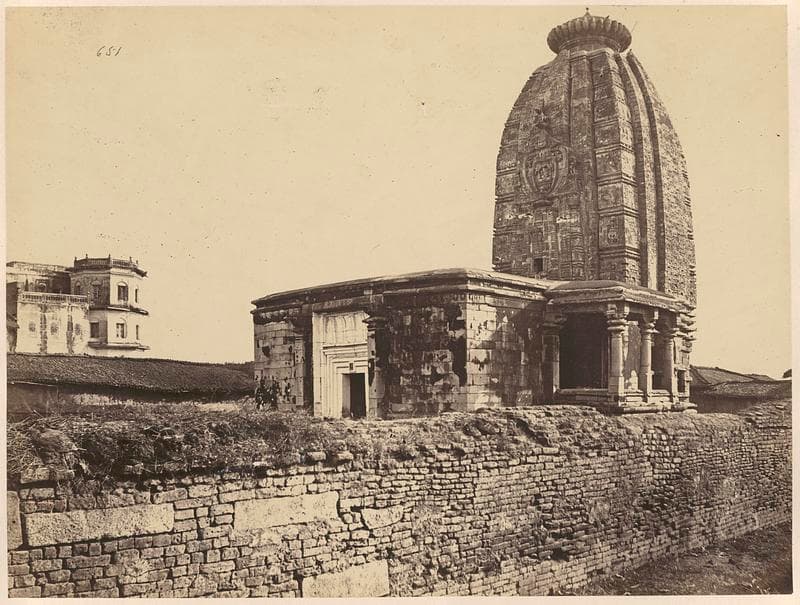
The Sun temple that turns to the setting sun — Surya's seat at Deo in Bihar's Aurangabad district, where a hundred feet of shikhara stands over a west-facing door and Chhath fills the kunds twice a year.
- Deity
- Surya, worshipped at Deo at sunrise and at sunset both
- Location
- Deo, Aurangabad, Bihar
- Category
- Devata
- Established
- Contested. The district administration calls it a 15th-century temple and ascribes it to Bhairvendra Sing, a Chandravanshi king of Umga; an inscription of 1437 is read as recording Bhairavendra's dedication; the lettering of an older inscription outside the shrine is read to the 8th–9th century, and the surviving fabric is placed by historians of temple architecture between the 8th and 12th centuries. Deo's own tradition puts the temple in the Treta Yuga, raised by Vishwakarma in a single night
- Setting
- In Deo town, about ten kilometres south-east of Aurangabad town, in the old Magadha land south of the Son; the kunds lie below the temple
- Best Time to Visit
- October to March by Bihar Tourism's ready reckoner, September to April by its destination page; the Kartik Chhath and the Chaiti Chhath of Chaitra bring the greatest gatherings
- West-facing — the shrine looks to the setting sun, not the rising; Bihar Tourism states this as what sets Deo apart
- Surya is worshipped here at sunrise and at sunset both (Bihar Tourism)
- A hundred feet tall with an umbrella-like top, by the district administration's reckoning
- A dome carved above, a gold urn set on the dome; Nagara, Dravidian and Vesara read together (Bihar Tourism)
- Three presiding images named in the sanctum — Vishnu, Surya and Avalokiteshvara (Bihar Tourism)
- Deo speaks of Surya in his three hours — Udayachal, Madhyachal, Astachal
- Tradition holds Vishwakarma raised the temple in a single night, its worship coming down from the Treta Yuga
- The custom of worship and of bathing in the Brahma Kund is traced to the era of King Ayel (district administration)
- Dating contested: 15th century and Bhairvendra Sing by the district; an inscription of 1437; 8th–9th century lettering; 8th–12th century fabric
- All India Radio's news names Deo among the famous temples the Chhath crowds reach
- Chaiti Chhath in Chaitra brings a four-day fair at Deo, opening with Nahay-Khay
- Bihar Tourism counts it among the most important Sun temples of India
Significance
Bihar's tourism department states the practice plainly: at Deo, Surya is worshipped at sunrise and at sunset both. That is the shrine's whole disposition, and it is why Chhath belongs here. Chhath, the department writes, is the one occasion on which the setting sun is worshipped along with the rising — Surya Shashti, kept on the sixth day of Kartik, a bathing festival held inside four days of abstinence and ritual purity.
The four days run at Deo as they run at every ghat of Bihar: the holy dip of Nahay-Khay; Kharna, the day-long fast broken late in the evening on kheer and fruit; the third day's Sanjhiya Arghya, the water crowded with those standing in it to offer to the setting sun, and the night's Kosi, its canopy of sugarcane hung with earthen lamps; and before dawn on the fourth, the Arghya to the sun as he rises. All India Radio's news names Deo among the famous temples the crowds reach at Chhath.
Chaitra brings it all again — the Chaiti Chhath fair at Deo opens with Nahay-Khay and runs its four days, drawing devotees from across the land.
History
Deo is a small town ten kilometres south-east of Aurangabad town, in Bihar's Aurangabad district, in the old Magadha land south of the Son. Bihar's tourism department calls the shrine an ancient temple of Lord Sun and counts it among the most important Surya temples of India; the district administration records that the custom of worshipping the Sun God and bathing in its Brahma Kund goes back to the era of King Ayel.
Deo puts the raising of the temple beyond history altogether. Tradition holds that Vishwakarma, the architect of the devas, built it with his own hands in the course of a single night, and that its worship comes down from the Treta Yuga. That is Deo's own telling, set down here as Deo tells it.
The recorded dating is genuinely unsettled, and the honest account gives the spread. The district administration calls this a fifteenth-century temple and ascribes it to Bhairvendra Sing, a Chandravanshi king of Umga, whose Vaishnava temple at Umga, fifteen kilometres from Deo, the district says resembles the Sun temple built at Deo. An inscription of 1437 is read as recording Bhairavendra's dedication; the lettering of an older inscription outside the shrine is read to the eighth or ninth century; historians of temple building place the surviving fabric somewhere between the eighth and the twelfth. What no reading disputes is that Surya has been worshipped at Deo a very long time, and is worshipped still.
Architecture
The temple faces west. The tourism department states it as the thing that sets Deo apart: the shrine looks towards the setting sun, not the rising, where a Surya temple is expected to face east. The district administration gives the building at a hundred feet with an umbrella-like top; the tourism department describes a dome carved above it, a gold urn set on the dome, and the whole a mixture of Nagara, Dravidian and Vesara work in intricately carved stone. In the sanctum the department names three presiding images — Vishnu, Surya and Avalokiteshvara — while Deo itself speaks of Surya in his three hours, Udayachal of the morning, Madhyachal of the noon and Astachal of the evening. Below the temple lie the kunds, the sacred tanks whose water is the first act of every Chhath kept here.
Festivals
Timings
Bihar Tourism's ready reckoner gives 04:30 AM to 08:30 PM. Neither the district administration nor the temple publishes separate darshan hours, and the doors keep longer hours through the Kartik and Chaitra Chhath fairs. Confirm locally before travelling.
Deo lies about ten kilometres south-east of Aurangabad town. The nearest railhead is Anugrah Narayan Road — twenty kilometres by the district administration's reckoning, thirty by the tourism department's. Gaya International Airport is about seventy kilometres off; Patna's Jay Prakash Narayan airport is roughly three hours' drive. By road Deo is almost a hundred and sixty kilometres from Patna, the district giving the route through Bikram, Arwal, Daudnagar, Obra and Aurangabad on NH-98. The bus stand and the police station both stand within five hundred metres of the temple.
Timings are indicative — please confirm with the temple trust before travelling.
Nearby Temples


Frequently Asked Questions
Where is Deo Surya Mandir Temple located?+
Deo Surya Mandir Temple is in Deo, Aurangabad, Bihar, India.
Which deity is worshipped at Deo Surya Mandir Temple?+
Deo Surya Mandir Temple is dedicated to Surya, worshipped at Deo at sunrise and at sunset both.
Which tradition does Deo Surya Mandir belong to?+
Deo Surya Mandir is one of the Devata temples dedicated to The Devas.
What are the timings of Deo Surya Mandir Temple?+
Bihar Tourism's ready reckoner gives 04:30 AM to 08:30 PM. Neither the district administration nor the temple publishes separate darshan hours, and the doors keep longer hours through the Kartik and Chaitra Chhath fairs. Confirm locally before travelling.
What is the best time to visit Deo Surya Mandir Temple?+
October to March by Bihar Tourism's ready reckoner, September to April by its destination page; the Kartik Chhath and the Chaiti Chhath of Chaitra bring the greatest gatherings
When was Deo Surya Mandir Temple established?+
Deo Surya Mandir Temple — Contested. The district administration calls it a 15th-century temple and ascribes it to Bhairvendra Sing, a Chandravanshi king of Umga; an inscription of 1437 is read as recording Bhairavendra's dedication; the lettering of an older inscription outside the shrine is read to the 8th–9th century, and the surviving fabric is placed by historians of temple architecture between the 8th and 12th centuries. Deo's own tradition puts the temple in the Treta Yuga, raised by Vishwakarma in a single night.
Sources & further reading
- Deo Sun Temple — Bihar Tourism, Government of Bihar
- Sun Temple, Deo, Aurangabad — Ready Reckoner, Department of Tourism, Government of Bihar (pp. 4–5)
- Deo Temple — District Aurangabad, Government of Bihar
- Places of Interest — District Aurangabad, Government of Bihar
- Chhath Puja — Bihar Tourism, Government of Bihar
- Festival of Chhath Puja begins today — Akashvani News (Prasar Bharati), Government of India
Photo: Thomas Fraser Peppé (attributed) — Boston Public Library, via DPLA · Public domain