
Surya as Suryanarayana Swamy at Arasavalli — the Pratyaksha Daivam, the visible god, cut with his consorts from one block of black granite, where twice a year the early light comes through five gates to rest on his feet.
- Deity
- Surya (Suryanarayana Swamy), with Usha, Chhaya and Padmini
- Location
- Arasavalli, Srikakulam, Andhra Pradesh
- Category
- Devata
- Established
- Attributed by the temple's own account, reading its stone inscriptions, to Devendra Varma of the Kalinga kingdom in the later half of the 7th century, with grants by his successors recorded before the 11th century; administered as the Sri Suryanarayana Swamy Vari Devasthanam under an Executive Officer
- Setting
- In Arasavalli village on the north-coastal Andhra plain, about a kilometre east of Srikakulam town, beside the Indra Pushkarini
- Best Time to Visit
- October to March; Ratha Saptami in Magha (Jan–Feb) is the great day, and the sun's rays reach the deity in the early hours twice a year
- Surya as Suryanarayana Swamy — the Pratyaksha Daivam, the visible god
- Surya with Usha, Chhaya and Padmini, carved from a single block of finely polished black granite
- Attributed on the temple's own inscriptions to Devendra Varma of the Kalinga kingdom, later half of the 7th century
- Inscribed grants before the 11th century for perpetual lamps and a school for pupils of the shastras and the Vedas
- Twice a year the early sun comes through the five entrance gates to rest a few minutes on the Lord's feet
- Ratha Saptami on Magha Shukla Saptami — Surya Jayanti, and a declared state festival of Andhra Pradesh
- Panchayatana worship by the Agama Shastras: Aditya, Ambika, Vishnu, Ganesha, Maheswara
- The seven horses of his chariot bear the names of the Vedic metres — Gayatri, Brihati, Ushnik, Jagati and the rest
- The Indra Pushkarini, where the Lord goes out on the Hamsa Nava at Kartika Shukla Dwadashi
Significance
Surya is the god who need not be imagined. The Devasthanam names him Pratyaksha Daivam, the visible god — he who passes daily over the universe and sees all that is in it, source and sustainer of life, whom the puranas call the embodiment of Brahma, Vishnu and Maheswara. His worship is old as the Vedic dawn and is kept here in that form: those who make Surya namaskara recite the Maha Saura and Aruna mantras, whose bijaksharas are of the Rigveda and the Yajurveda, and the seven horses of his chariot carry the names of the Vedic metres — Gayatri, Brihati, Ushnik, Jagati and the rest.
The year turns on Ratha Saptami, Magha Shukla Saptami, kept as Surya Jayanti. From this day, the district writes, the land passes out of darkness into light: winter ceases, spring begins, the harvest season opens. His chariot has a single wheel and seven horses for the seven colours of light, and on that morning the Nija Rupa darshan is given. Andhra Pradesh has declared Ratha Saptami at Arasavalli a state festival.
Twice in every year his own light is brought to him. The temple is built, the Devasthanam says, so that the sun's rays focus on the feet of the god twice in the year in the early hours of the day, passing through the five entrance gates and resting there a few minutes. The temple gives those months as March and September — or, by its own festival reckoning, the opening days of October.
History
Arasavalli stands a kilometre east of Srikakulam, on the north coast of Andhra where the Telugu land runs up into the old Kalinga. Its name, the Devasthanam says, was Harshavalli, the abode of joy, and the daily slokam greets the Lord by it still — dwelling in Harshavalli, joined with Chhaya, Usha and Padmini, giver of all things. By the Padma Purana, the temple holds, Sage Kasyapa installed the image of Surya here for the welfare of mankind; so the Lord of this place is of Kasyapa gotra.
The sthalapurana tells how he came to be seated. Balarama drew the Nagavali along the furrow of his plough and raised the shrine of Uma and Rudrakoteswara on its bank, and the devas came to make obeisance. Indra came late, and pressing in at an untimely hour was turned back by Nandi at the door; fallen and in pain, he dreamt that his hurt would leave him if he built a temple to the Sun. Waking, he lifted three handfuls of earth where he lay and found the image there. With his vajra he opened the tank called the Indra Pushkarini still.
For the fabric, the temple states what its own stones say. Archaeological opinion, it records, reads the inscriptions here to mean that Devendra Varma, ruler of the Kalinga kingdom, must have built this temple and installed the image in the later half of the seventh century; their translations show grants of land from his successors, before the eleventh century, for perpetual lamps and for a school for pupils of the shastras and the Vedas.
Architecture
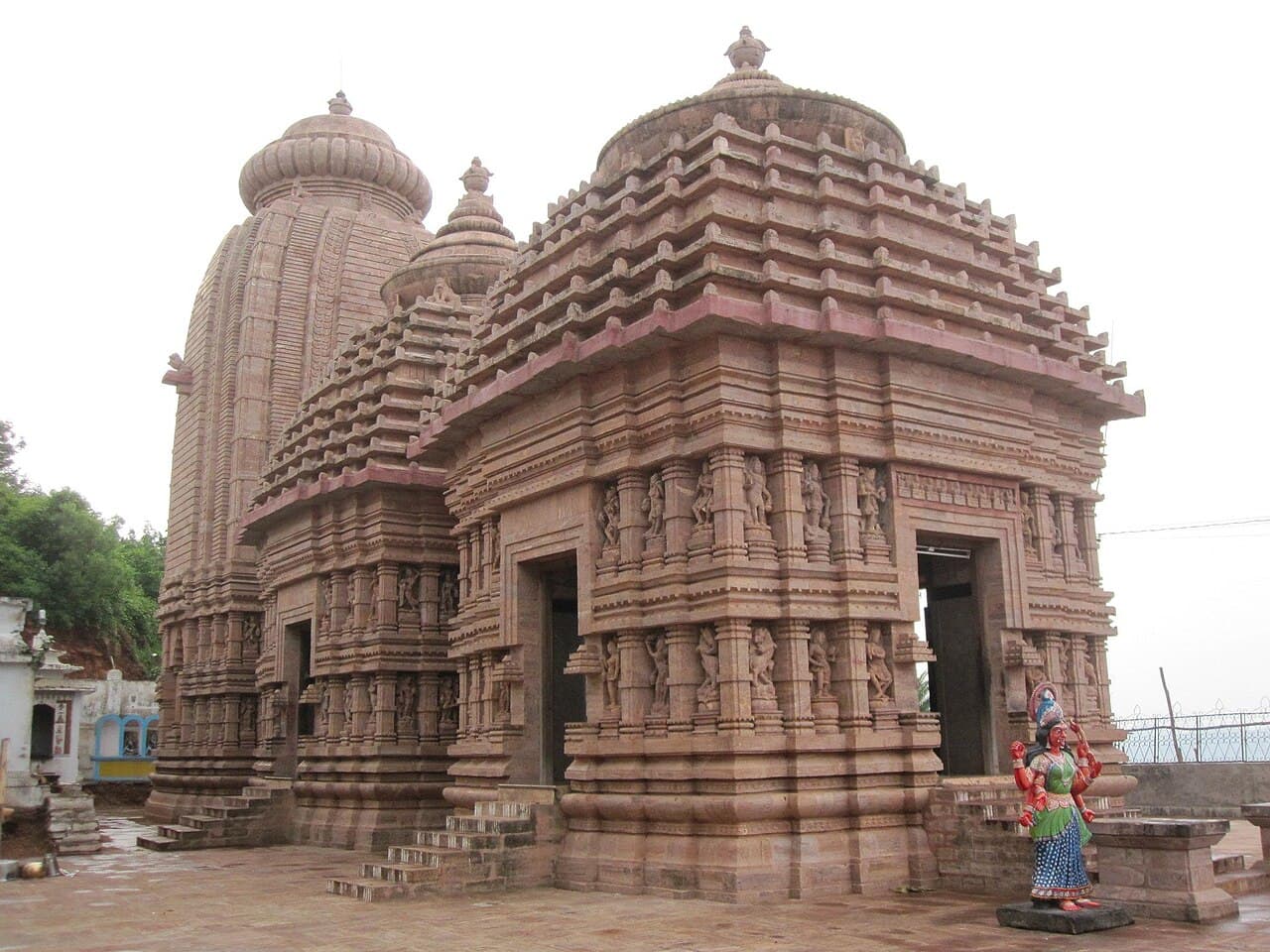
Everything essential here is one stone: Surya with Usha, Chhaya and Padmini beside him, Mathara and Pingala the dwarapalakas at the base, the sages Sanaka and Sanandana holding the chatram above, and Aruna driving the chariot before him — all, the temple records, exquisitely carved out of a single black, finely polished granite. Five entrance gates open on the axis the light travels. Beside the presiding deity the Panchayatana is set as the Agama Shastras direct — Aditya, Ambika, Vishnu, Ganesha, Maheswara — so that here Shiva and Kesava are one. A Navagraha mandapam stands in the compound, and beyond it the Indra Pushkarini.
Festivals
Timings
The Devasthanam gives Sarva Darshanam 6:00 AM – 12:30 PM and 3:30 PM – 8:00 PM, with Suprabhatam about 5:00 AM, Nitya Archana 5:30 AM and Maha Nivedana at 12:30 PM; on Ratha Saptami the Nija Rupa darshan is given from 5:00 AM to 2:00 PM. Confirm with the temple before travelling.
The village lies about a kilometre east of Srikakulam town, some five kilometres from its bus stand. The district gives Visakhapatnam, a hundred and seventeen kilometres down the coast, as the nearest airport, and Srikakulam Road, nine kilometres off on the Visakhapatnam–Bhubaneswar line, as the railhead. Tara Tarini on the Ganjam coast is about a hundred and ninety kilometres up the highway.
Timings are indicative — please confirm with the temple trust before travelling.
Nearby Temples
Frequently Asked Questions
Where is Suryanarayana Swamy, Arasavalli Temple located?+
Suryanarayana Swamy, Arasavalli Temple is in Arasavalli, Srikakulam, Andhra Pradesh, India.
Which deity is worshipped at Suryanarayana Swamy, Arasavalli Temple?+
Suryanarayana Swamy, Arasavalli Temple is dedicated to Surya (Suryanarayana Swamy), with Usha, Chhaya and Padmini.
Which tradition does Suryanarayana Swamy, Arasavalli belong to?+
Suryanarayana Swamy, Arasavalli is one of the Devata temples dedicated to The Devas.
What are the timings of Suryanarayana Swamy, Arasavalli Temple?+
The Devasthanam gives Sarva Darshanam 6:00 AM – 12:30 PM and 3:30 PM – 8:00 PM, with Suprabhatam about 5:00 AM, Nitya Archana 5:30 AM and Maha Nivedana at 12:30 PM; on Ratha Saptami the Nija Rupa darshan is given from 5:00 AM to 2:00 PM. Confirm with the temple before travelling.
What is the best time to visit Suryanarayana Swamy, Arasavalli Temple?+
October to March; Ratha Saptami in Magha (Jan–Feb) is the great day, and the sun's rays reach the deity in the early hours twice a year
When was Suryanarayana Swamy, Arasavalli Temple established?+
Suryanarayana Swamy, Arasavalli Temple — Attributed by the temple's own account, reading its stone inscriptions, to Devendra Varma of the Kalinga kingdom in the later half of the 7th century, with grants by his successors recorded before the 11th century; administered as the Sri Suryanarayana Swamy Vari Devasthanam under an Executive Officer.
Sources & further reading
- Om Sri Suryanarayana Swamy Vari Devasthanam, Arasavalli (official)
- About Temple — Sri Suryanarayana Swamy Vari Devasthanam, Arasavalli (official)
- Arasavilli — Srikakulam District, Government of Andhra Pradesh
- Ratha Saptami — Festival of Sun God, Arasavalli — Srikakulam District, Government of Andhra Pradesh
- Sri Suryanarayana Swamy Vari Radhasapthami Festival — Utsav, Ministry of Tourism, Govt. of India (official)
Photo: విశ్వనాధ్.బి.కె. (B.K.Viswanadh) · CC BY-SA 4.0