
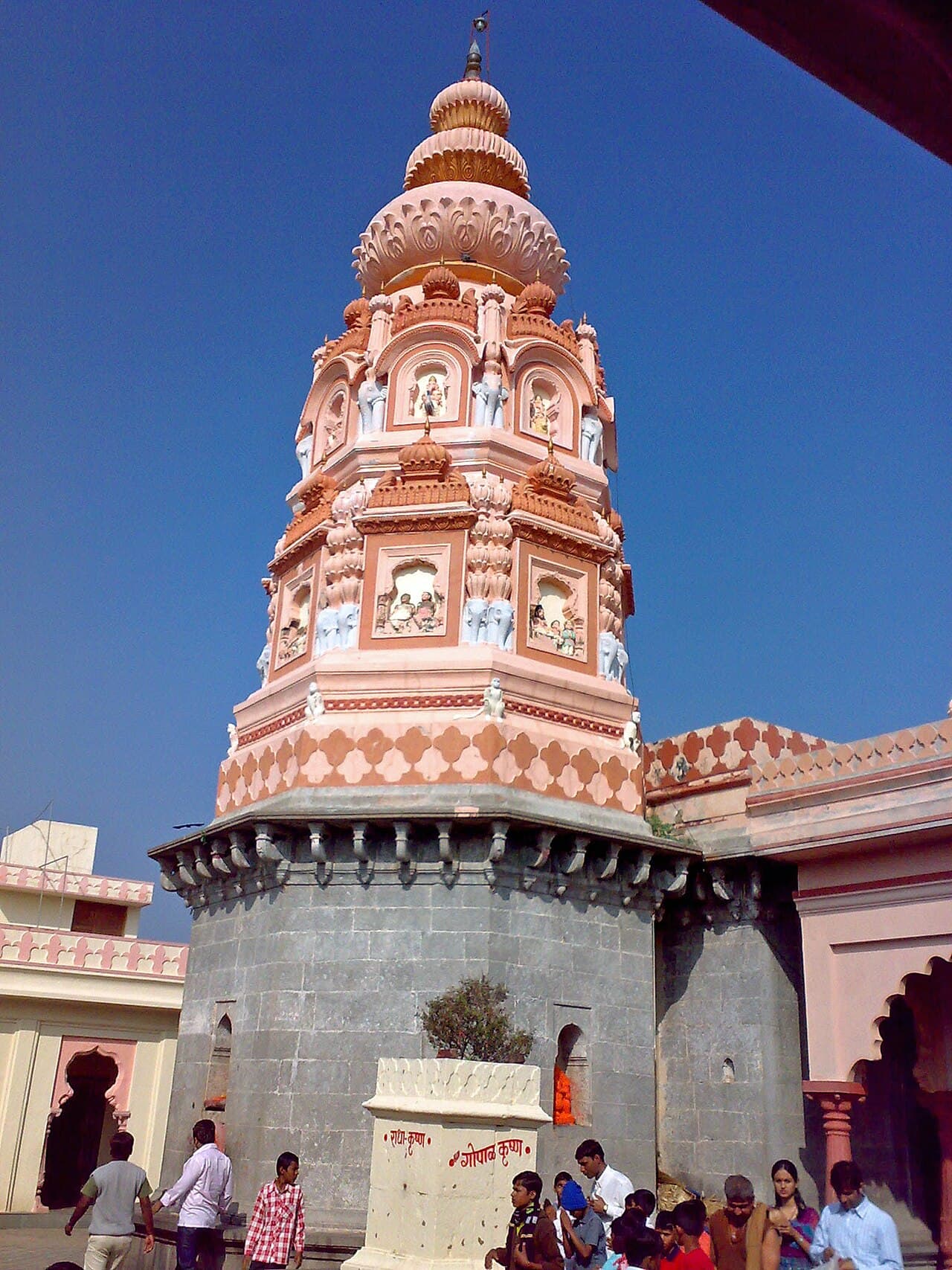
The first and last bow of the Ashtavinayak yatra — where Ganesha, riding his peacock, slew the demon Sindhu at Morgaon on the Karha.
- Deity
- Ganesha (Mayureshwar)
- Location
- Morgaon, Pune, Maharashtra
- Category
- Ashtavinayaka
- Established
- Present temple c. 14th–17th century; associated with Morya Gosavi and Peshwa patronage
- Setting
- On the banks of the Karha river, near Jejuri and Baramati
- Best Time to Visit
- October to February; and the Ganesh festivals (Bhadrapada and Magh)
- First and last shrine of the Ashtavinayak; the yatra is closed here
- Revered as the adya pitha, the foremost seat of Ganesha worship
- Ganesha as Mayureshwar, who rode a peacock to slay the demon Sindhu
- Swayambhu image with a left-turning trunk, under a cobra-hood canopy
- Fort-like black-stone walls with a minaret at each corner
- A rare stone Nandi and a stone mouse stand before the sanctum
- Cared for by the Chinchwad Devasthan Trust
Significance
As the first and last of the eight, Morgaon frames the whole Ashtavinayak journey; to bow here at the outset and again on the return is, for Maharashtrian devotees, to complete a circle of devotion that many undertake at least once in a lifetime. The Ganapatya tradition holds it the very source of Ganesha worship, which lends the modest village an outsized place in the faith.
The deity's trunk turns to the left, and the image sits beneath a canopy formed by a cobra's hood, jewels set in its eyes and navel and consort figures at its side. Around the sanctum stand some two dozen other images of Ganesha and, unusually for a Ganesha shrine, a large stone Nandi — Shiva's bull — together with a stone mouse, the Lord's own mount, keeping watch before him.
History
Morgaon, on the banks of the Karha river southeast of Pune, is the head and the foot of the Ashtavinayak pilgrimage: the circuit of eight Ganesha shrines begins here and is held incomplete unless the pilgrim returns to Morgaon to close it. The village is revered by the Ganapatya tradition as the adya pitha, the foremost seat of Ganesha worship, and its name — 'village of peacocks' — is bound to the legend it keeps.
Here Ganesha took the form of Mayureshwar, the Lord who rides the peacock (mayura), to destroy the demon Sindhu and his army; having felled the demon's general and then Sindhu himself, he set aside the peacock mount, and the place took its name from it. The image worshipped today is swayambhu, its features long softened beneath a thick coat of vermilion and oil that is renewed only about once a century.
The temple's exact age is unknown — scholars place it no earlier than perhaps the 14th to 17th centuries — but its cult is inseparable from the saint Morya Gosavi, whose Chinchwad lineage came to administer many of the Ashtavinayak shrines, and from the Peshwas, for whom Ganesha was the family deity. It is cared for today by the Chinchwad Devasthan Trust, and palkhi processions still travel between Morgaon and Chinchwad on the great festival days.
Architecture
Morgaon's temple is enclosed by a high black-stone wall with a minaret at each of its four corners — a deliberately fort- and mosque-like design widely said to have been meant to spare it from destruction in troubled centuries. Four gates face the cardinal directions, each associated in tradition with one of the four ages of the world, and guarded by paired deities.
The rare stone Nandi before the sanctum is explained by a story that a cart carrying it to a Shiva temple broke down here and would go no further, so it stayed. Within the walls stand a sabha-mandapa, a Nagarkhana and two tall deepmalas, and a revered kalpavriksha tree; the whole is raised in the dark basalt of the Deccan, plain and massive.
Festivals
Timings
Open daily, commonly from about 5:00 AM to 10:00 PM, through the Kakad, midday and evening aartis; palkhi processions arrive from Chinchwad on festival days. Timings vary by source — confirm before travelling.
Morgaon lies about 65 km southeast of Pune, near Jejuri and Baramati; the usual road runs by way of Jejuri, whose own famous temple many pilgrims visit en route. The nearest railhead is Jejuri, about 17 km away, while Pune, some 65 km off, is the nearest airport. Being the start and finish of the circuit, Morgaon is where most Ashtavinayak journeys are planned to begin and end.
Timings are indicative — please confirm with the temple trust before travelling.
Nearby Temples
Frequently Asked Questions
Where is Mayureshwar, Morgaon Temple located?+
Mayureshwar, Morgaon Temple is in Morgaon, Pune, Maharashtra, India.
Which deity is worshipped at Mayureshwar, Morgaon Temple?+
Mayureshwar, Morgaon Temple is dedicated to Ganesha (Mayureshwar).
Which tradition does Mayureshwar, Morgaon belong to?+
Mayureshwar, Morgaon is one of the Ashtavinayaka temples dedicated to Ganesha.
What are the timings of Mayureshwar, Morgaon Temple?+
Open daily, commonly from about 5:00 AM to 10:00 PM, through the Kakad, midday and evening aartis; palkhi processions arrive from Chinchwad on festival days. Timings vary by source — confirm before travelling.
What is the best time to visit Mayureshwar, Morgaon Temple?+
October to February; and the Ganesh festivals (Bhadrapada and Magh)
When was Mayureshwar, Morgaon Temple established?+
Mayureshwar, Morgaon Temple — Present temple c. 14th–17th century; associated with Morya Gosavi and Peshwa patronage.
Photo: Redtigerxyz · CC BY-SA 3.0