
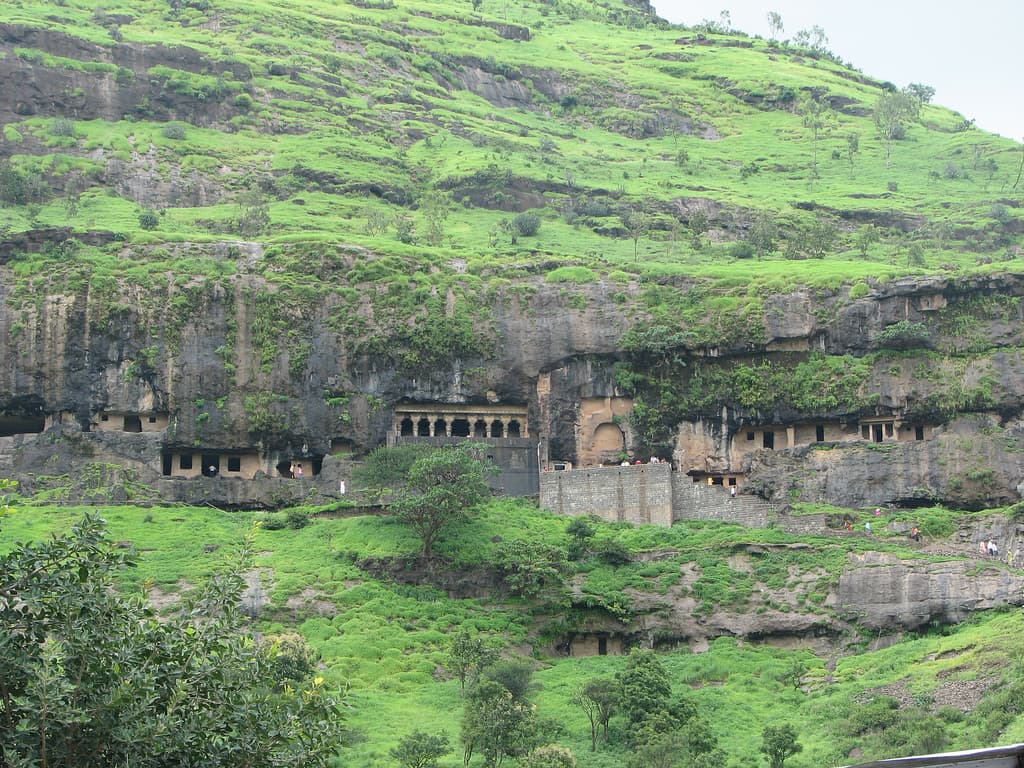
The only hill-and-cave Ganesha of the eight — Girija's son, enshrined in an ancient rock-cut Buddhist vihara above the Kukadi.
- Deity
- Ganesha (Girijatmaj)
- Location
- Lenyadri, Pune, Maharashtra
- Category
- Ashtavinayaka
- Established
- Ganesha shrine in Lenyadri Cave 7 (Buddhist caves c. 1st–3rd century CE), adapted in the medieval and Maratha periods
- Setting
- In the Lenyadri hill-caves above the Kukadi river, near Junnar
- Best Time to Visit
- The cooler months, October to February; and the Ganesh festivals
- Sixth shrine of the Ashtavinayak and the only one set on a hill
- Enshrined in an ancient rock-cut Buddhist vihara (Lenyadri Cave 7)
- Reached by a stone stairway of about 283 steps
- 'Girijatmaj' means the son of Girija (Parvati)
- The great cave hall is unpillared, hewn entirely from the rock
- Deity faces north; devotees worship from the rear; trunk turns left
- The cave group is protected by the Archaeological Survey of India
Significance
Girijatmaj is the sixth shrine of the Ashtavinayak yatra and its only hill temple. The climb of some 283 stone steps is itself part of the pilgrimage, opening at the top onto the cave-sanctum and a wide view across the Kukadi valley.
The image is carved directly onto the cave's rear wall and counted swayambhu, self-arisen; it is the least distinctly formed of the eight, roughly hewn and thickly coated in sindoor, its trunk turning to the left. Unusually, the shrine's entrance faces south while the deity faces north, so devotees offer worship from behind the Lord — and, stripped of its ceremonial brass mask, the rock image is said to show but a single eye, a detail pilgrims recount with wonder.
Worshipped as the child of Parvati, Ganesha at Lenyadri carries a gentleness that draws families in particular. The shrine's great days are the Magh festival around Ganesh Jayanti and Bhadrapada's Ganesh Chaturthi, when the hillside fills with pilgrims and, by local custom, bullock-cart races are run in the fields below.
History
Girijatmaj is the most unusual of the Ashtavinayak shrines, for it is not a built temple at all but a chamber cut into living rock. It occupies one of the Lenyadri caves — a group of some thirty Buddhist excavations of the Hinayana period, roughly the 1st to 3rd centuries CE — ranged along a hill on the north bank of the Kukadi river near Junnar, about ninety kilometres north of Pune. Two of the caves are chaitya prayer-halls and the rest viharas, or monks' residences; the group is sometimes called Ganesh Lena for the shrine at its heart, which sits in the largest excavation, long known as Cave 7.
The name means 'son of Girija', Girija being a name of Parvati; by tradition the goddess performed years of penance on this hill to obtain Ganesha as her child, and here he passed his infancy, so the Lord is worshipped in his child form. In a later age two of the vihara's rear cells were merged and the opening widened to frame the rock image, and Maratha-period murals were painted on the walls.
That layered heritage — a Buddhist monastery become a Hindu shrine, its sanctity gathered over nearly two thousand years — sets Lenyadri apart from every other stop on the circuit; the complex, with its neighbouring halls and cells, is today protected by the Archaeological Survey of India, as much a monument of India's rock-cut architecture as a living place of worship.
Architecture
The sanctum occupies a vihara of striking scale: a hall about seventeen metres deep and fifteen across, entirely unpillared — the rock ceiling spanning the whole space without a single central support — with low stone benches along three sides and some twenty former monks' cells opening off it. A pillared veranda fronts the hall, its columns crowned with animal capitals of lion, elephant and bull in the old Buddhist manner, and a rock-cut cistern still holds water in the courtyard.
There is no shikhara and no masonry tower; the architecture here is one of subtraction, everything carved away from the hill rather than built up upon it. Light from the mouth of the cave reaches deep into the hall, so that the sanctum is lit without lamps for part of the day. The ascent, up eight flights of stone steps, is railed and dotted with rest-points, and doli-bearers carry those who cannot make the climb.
Festivals
Timings
Open daily from about 5:00 AM to around 8:00 PM, with the last ascent well before dusk; hours can shift with the season, so confirm locally and allow time to climb the steps.
Lenyadri lies about 95 km north of Pune. The road runs up the Pune–Nashik highway through Chakan, Rajgurunagar and Narayangaon to Junnar, and on a few kilometres more to the foot of the hill; from there the way is on foot up the stairway, with palanquin (doli) service for those who need it. Pune Junction is the nearest major railhead and Pune the nearest airport, both around a hundred kilometres to the south. The shrine pairs naturally with nearby Ozar; many pilgrims climb in the early morning, before the heat and the crowds.
Timings are indicative — please confirm with the temple trust before travelling.
Nearby Temples
Frequently Asked Questions
Where is Girijatmaj, Lenyadri Temple located?+
Girijatmaj, Lenyadri Temple is in Lenyadri, Pune, Maharashtra, India.
Which deity is worshipped at Girijatmaj, Lenyadri Temple?+
Girijatmaj, Lenyadri Temple is dedicated to Ganesha (Girijatmaj).
Which tradition does Girijatmaj, Lenyadri belong to?+
Girijatmaj, Lenyadri is one of the Ashtavinayaka temples dedicated to Ganesha.
What are the timings of Girijatmaj, Lenyadri Temple?+
Open daily from about 5:00 AM to around 8:00 PM, with the last ascent well before dusk; hours can shift with the season, so confirm locally and allow time to climb the steps.
What is the best time to visit Girijatmaj, Lenyadri Temple?+
The cooler months, October to February; and the Ganesh festivals
When was Girijatmaj, Lenyadri Temple established?+
Girijatmaj, Lenyadri Temple — Ganesha shrine in Lenyadri Cave 7 (Buddhist caves c. 1st–3rd century CE), adapted in the medieval and Maratha periods.
Photo: Niemru from MUMBAI, INDIA · CC BY 2.0