
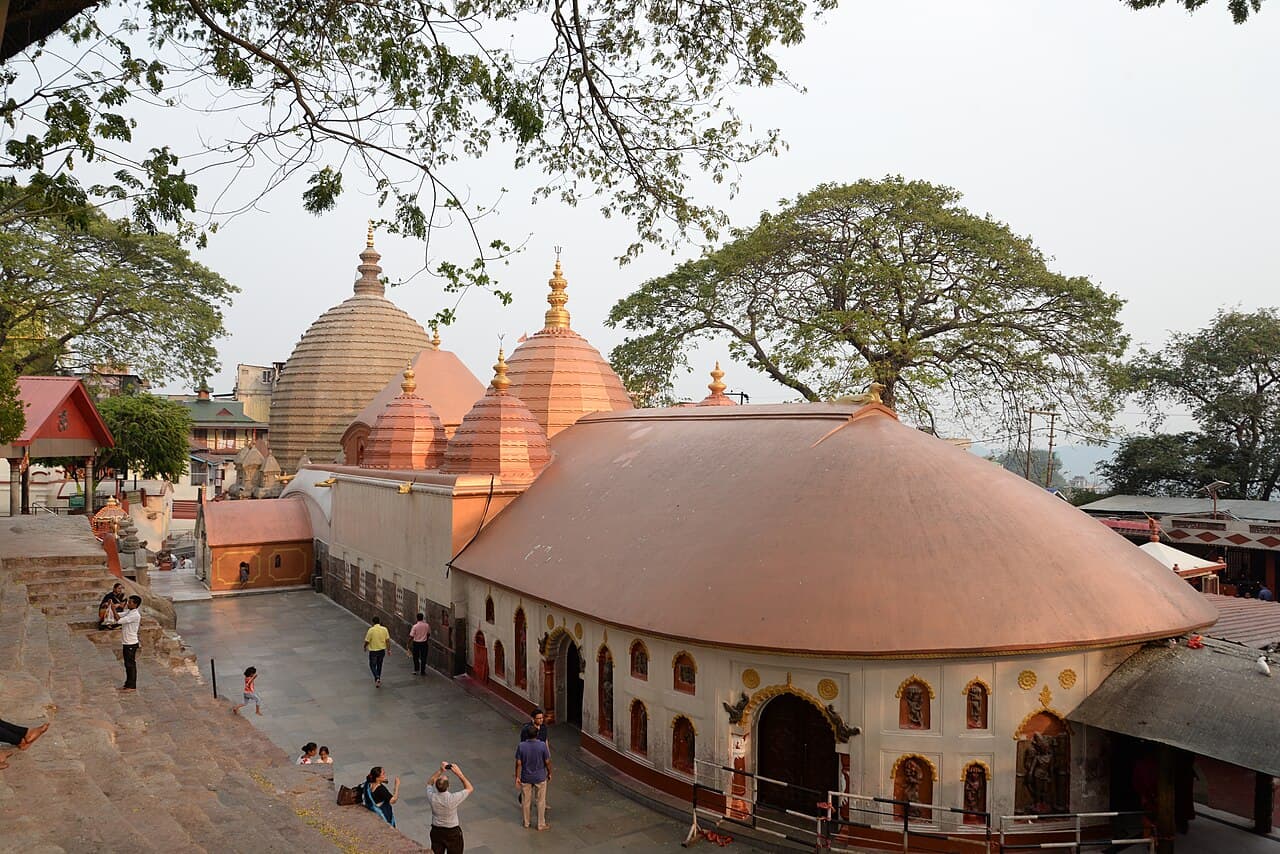
The great Tantric seat on Nilachal Hill above the Brahmaputra — where the Goddess is worshipped as the yoni and is believed to menstruate each year.
- Deity
- Devi Kamakhya
- Location
- Guwahati, Assam
- Category
- Shakti Peethas
- Established
- Rebuilt 1565 under the Koch king Nara Narayan; structural origins c. 8th–9th century
- Setting
- On Nilachal Hill, above the Brahmaputra, Guwahati
- Best Time to Visit
- October to April; and the Ambubachi Mela in June
- Among the most powerful Shakti Peethas — tradition: Sati's yoni fell here
- The supreme seat of Tantric worship in India
- No idol — a yoni-shaped stone kept moist by a natural spring is worshipped
- The goddess is believed to menstruate; celebrated at the Ambubachi Mela (June)
- The ten Mahavidya shrines stand around it on Nilachal Hill
- Rebuilt in 1565 under the Koch king Nara Narayan and his general Chilarai
- Its Bhairava, Umananda, is on Peacock Island in the Brahmaputra
Significance
What most sets Kamakhya apart is the belief that the goddess menstruates. Each year, around mid-June, the spring is said to run red and the sanctum is closed for some days; its reopening is the Ambubachi Mela, one of the largest gatherings of Tantrics, sadhus and pilgrims in eastern India — a celebration of the Mother's generative power.
A pilgrimage to Kamakhya is held incomplete without darshan of her Bhairava, Umananda, on the little Peacock Island in the Brahmaputra below. Together the hill-shrine and the river-shrine make Kamakhya a place apart in the Shakta world — the Goddess worshipped not as form but as the very source of life.
Daily worship follows the Tantric Kaula rite, and the hill draws sadhus and ascetics as well as ordinary pilgrims. Beyond the Ambubachi days the calendar turns through Durga Puja, Manasa Puja and the trance-dance of the Deodhani festival, and the ten Mahavidya shrines mean a full circuit of Nilachal is a pilgrimage through every face of the Goddess — from gentle Kamala to fierce Chinnamasta and Dhumavati. Few places gather so much of the Shakta world onto a single hill.
History
Kamakhya rises on Nilachal Hill in the west of Guwahati, above the broad Brahmaputra, and is among the most powerful and ancient of all the Shakti Peethas — the supreme seat of the Tantric worship of the Goddess in India. By the Shakti Peetha tradition it is here that the yoni, the womb, of Sati fell, and so the Devi is worshipped in her creative, generative aspect as Kamakhya, the goddess of desire.
Uniquely, there is no image of the goddess. In the dim cave-sanctum the rock slopes down to a yoni-shaped cleft, kept always moist by a natural spring; it is draped in red cloth, and the spring water is given to pilgrims as prasad. On the hill around the main temple stand the shrines of the ten Mahavidyas — Kali, Tara, Tripura Sundari and the rest — so that the whole of Nilachal is a mandala of the Goddess.
Structurally the temple goes back to about the 8th or 9th century; it was destroyed in the turmoil of the late 15th century and rebuilt in 1565 under the Koch king Nara Narayan, his general Chilarai overseeing the work with the scattered stones of the older shrine.
Architecture
The rebuilt temple gave rise to a hybrid manner sometimes called the Nilachal type: a tall, beehive-like hemispherical shikhara over a cruciform base, its brick tower ringed with smaller angashikaras and touched, here and there, by the arched forms of the age in which it was raised.
Beyond the domed sanctum lies a sequence of mandapas — halls for offering and assembly — added over the centuries. It is a building unlike the temples of the plains, shaped by Assam's own traditions and by the long history of destruction and renewal the shrine has passed through.
Festivals
Timings
Open daily, commonly from about 5:30 AM to 1:00 PM and 2:30 PM to 5:30 PM, beginning with the Mangala aarti; the sanctum closes for the Ambubachi days in June. Special-entry darshan is available. Confirm current timings locally.
Kamakhya sits on Nilachal Hill in Guwahati, reached by road up the hill by taxi or auto. The nearest airport, Lokpriya Gopinath Bordoloi International at Borjhar, is about twenty kilometres away; Kamakhya Junction railway station is around six kilometres off and Guwahati's main station a little further. As Assam's foremost shrine, it is the natural centre of any pilgrimage to the state.
Timings are indicative — please confirm with the temple trust before travelling.
Videos
Frequently Asked Questions
Where is Kamakhya Temple located?+
Kamakhya Temple is in Guwahati, Assam, India.
Which deity is worshipped at Kamakhya Temple?+
Kamakhya Temple is dedicated to Devi Kamakhya.
Which tradition does Kamakhya belong to?+
Kamakhya is one of the Shakti Peethas temples dedicated to Devi (Shakti).
What are the timings of Kamakhya Temple?+
Open daily, commonly from about 5:30 AM to 1:00 PM and 2:30 PM to 5:30 PM, beginning with the Mangala aarti; the sanctum closes for the Ambubachi days in June. Special-entry darshan is available. Confirm current timings locally.
What is the best time to visit Kamakhya Temple?+
October to April; and the Ambubachi Mela in June
When was Kamakhya Temple established?+
Kamakhya Temple — Rebuilt 1565 under the Koch king Nara Narayan; structural origins c. 8th–9th century.
Sources & further reading
Photo: Devkmaravi · CC BY-SA 4.0